If you have seen “IKK” in a text, DM, or social media comment, you may wonder what the extra “K” means.
In casual online conversations, IKK usually expresses “I know,” “I know, I know,” or an emphatic form of agreement such as “I know, right?” It is informal and does not have one fixed, official definition.
The exact meaning depends on the conversation, tone, punctuation, and relationship between the people chatting.
You may see IKK in text messages, WhatsApp chats, Instagram DMs, TikTok comments, Snapchat conversations, and other casual online spaces.
This guide explains the meaning of IKK, how people use it, how it differs from similar slang, and how to reply naturally.
| Term | Most Common Meaning | Full Form | Typical Tone | Common Usage |
|---|---|---|---|---|
| IKK | I know / I know, I know | Informal expression | Casual, emphatic | Texts, DMs, social media |
| IK | I know | I know | Neutral, casual | Quick replies |
| IKR | I know, right? | I know, right? | Agreeing, validating | Casual conversations |
Quick answer:
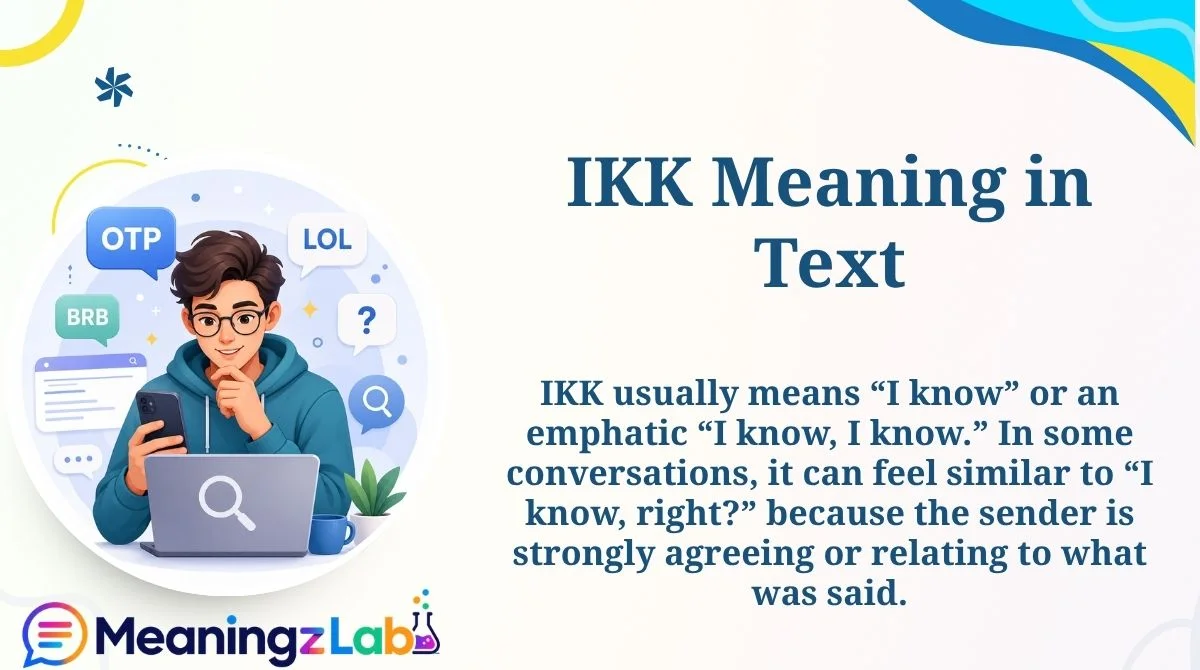
IKK usually means “I know” or an emphatic “I know, I know.” In some conversations, it can feel similar to “I know, right?” because the sender is strongly agreeing or relating to what was said.
What Does IKK Mean in Text & Chat?
In text and chat, IKK is an informal way to say “I know,” often with extra emphasis. It can show that the sender already understands something, agrees with the other person, or strongly relates to their statement.
The extra K is usually expressive rather than part of a strict grammatical abbreviation. Think of the difference between saying “I know” calmly and saying “I knowww!” with emotion. Online, people often stretch or repeat letters to make a short message feel more expressive.
For example:
Person A: “This week has been exhausting.”
Person B: “IKK 😭”
Here, IKK means something close to “I know, I know!” The crying emoji adds emotional agreement.
However, IKK should not automatically be expanded into one exact phrase every time. Texting slang is flexible. One person may use it as “I know,” while another may intend “I know, right?” or simply use it as an expressive version of “IK.”
What Does the Extra K Add?
The second K can make the response feel:
- More emotional
- More emphatic
- More playful
- More conversational
- More relatable
Compare these:
“IK.” → Simple acknowledgment.
“IKK.” → Stronger or more expressive acknowledgment.
“IKKK 😭.” → Very emotional or dramatic agreement.
The surrounding conversation is important. IKK is usually friendly or casual, but punctuation can make it sound different.
Full Form, Stands For & Short Meaning of IKK
There is no single standardized full form of IKK in everyday texting. Unlike abbreviations such as “BRB” or “IDK,” IKK is better understood as an informal texting expression.
The most useful interpretations are:
| IKK Interpretation | What It Communicates |
|---|---|
| I know | The sender already understands |
| I know, I know | The sender strongly acknowledges something |
| I know, right? | The sender agrees or relates strongly |
| Emphatic “IK” | Extra emotional emphasis |
The safest interpretation is usually “I know” with extra emphasis.
For example:
Person A: “You have to submit the assignment tonight.”
Person B: “IKK, I’m working on it.”
Here, the sender is saying, “I know. I’m already aware.”
In another conversation:
Person A: “That restaurant has the best fries.”
Person B: “IKKK!”
Here, IKK is closer to “I know, right?!” It shows strong agreement.
Is IKK a Formal Acronym?
No. In casual texting, it should not be treated like a formal acronym with one universally accepted expansion.
That matters because someone searching for the “full form” of IKK may expect a fixed phrase. In reality, the expression is flexible and context-driven.
If someone sends only “IKK”, look at the message immediately before it. That usually gives you enough information to understand whether the person means simple awareness, agreement, or stronger emotional validation.
Origin, History & First Known Use of IKK
There is no reliable single origin story or confirmed first-use date for IKK as everyday texting slang. It is safer to avoid claims that one person, website, social platform, or specific year created it.
Informal internet language often develops gradually. People shorten words, repeat letters, change spellings, and create expressive forms during ordinary conversations. IKK fits this broader pattern.
The relationship between IK and IKK is especially useful for understanding its style. “IK” naturally represents “I know.” Adding another letter can make the response look more expressive, similar to the way people write:
- “Nooo!”
- “Yesss!”
- “Okaaay!”
- “Pleaseee!”
- “IKKK!”
These spellings do not necessarily create new dictionary words. Instead, they imitate the emotion or emphasis found in spoken conversation.
Why Do People Repeat Letters?
Digital messages do not carry voice volume, facial expressions, or body language. Repeated letters can help fill that gap.
For example:
“I know.” can sound neutral.
“IKKK 😭” can sound excited, frustrated, amused, or strongly relatable.
That does not mean IKK has a documented historical origin tied to this exact pattern. It simply follows a common feature of informal online communication: changing spelling to express emotion.
So, if someone asks for the exact date when IKK was “invented,” there is no strong basis for giving one.
How People Use IKK in Daily Conversations
People generally use IKK when they want to show awareness, agreement, or strong emotional connection without typing a longer sentence.
It can appear as a complete reply:
Person A: “Mondays are the worst.”
Person B: “IKK 😭”
Or it can appear at the beginning of a longer response:
Person A: “You need to stop staying up so late.”
Person B: “IKK, but I can’t sleep early.”
In the second example, IKK means “I know,” while the rest of the sentence explains the situation.
Common Uses of IKK
1. Showing awareness
“Don’t forget your keys.”
“IKK.”
The sender already knows.
2. Agreeing with someone
“This weather is so hot.”
“IKK 🥵.”
The sender agrees.
3. Showing strong relatability
“This song gets stuck in my head every day.”
“IKKK 😭.”
The sender has the same experience.
4. Responding playfully
“You said you wouldn’t buy another hoodie.”
“IKK 😂.”
The sender knows they contradicted themselves.
5. Showing mild frustration
“You’ve already heard this story.”
“IKK.”
Depending on the context, the short reply could mean, “Yes, I know already.”
Because of this, IKK is highly dependent on tone.
A friendly emoji can make it warm. A period or very short response can make it feel more blunt. In an argument, it may even sound slightly annoyed.
IKK Meaning Across WhatsApp, Instagram, TikTok & Snapchat
The basic meaning of IKK usually does not change significantly from one major social platform to another. WhatsApp, Instagram, TikTok, and Snapchat all support casual communication, so users may use IKK as an informal expression of agreement or acknowledgment.
However, the style can change depending on where it appears.
| Platform | Typical Use of IKK | Likely Tone |
|---|---|---|
| Quick reply in private or group chats | Casual | |
| DM or comment response | Friendly/playful | |
| TikTok | Reaction to relatable content | Expressive |
| Snapchat | Short conversation reply | Casual/emotional |
IKK on WhatsApp
WhatsApp conversations often involve people who already know each other. IKK can therefore be very relaxed.
“You forgot your umbrella again.”
“IKK 😭.”
IKK on Instagram
In an Instagram DM, IKK may respond to a shared opinion or relatable message.
“That outfit is actually perfect.”
“IKKK 😭❤️.”
IKK on TikTok
In a TikTok comment, a person may use IKK to agree with something in a video or another comment.
“Nobody talks about how stressful this part is.”
“IKKK 😭.”
IKK on Snapchat
Snapchat encourages quick, informal replies, so IKK can work as a short reaction.
The key point is that the platform usually does not determine the meaning by itself. The surrounding message matters much more.
Different Meanings of IKK in Other Fields
The meaning of IKK outside texting can be completely different.
This is important because three-letter combinations can represent unrelated terms in medicine, science, aviation, organizations, technology, and other fields.
For example, in biomedical and molecular research, IKK can refer to IκB kinase, a group of enzymes involved in signaling pathways related to inflammation and immune responses. This is a technical use and has nothing to do with texting slang.
IKK can also appear as a code or abbreviation in other specialized contexts. Therefore, you should not assume that every appearance of “IKK” means “I know.”
How to Identify the Correct Meaning
Use the context.
If you see:
“That movie was amazing. IKK!”
It is probably casual internet language.
If you see:
“IKK activity was measured in the experiment.”
That is clearly a scientific context.
A simple rule is:
If IKK appears in a personal message or social-media conversation, think texting slang first. If it appears in a technical document, check the field-specific meaning.
This distinction prevents a common mistake: treating every abbreviation as if it has one universal definition.
Common Confusions, Mistakes & Wrong Interpretations
IKK can be confusing because it looks similar to several other short forms.
One of the biggest sources of confusion is IKR, which clearly means “I know, right?” IKK can sometimes communicate a similar feeling of agreement, but IKK should not automatically be expanded as IKR.
Another common comparison is IK, which simply means “I know.” IKK may be an expressive or emphasized version of that idea.
IKK vs. IK
IK: “I know.”
IKK: “I know!” / “I know, I know!”
The difference is often emotional rather than grammatical.
IKK vs. IKR
IKK: Usually expresses awareness or emphatic agreement.
IKR: Specifically means “I know, right?” and usually invites or confirms shared agreement.
IKK vs. IDK
These are completely different:
IKK: “I know” or an expressive variation.
IDK: “I don’t know.”
Confusing the two can completely reverse the meaning of a message.
Can IKK Mean Disgust?
Sometimes people may interpret unusual spellings like “ikk” as a reaction to something unpleasant because it visually resembles other expressions associated with disgust. However, that is not the safest default interpretation.
If the conversation is:
“I finally finished my exams.”
“IKK 😭.”
The likely meaning is agreement or shared emotion.
Context should always come before assumptions.
Similar Terms, Alternatives & Related Slang
Several texting expressions overlap with IKK, but they are not identical.
| Term | Meaning | Main Purpose |
|---|---|---|
| IK | I know | Acknowledgment |
| IKR | I know, right? | Strong agreement |
| IDK | I don’t know | Uncertainty |
| FR | For real | Agreement or emphasis |
| FRFR | For real, for real | Strong agreement |
| SAME | I feel the same | Relating to someone |
| EXACTLY | Complete agreement | Strong confirmation |
| TRUE | That is correct | Agreement |
IKK vs. “Same”
If someone says:
“I could sleep all day.”
“Same” means “I feel exactly that way too.”
IKK, however, is more closely connected to knowing or acknowledging what the other person said.
IKK vs. “Exactly”
“Exactly” strongly confirms another person’s statement.
IKK can also communicate agreement, but it often sounds more casual and personal.
IKK vs. IKR
These are probably the closest expressions in conversational use.
“IKR” directly asks or implies “I know, right?”
“IKK” is less standardized and can be more flexible. It may simply mean “I know” with extra emphasis.
When interpreting IKK, therefore, do not force it into the exact meaning of IKR.
Examples of IKK in Real Chat Situations
The best way to understand IKK is to see it in different conversations.
Example 1: Simple Agreement
Person A: “This homework is taking forever.”
Person B: “IKK 😭”
Meaning: “I know! I feel the same way.”
The crying emoji makes the response emotional and relatable.
Example 2: Showing Awareness
Person A: “Remember that we have a test tomorrow.”
Person B: “IKK, I already studied.”
Meaning: “I know. I’m already aware.”
Here, IKK is not really asking for agreement. It is confirming that the information is already known.
Example 3: Strong Agreement
Person A: “That was the funniest scene in the whole movie.”
Person B: “IKKK 😂”
Meaning: “I know, right?!”
The extra K and laughing emoji make the agreement more energetic.
Example 4: Mild Frustration
Person A: “You need to charge your phone before leaving.”
Person B: “IKK.”
Meaning: “I know.”
The period can make the message feel more direct or slightly irritated.
Example 5: Playful Conversation
Person A: “You said you weren’t going to buy anything.”
Person B: “IKKK 😂 But look how cute it is.”
Meaning: “I know, I know! But I bought it anyway.”
The longer spelling and laughing emoji make the response playful rather than defensive.
Example 6: Affectionate Agreement
Person A: “We always end up talking for three hours.”
Person B: “IKKK 😂❤️”
Meaning: “I know! We really do.”
The heart emoji makes the exchange warmer and more affectionate.
How to Reply When Someone Says IKK
Your best reply depends on what the person means by IKK.
If they are agreeing with you, you can simply continue the conversation.
Friendly Replies
- “Right?!”
- “Exactly!”
- “I know 😂”
- “Same!”
- “For real!”
- “You get it 😭”
If They Mean “I Know, I Know”
You could say:
- “Okay okay 😂”
- “I had to remind you!”
- “Good, then we’re on the same page.”
- “Haha, fair enough.”
If You Are Unsure
If IKK does not make sense in the conversation, there is nothing wrong with asking.
You can say:
- “You mean you know?”
- “Wait, what do you mean by IKK?”
- “Are you agreeing with me? 😂”
Asking is better than assuming, especially if the conversation is serious.
Should You Use IKK in Professional Messages?
Usually, no.
IKK is informal internet language. It fits casual conversations with friends, family, classmates, or people who already communicate in a relaxed way.
For work emails, formal messages, academic communication, or professional customer conversations, use clearer language such as:
“I understand.”
“Yes, I’m aware.”
“Exactly.”
“I agree.”
These options remove ambiguity and sound more professional.
Is IKK Still Popular? Trends & Online Usage
IKK should be treated as informal, context-dependent internet language rather than a universally standardized texting abbreviation.
People continue to create expressive variations of short words and abbreviations online. Adding letters can make a message feel more emotional, playful, dramatic, or conversational. That pattern is common across modern digital communication.
However, it would be misleading to claim that IKK has one fixed popularity level across all age groups or platforms. Internet slang changes quickly, and individual communities often develop their own typing habits.
You may also see variations such as:
- IK
- IKK
- IKKK
- IKKKK
Usually, additional letters are being used for emphasis rather than creating a completely new definition.
What Does IKK Tell You About the Sender’s Tone?
The spelling alone is not enough.
Compare:
“IK.” → calm or neutral
“IKK 😭” → emotional agreement
“IKKK 😂” → playful or excited
“IKK.” → possibly blunt or annoyed
“IKKK ❤️” → warm or affectionate
The safest approach is to read IKK together with the words, emojis, punctuation, and relationship involved.
Frequently Asked Questions
What does IKK mean in text?
IKK usually means “I know” or an emphatic version of “I know, I know.” It can also express strong agreement similar to “I know, right?” depending on context.
Is IKK the same as IKR?
Not exactly. IKR specifically means “I know, right?” while IKK is less standardized and usually expresses “I know” with extra emphasis or agreement.
What does IKK mean on WhatsApp?
On WhatsApp, IKK usually has the same casual meaning: “I know,” “I know, I know,” or strong agreement. The surrounding conversation determines the exact tone.
What does IKK mean on Instagram or TikTok?
On Instagram and TikTok, IKK can be used as a quick reaction to show agreement, recognition, or relatability. Emojis and the message it responds to can make the tone playful, emotional, or sarcastic.
Is IKK rude?
IKK is not inherently rude. However, a short reply such as “IKK.” can sound annoyed or dismissive in some situations, especially during an argument or serious conversation.
What is the difference between IK and IKK?
IK simply means “I know.” IKK often adds emotional emphasis, making it closer to “I know!” or “I know, I know!” The extra K is usually stylistic.
How should I reply to IKK?
If the person is agreeing with you, replies such as “Exactly!”, “Right?!”, “Same!”, or “For real!” work well. If you are unsure what they mean, simply ask them.
Does IKK have a formal full form?
No single formal full form is universally accepted for IKK in everyday texting. It is better understood as an informal expression based around “I know” and agreement.
Conclusion
The most common IKK meaning in text is an informal, expressive way of saying “I know,” “I know, I know,” or sometimes “I know, right?” It is mainly used in casual conversations to show awareness, agreement, or strong emotional connection.
The extra K often adds emphasis rather than creating a completely different word. That is why “IKK” can feel more expressive than the simpler “IK.” Emojis, punctuation, surrounding words, and the relationship between the people can also change its tone.
Because IKK is not a strictly standardized abbreviation, context is the best guide. If you understand the message around it, you can usually tell what the sender means. For more texting slang and abbreviation meanings, explore other common online expressions and their real-world uses.

Evan Rellmont is a content writer and researcher who specializes in internet slang, text abbreviations, and social media language. He creates clear, helpful content to make modern online communication easier to understand.