If you have seen IWK in a text, DM, or social media comment, its meaning may not be obvious.
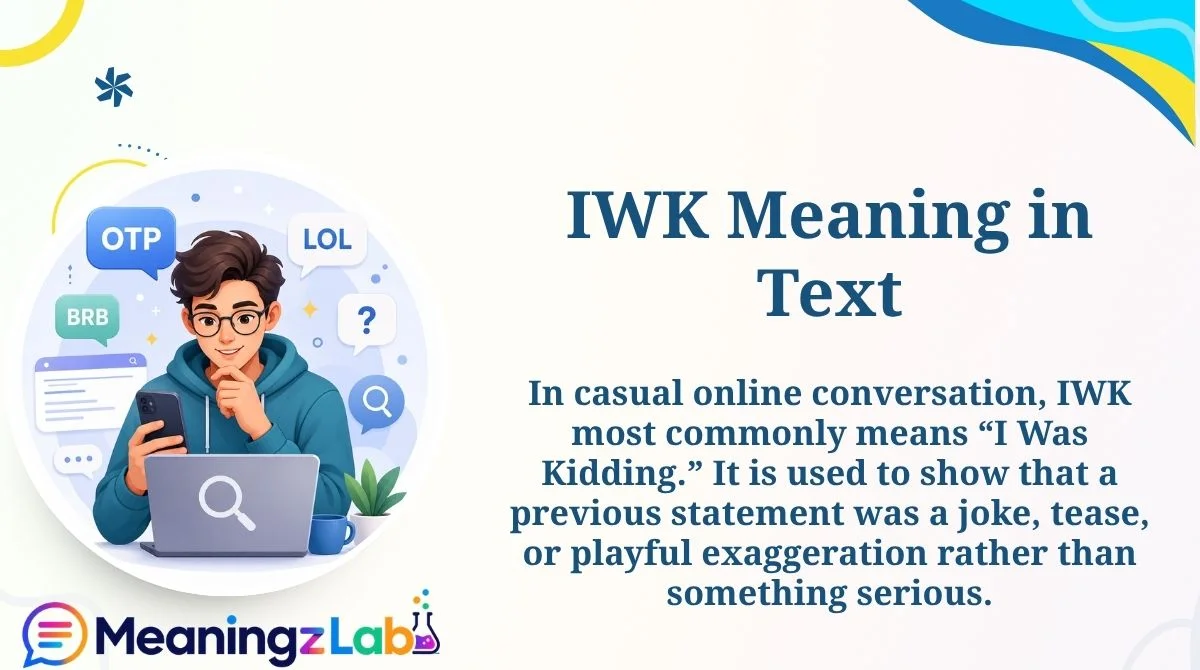
In casual online conversation, IWK most commonly means “I Was Kidding.” It is used to show that a previous statement was a joke, tease, or playful exaggeration rather than something serious.
However, IWK is not a highly standardized abbreviation, so context matters.
Some people may use it for other phrases, such as “I Would Know” or “I Wouldn’t Know.”
You may encounter IWK in private texts, group chats, Instagram DMs, Snapchat, TikTok comments, or other informal online conversations.
This guide explains its main meaning, possible alternatives, tone, platform use, examples, and appropriate replies.
| Term | Most common meaning | Full form | Typical tone | Common usage |
|---|---|---|---|---|
| IWK | I Was Kidding | I Was Kidding | Playful, joking, casual | Texts, DMs, social media |
What Does IWK Mean in Text & Chat?
IWK usually means “I Was Kidding” in text and chat. People use it after making a joke, teasing someone, or saying something that could be taken literally.
Quick answer:
IWK = I Was Kidding. It tells the reader, “I wasn’t being serious.”
For example:
Person A: “You are officially banned from choosing the movie tonight.”
Person B: “Seriously? 😭”
Person A: “IWK 😂 You can choose.”
Here, IWK changes the meaning of the earlier statement. The speaker is not actually banning the other person. They were teasing.
Why context matters
Text messages do not include facial expressions or voice tone. A sentence such as “I hate your new haircut” can sound genuinely rude. Adding “IWK” can signal that the speaker was joking.
Still, IWK does not automatically make every comment harmless. If the original statement is insulting, the other person may still feel offended.
Capitalization can also affect how the message feels:
- iwk — relaxed and casual
- IWK — slightly more noticeable or emphatic
- IWK 😂 — clearly playful in many contexts
- IWK. — can feel short or abrupt
Full Form, Stands For & Short Meaning of IWK
The most common texting expansion of IWK is “I Was Kidding.” It works as a short way to explain that something said earlier was not intended literally. Current online references also show that IWK is not completely standardized, so other interpretations can appear in different conversations.
| Form | Meaning | Typical use |
|---|---|---|
| IWK | I Was Kidding | Clarifying a joke |
| iwk | I Was Kidding | Casual texting |
| IWK 😂 | I Was Kidding | Making the joke obvious |
| IWK! | I Was Kidding | Stronger playful emphasis |
The phrase is similar in purpose to “JK,” which means “just kidding.” However, JK is much more widely recognized in everyday internet slang.
For example:
“I’m keeping your charger forever. IWK 😂”
The sender is telling you that the statement about keeping your charger was a joke.
Other possible expansions
Depending on the conversation, IWK may have another meaning. Some sources and users interpret it as phrases such as “I Would Know” or “I Wouldn’t Know.” These meanings should not be treated as universal definitions because IWK is less standardized than abbreviations such as IDK, LOL, or BRB.
The safest approach is to read the words before and after IWK before deciding what the sender means.
Origin, History & First Known Use of IWK
There is no reliable, widely accepted record establishing an exact first-use date for IWK as internet slang. It is better to avoid claiming that it began on a particular website, app, or year without strong evidence.
The most reasonable explanation is that IWK developed from the general habit of shortening familiar phrases in digital communication. Online conversations encourage quick replies, and phrases such as “I was kidding” can naturally be reduced to their initial letters.
The same general pattern appears in many texting abbreviations. People shorten common expressions because the meaning can often be understood from the surrounding conversation.
Why abbreviations like IWK develop
Digital communication has several features that encourage shorthand:
- People often want to reply quickly.
- Casual conversations do not require complete sentences.
- Friends develop shared texting habits.
- Social media rewards short comments and quick reactions.
- Abbreviations can help signal tone without a long explanation.
However, IWK should not be presented as an ancient or formally established acronym. It is informal internet language, and its usage can vary between communities.
That distinction matters for accurate SEO content. The meaning can be explained confidently, but an exact “first known use” should not be invented when reliable historical evidence is unavailable.
How People Use IWK in Daily Conversations
People generally use IWK after a statement that might be misunderstood as serious. The abbreviation acts like a quick tone correction.
A friend might tease you about being late:
Person A: “You are never allowed to plan our trips again.”
Person B: “Wow, harsh 😂”
Person A: “IWK. You actually did great.”
The first sentence sounds critical, but the follow-up makes the playful intention clearer.
Playful teasing
IWK works naturally between friends who already joke with each other.
Person A: “Your music taste is officially terrible.”
Person B: “Excuse me? 😭”
Person A: “IWK 😂 Your playlist is actually good.”
Sarcastic comments
It can also soften obvious sarcasm:
Person A: “Sure, because waiting two hours is my favorite hobby. IWK.”
The statement is exaggerated for humor.
Affectionate joking
Among close friends or partners, IWK can make teasing sound lighter:
Person A: “I’m blocking you for stealing my fries.”
Person B: “You wouldn’t dare.”
Person A: “IWK ❤️”
The heart emoji makes the exchange feel affectionate rather than hostile.
Important limitation
Do not assume that IWK means the sender is friendly. Tone depends on the relationship, the original message, punctuation, and the situation.
IWK Meaning Across WhatsApp, Instagram, TikTok & Snapchat
The basic meaning of IWK generally does not change simply because it appears on a different platform. If the sender uses IWK to mean “I Was Kidding,” that meaning can work in a WhatsApp message, Instagram DM, TikTok comment, or Snapchat chat.
What changes is the communication style around it.
| Platform | Possible use of IWK | Typical context |
|---|---|---|
| Clarifying a joke | Private or group chats | |
| Softening a comment | DMs and comments | |
| TikTok | Marking a playful reaction | Comments and messages |
| Snapchat | Clarifying teasing | Short private chats |
WhatsApp conversations often contain short, informal replies. IWK may appear immediately after a joke.
“I’m deleting your number. IWK 😂”
On Instagram, IWK can appear in DMs after playful teasing about a post, photo, or story.
TikTok
A person may use IWK after making a dramatic comment about a video:
“This is the worst video ever. IWK 😭”
Snapchat
Because Snapchat conversations are often fast and casual, lowercase iwk may fit naturally into a short reply.
The key point is simple: the platform usually does not determine the meaning. The surrounding conversation does.
Different Meanings of IWK in Other Fields
Outside casual texting, IWK does not have one universal expansion. Acronyms can represent different phrases in different industries, organizations, communities, or technical contexts.
That means you should not automatically interpret every appearance of IWK as “I Was Kidding.”
“I Would Know”
Some online users interpret IWK as “I Would Know.” In that context, it expresses confidence based on personal knowledge or experience.
For example:
Person A: “Is that restaurant really that good?”
Person B: “IWK. I eat there all the time.”
Here, “I Would Know” makes more sense than “I Was Kidding.”
“I Wouldn’t Know”
Another possible interpretation is “I Wouldn’t Know.” This can appear as a response when someone does not have enough information or experience to answer.
Person A: “Why did they cancel the event?”
Person B: “IWK. I wasn’t involved.”
Again, the surrounding words are essential.
Specialized meanings
In a company, school, gaming group, or private community, IWK could also be an internal abbreviation. Such meanings cannot be assumed without context.
So, when IWK does not fit the joking meaning, check the conversation before choosing an expansion.
Common Confusions, Mistakes & Wrong Interpretations
The biggest mistake people make with IWK is assuming that every occurrence has the same meaning.
Although “I Was Kidding” is a common interpretation in current slang references, online usage is not perfectly standardized.
Confusing IWK with IDK
IDK means “I Don’t Know.”
IWK can mean “I Was Kidding.”
Compare:
“Where is Sarah?”
“IDK.”
The person does not know.
But:
“Sarah moved to Mars. IWK 😂”
The person was joking.
Confusing IWK with JK
JK means “Just Kidding” and is much more familiar to many internet users.
Both can clarify a joke:
- “I’m stealing your snacks. JK.”
- “I’m stealing your snacks. IWK.”
The meaning is similar, but JK is generally more recognizable.
Ignoring the previous message
If someone sends only “IWK”, do not interpret it without looking at what came before it.
The previous sentence often provides the strongest clue.
Assuming IWK is always friendly
A joke can still hurt someone. Adding IWK afterward does not erase the effect of an insulting statement.
If the conversation is tense, consider the relationship and tone before assuming the sender is simply being playful.
Similar Terms, Alternatives & Related Slang
Several abbreviations can perform a similar role to IWK, especially when someone wants to show that a statement was not serious.
| Term | Meaning | Main purpose |
|---|---|---|
| IWK | I Was Kidding | Clarifies a joke |
| JK | Just Kidding | Marks a joke |
| LOL | Laughing Out Loud | Shows amusement |
| LMAO | Laughing My Ass Off | Stronger laughter |
| /s | Sarcasm marker | Signals sarcasm |
| IDK | I Don’t Know | Shows uncertainty |
IWK vs. JK
These are the closest alternatives. JK is shorter and more familiar, while IWK spells out the idea of “I was kidding.”
IWK vs. LOL
LOL does not necessarily mean that the speaker was joking. It mainly signals laughter or amusement.
IWK vs. /s
The /s marker is often used online to indicate sarcasm. It does not literally mean “I was kidding.”
IWK vs. IDK
These have completely different functions. IWK relates to joking, while IDK expresses a lack of knowledge.
If your audience may not understand IWK, simply writing “just kidding” or “I’m joking” is clearer.
Examples of IWK in Real Chat Situations
Real context makes IWK much easier to understand. Here are several examples showing how the same abbreviation can carry different emotional tones.
Playful
Person A: “You ate the last slice, so you’re officially my enemy.”
Person B: “That sounds serious 😂”
Person A: “IWK. I forgive you.”
Tone: Friendly and playful. The sender uses IWK to show that “enemy” was an exaggeration.
Sarcastic
Person A: “Great, another three-hour meeting. Exactly what I wanted.”
Person B: “You sound thrilled.”
Person A: “IWK 😭”
Tone: Sarcastic. The sender is joking about not wanting the meeting.
Affectionate
Person A: “You are impossible to deal with sometimes.”
Person B: “Wow 😭”
Person A: “IWK ❤️”
Tone: Affectionate teasing. The heart emoji softens the statement.
Potentially rude
Person A: “Your idea makes absolutely no sense.”
Person B: “Okay…?”
Person A: “IWK.”
Tone: This can still feel rude. The original statement is harsh, and IWK may not fully repair it.
Another possible meaning
Person A: “Do you know why they left early?”
Person B: “IWK, I wasn’t there.”
Tone: In this context, “I Wouldn’t Know” may make more sense than “I Was Kidding.”
This is why context should always come before assumptions.
How to Reply When Someone Says IWK
Your response should depend on what the sender meant and how their message sounded.
If they are clearly joking
You can respond playfully:
- “Haha, I knew you were joking 😂”
- “You almost got me!”
- “Okay, you got me there 😭”
If the joke surprised you
Try:
- “You had me worried for a second!”
- “I actually believed you 😂”
- “Okay, that was a good one.”
If you’re not sure what IWK means
Ask directly:
“Wait, what do you mean by IWK?”
There is nothing wrong with asking. Since IWK can have different interpretations, clarification is often better than guessing.
If the joke was rude
You can stay calm:
“I get that you were joking, but that came across a little harsh.”
This makes your boundary clear without creating unnecessary conflict.
If IWK means something else
Look at the surrounding message. If the sender is answering a factual question, “I Would Know” or “I Wouldn’t Know” might fit better than “I Was Kidding.”
Is IWK Still Popular? Trends & Online Usage
IWK is still understandable in casual online communication, but it is not one of the most universally recognized texting abbreviations. That distinction is important.
Widely established forms such as LOL, IDK, BRB, and JK are more familiar to a broad range of internet users. IWK can be more dependent on the person’s social circle, age group, platform, and personal texting habits.
Current online references from 2026 show that IWK is being discussed as a texting abbreviation, but those references do not agree on a single universal expansion. Some identify “I Was Kidding” as the main meaning, while others give alternatives such as “I Would Know” or “I Wouldn’t Know.”
That disagreement is useful information in itself: IWK is context-dependent slang, not a perfectly standardized abbreviation.
For everyday use, clarity is usually best. If there is any chance the reader will misunderstand you, writing “I was kidding” is safer than relying on IWK.
Frequently Asked Questions
What does IWK mean in text?
IWK most commonly means “I Was Kidding.” It is used to show that a previous statement was intended as a joke, tease, or playful comment.
Is IWK the same as JK?
They can have a similar purpose. JK means “Just Kidding,” while IWK can mean “I Was Kidding.” JK is generally more widely recognized.
Can IWK mean “I Would Know”?
Yes. Some users interpret IWK as “I Would Know.” The correct meaning depends on the sentence and conversation.
Can IWK mean “I Wouldn’t Know”?
Yes, this is another possible interpretation. If IWK appears as an answer to a question, “I Wouldn’t Know” may fit better than “I Was Kidding.”
Is IWK rude?
Not by itself. When it follows an obvious joke, it is usually playful. However, the original statement, punctuation, relationship, and context can make it sound rude or dismissive.
What does IWK mean on Instagram or Snapchat?
It can mean “I Was Kidding” on either platform. The platform usually does not change the core meaning. Read the surrounding conversation to confirm the intended use.
How should I reply to IWK?
If it clearly means “I Was Kidding,” you can reply with something like “Haha, you got me 😂” or “I knew you were joking.” If the meaning is unclear, ask what the sender means.
Is IWK appropriate in professional messages?
It is better to avoid it in formal or professional communication because not everyone will recognize it. Writing “I was joking” or “Just kidding” is clearer.
Conclusion
The most common IWK meaning in text is “I Was Kidding.” People use it to show that a previous comment was a joke, playful tease, exaggeration, or sarcastic remark. It is most natural in casual texts, DMs, group chats, and social media conversations.
However, IWK is not completely standardized. Depending on the context, some people may use it to mean “I Would Know” or “I Wouldn’t Know.” That is why the surrounding message matters more than the three letters alone.
Pay attention to punctuation, emojis, the previous sentence, and your relationship with the sender. When the meaning is unclear, asking for clarification is the safest choice. For formal communication, using the full phrase is usually better.

Evan Rellmont is a content writer and researcher who specializes in internet slang, text abbreviations, and social media language. He creates clear, helpful content to make modern online communication easier to understand.