The JS meaning in text is usually “just saying.” People often use JS in text messages and social media conversations to share an opinion, make a comment, or express a thought without making it sound too serious.
For example, someone might text, “JS, you should get some rest,” to offer friendly advice.
However, JS can have other meanings depending on the conversation.
In some situations, it may stand for “JavaScript,” a programming language, or have another meaning specific to a particular group.
You might see it in WhatsApp messages, Instagram comments, TikTok discussions, Snapchat chats, and online forums.
Understanding the surrounding words can help you identify the intended meaning.
In this guide, you will learn what JS means, how people use it, how its tone can change, and how to respond when someone sends it.
| Quick detail | Meaning |
|---|---|
| Abbreviation | JS |
| Common texting meaning | Just saying |
| Full form | Just saying |
| Typical tone | Casual, neutral, playful, or sarcastic |
| Common usage | Text messages, social media, and online chats |
What Does JS Mean in Text & Chat?
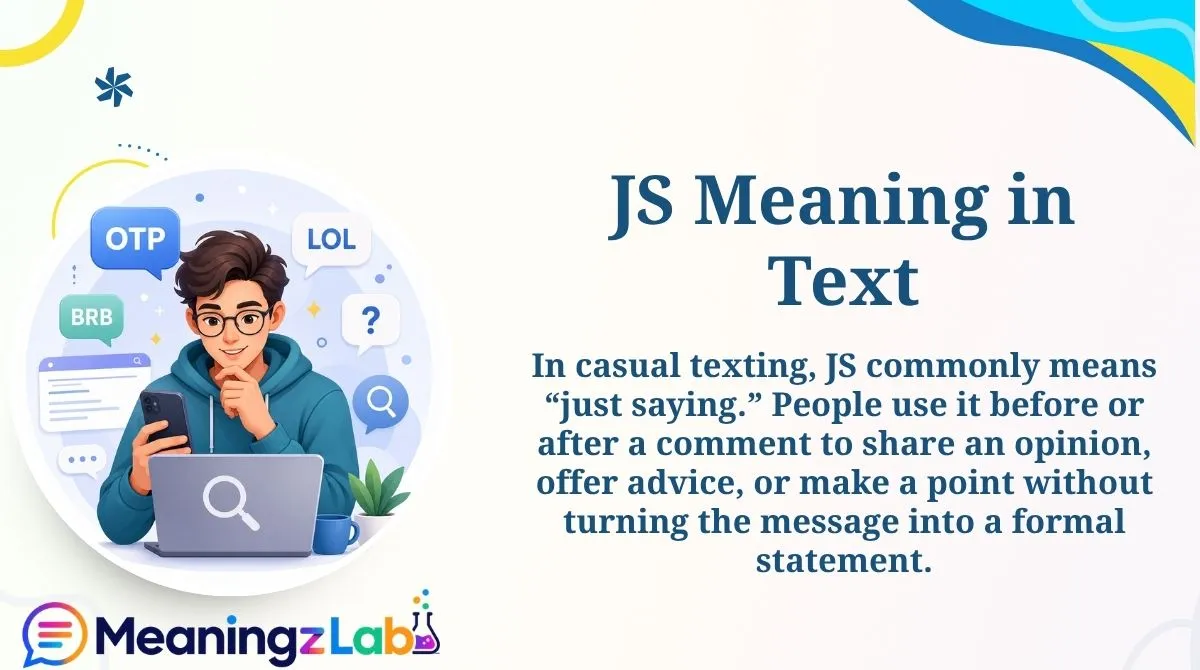
In casual texting, JS commonly means “just saying.” People use it before or after a comment to share an opinion, offer advice, or make a point without turning the message into a formal statement.
For example, if a friend texts, “JS, you deserve better,” they are expressing an opinion or offering support. The abbreviation makes the message feel informal and conversational.
JS can serve several purposes in a chat:
- Sharing an opinion: Expressing a personal view about something.
- Giving advice: Suggesting an idea without sounding too forceful.
- Making a point: Adding a comment to emphasize something.
- Joking around: Making a playful observation.
- Softening a statement: Trying to make a comment sound less direct.
The tone depends on the words around JS. A message like “JS, you did a great job!” sounds supportive. However, “JS, that was a bad idea” may sound critical or sarcastic.
It is also important to remember that JS does not automatically make a statement polite. Someone might use it to soften criticism, but the actual words can still sound rude.
Quick answer: If someone uses JS in an everyday conversation, read it as “just saying” first. If the message discusses coding or technology, JS may instead mean JavaScript.
The surrounding conversation is usually the best clue to the intended meaning.
Full Form, Stands For & Short Meaning of JS
The common texting full form of JS is “just saying.” It is an informal abbreviation used to introduce or emphasize a personal comment.
People often use it when they want to express something without making it sound like a serious argument. However, it can also be used sarcastically, especially when someone makes a sharp comment and then adds JS.
Here is a simple breakdown of how the abbreviation works.
| Form | Meaning | Example |
|---|---|---|
| JS | Just saying | “JS, you should try it.” |
| JS, … | Just saying, followed by a comment | “JS, that color looks great.” |
| …, JS | A comment followed by “just saying” | “You need more sleep, JS.” |
| JS 😂 | Just saying in a playful context | “You always arrive late, JS 😂” |
| JS! | Emphasis, depending on context | “JS! I think you’re right.” |
The same letters can also stand for different things outside everyday texting.
For example, JavaScript is a programming language used to add interactive features to websites and applications. Developers often use JS as its standard short name. In a programming discussion, this meaning is more likely than “just saying.”
In other settings, JS may refer to a person’s initials, a company abbreviation, or a specialized term. These uses should not automatically be treated as common texting meanings.
The main point is to consider the context before interpreting the letters. If someone writes, “JS, I think you should call her,” they probably mean “just saying.” If they write, “I’m learning JS for web development,” they almost certainly mean JavaScript.
Origin, History & First Known Use of JS
JS as a texting abbreviation fits the wider habit of shortening everyday expressions in digital conversations. People often use abbreviations to type faster and make informal messages feel more natural.
The phrase “just saying” is used to introduce a personal comment or observation. In online communication, JS provides a compact way to express the same idea.
However, the exact first use of JS as a texting abbreviation is not established here. It would be inaccurate to claim a specific year, website, or person introduced it without reliable historical evidence.
There are several reasons short forms like JS are useful in online conversations:
- Faster typing: Two letters take less time to enter than the complete phrase.
- Informal communication: Abbreviations fit relaxed conversations with friends.
- Short comments: They work well in quick replies and social media discussions.
- Personal expression: They can introduce an opinion or make a comment feel conversational.
- Digital convenience: Short forms are easy to use in chats, captions, and comments.
It is also important to distinguish the texting abbreviation from the technical abbreviation. In programming, JS commonly stands for JavaScript. That use belongs to a different context and should not be confused with the slang expression.
The phrase “just saying” does not guarantee that a comment is harmless or friendly. Someone may use JS to make a genuine suggestion, while another person may use it to deliver criticism indirectly.
Rather than relying on an unverified origin story, focus on how JS functions in the message you are reading. Its surrounding words usually reveal whether it introduces advice, an opinion, a joke, or a critical remark.
How People Use JS in Daily Conversations
People use JS in daily conversations to express opinions, offer suggestions, make observations, or add a comment to an ongoing discussion. It is common in informal communication where people do not need to use complete, formal wording.
The abbreviation can appear at the beginning or end of a message. Its position does not usually change the basic meaning, but it can affect how the sentence feels.
Sharing advice
Person A: “I’ve been staying up until 3 AM every night.”
Person B: “JS, getting more sleep might help you feel better.”
Here, JS introduces friendly advice. The sender is suggesting a change without making it sound like an order.
Expressing an opinion
Person A: “Do you think I should join the school club?”
Person B: “JS, I think you’d really enjoy it.”
The sender shares a personal view and leaves the decision to the other person.
Making a playful comment
Person A: “I bought another pair of sneakers.”
Person B: “JS, your shoe collection is taking over your room 😂”
The abbreviation introduces a humorous observation.
Giving indirect criticism
Person A: “I forgot my homework again.”
Person B: “JS, you might want to pack your bag the night before.”
This may be helpful advice, although the recipient could feel criticized depending on their relationship.
Making a sarcastic remark
Person A: “I said I’d be there at 6, and I arrived at 8.”
Person B: “JS, your clock must work differently from everyone else’s.”
The comment is sarcastic because it highlights the person’s lateness in a joking but critical way.
JS is flexible, but the phrase itself does not determine the emotion. The relationship between the people, their usual communication style, and the wording of the message all matter.
JS Meaning Across WhatsApp, Instagram, TikTok & Snapchat
On WhatsApp, Instagram, TikTok, and Snapchat, JS can mean “just saying” when it appears in an informal conversation. The basic meaning usually stays the same, but the platform and type of interaction can influence how people use it.
| Platform | Common use | Example |
|---|---|---|
| Sharing opinions or giving advice in private chats | “JS, take a jacket with you.” | |
| Adding opinions in direct messages or comments | “JS, this outfit looks amazing.” | |
| TikTok | Reacting to videos or discussing opinions | “JS, the original version was better.” |
| Snapchat | Making quick observations in casual chats | “JS, you looked happy today 😊” |
In private messages and group chats, JS can introduce advice or a personal comment. Friends may use it when discussing plans, relationships, school, or everyday problems.
In Instagram comments and direct messages, JS may introduce an opinion about a photo, outfit, caption, or situation. Depending on the wording, the comment can be supportive or critical.
TikTok
On TikTok, JS may appear in comments about videos, trends, opinions, or personal experiences. The abbreviation does not have a separate universal TikTok meaning.
Snapchat
In quick conversations, JS can be used to add a thought or make a casual observation. The tone depends on the relationship and the content of the message.
The meaning can change when the subject changes. For example, JS in a discussion about website development is likely to mean JavaScript, even if the conversation happens through WhatsApp or Instagram.
Therefore, do not rely on the platform alone. Look at the surrounding words and the subject being discussed to understand what the sender intends.
Different Meanings of JS in Other Fields
Although JS often means “just saying” in informal messages, it has other established uses in technical and professional contexts. The intended meaning depends on the subject of the conversation.
The most important alternative is JavaScript, a programming language widely used to create interactive websites and web applications. Developers commonly shorten its name to JS when discussing code, tools, and software development.
Here are some possible interpretations.
| Context | Possible meaning | How to identify it |
|---|---|---|
| Casual texting | Just saying | The message contains an opinion or comment |
| Web development | JavaScript | The discussion involves code, websites, or programming |
| Personal messages | Someone’s initials | The letters appear as a person’s name or signature |
| Workplace or technical documents | A specialized abbreviation | The surrounding document defines or explains it |
JS in programming
If someone says, “I need to fix my JS code,” they are referring to JavaScript rather than the texting expression.
JavaScript is used to make websites interactive. It can support features such as dynamic menus, form validation, and updates to page content.
JS as initials
JS can also represent a person’s initials. For example, it might appear in a contact name, username, or signature. In that case, it is not slang at all.
JS in specialized settings
Some organizations and professional fields use the same letters for their own terms. These meanings are not universal, so the subject matter or a document’s glossary may be needed to interpret them correctly.
The easiest way to distinguish the meanings is to examine the full sentence. A message such as “JS, you should take a break” likely uses “just saying.” A message such as “The JS function isn’t working” points to JavaScript.
Do not assume that a meaning used in one field applies to every conversation. Context is essential when interpreting short abbreviations.
Common Confusions, Mistakes & Wrong Interpretations
One common mistake is assuming that JS always means “just saying.” That is a useful starting point in casual texting, but it is not correct in every context.
The abbreviation can be misunderstood when people ignore the topic, the wording, or the sender’s tone.
Confusing JS with JavaScript
If someone mentions code, web development, or programming, JS probably means JavaScript.
For example:
Person A: “Why isn’t my JS working?”
Person B: “Can you show me the code?”
Here, JS refers to the programming language, not “just saying.”
Thinking JS always makes a comment friendly
JS can soften a statement, but it does not guarantee kindness.
For example, “JS, that was a terrible idea” may sound critical even though the sender uses an informal abbreviation.
Assuming the sender is being sarcastic
Some people use JS after a joke or criticism. Others use it to introduce sincere advice. The letters alone cannot tell you which one is intended.
Mixing JS up with similar abbreviations
These expressions may appear in similar conversations, but they have different meanings.
| Abbreviation | Meaning |
|---|---|
| JS | Just saying, in casual texting |
| IMO | In my opinion |
| TBH | To be honest |
| FYI | For your information |
| NGL | Not gonna lie |
| BTW | By the way |
For example, “IMO, that movie was great” clearly introduces an opinion. “JS, that movie was great” can sound like an additional comment or observation.
Ignoring punctuation and relationship
“JS, you look great!” sounds positive. “JS.” after an argument may feel more serious or dismissive, depending on the conversation.
Still, punctuation is only a clue, not proof of emotion.
Best tip: Read the whole message before deciding what JS means. If it remains unclear, ask the sender what they meant instead of assuming the worst.
Similar Terms, Alternatives & Related Slang
Several abbreviations have a purpose similar to JS because they help people share opinions, add comments, or introduce information. However, they are not exact replacements for one another.
| Term | Full form | Main purpose |
|---|---|---|
| JS | Just saying | Adds a comment or observation |
| IMO | In my opinion | Introduces a personal opinion |
| IMHO | In my humble opinion | Shares an opinion, often informally |
| TBH | To be honest | Introduces a candid statement |
| NGL | Not gonna lie | Signals a frank or personal comment |
| BTW | By the way | Adds related or new information |
| FYI | For your information | Shares information someone may need |
JS vs. IMO
IMO directly signals that a statement is the sender’s opinion. JS often adds a comment that the sender wants to put out there, sometimes without making it sound too forceful.
Example: “IMO, we should leave early” clearly presents an opinion. “JS, we should leave early” can sound more like a suggestion or an extra thought.
JS vs. TBH
TBH means “to be honest.” It often introduces a candid statement, such as “TBH, I didn’t enjoy the movie.”
JS can be used after a comment to emphasize that the sender is simply expressing a thought.
JS vs. NGL
NGL means “not gonna lie.” It often signals a frank or personal reaction. JS does not necessarily suggest that the sender is revealing something they might otherwise hide.
JS vs. BTW
BTW means “by the way” and introduces additional information. JS usually introduces or emphasizes a comment instead.
Choose the abbreviation that matches your intention. If you want to avoid misunderstandings, writing the complete phrase can be clearer than using slang.
Examples of JS in Real Chat Situations
These original conversations show how JS can appear in different situations. Pay attention to the wording and punctuation because they help establish the tone.
1. Friendly advice
Person A: “I’ve been feeling tired all week.”
Person B: “JS, maybe you need a little more rest.”
Meaning: The sender offers a suggestion in a casual way.
2. Complimenting a friend
Person A: “I’m not sure about this outfit.”
Person B: “JS, you look amazing in it! 😊”
Meaning: JS introduces a supportive opinion.
3. Playful teasing
Person A: “I finished the whole pizza by myself.”
Person B: “JS, you might be the biggest pizza fan I know 😂”
Meaning: The sender makes a lighthearted observation.
4. Sharing a personal opinion
Person A: “Should we watch the comedy or the action movie?”
Person B: “JS, I think the comedy would be more fun.”
Meaning: The sender shares a preference without demanding that others agree.
5. Making a sarcastic comment
Person A: “I forgot my keys for the third time this week.”
Person B: “JS, your keys must be playing hide-and-seek.”
Meaning: The sender jokes about the repeated mistake.
6. Giving constructive advice
Person A: “I have three assignments due tomorrow.”
Person B: “JS, starting them a little earlier next time might help.”
Meaning: The sender offers advice. Depending on the relationship, it may feel helpful or slightly critical.
7. A potentially rude comment
Person A: “I thought my presentation went well.”
Person B: “JS, you could have prepared more.”
Meaning: The sender introduces criticism. JS does not make the comment automatically polite.
8. Discussing programming
Person A: “I’m learning JS for my website.”
Person B: “Nice! Are you starting with the basics?”
Meaning: Here, JS means JavaScript because the conversation is about website development.
These examples show why the complete message matters. JS can introduce a compliment, a suggestion, a joke, or criticism. In technical conversations, it can have an entirely different meaning.
How to Reply When Someone Says JS
When someone sends JS, the best response depends on what they are saying and how they seem to mean it. You can agree, thank them, joke back, ask a question, or clarify their point.
You do not need to respond to the abbreviation itself. Respond to the actual comment.
| Situation | Possible reply |
|---|---|
| Friendly advice | “Thanks, I’ll keep that in mind.” |
| Compliment | “Thank you! 😊” |
| Personal opinion | “That’s a fair point.” |
| Playful joke | “Haha, you might be right 😂” |
| Confusing comment | “What do you mean by that?” |
| Potentially rude remark | “Could you explain what you mean?” |
| Programming discussion | “Are you referring to JavaScript?” |
If someone is being helpful
A simple acknowledgment works well.
Person A: “JS, you should get some rest tonight.”
Person B: “You’re right. I’ll try to sleep earlier.”
This response accepts the suggestion without making the conversation complicated.
If someone is joking
You can match their playful tone.
Person A: “JS, you take forever to choose a movie 😂”
Person B: “I have excellent taste. It takes time!”
The exchange stays lighthearted.
If you do not understand the message
Ask for clarification. For example, “Do you mean ‘just saying’?” is useful if you are unfamiliar with the abbreviation.
If the conversation is about technology, you can ask whether the sender means JavaScript.
If the comment feels rude
You do not have to agree with criticism simply because the person adds JS. You can calmly say, “I understand your point, but that came across a little harshly.”
The most useful approach is to consider the person’s full message before responding. This helps you avoid unnecessary arguments and gives the other person a chance to explain their meaning.
Is JS Still Popular? Trends & Online Usage
JS remains a useful abbreviation to recognize in informal digital communication, especially when it means “just saying.” However, its exact popularity in 2026 cannot be confirmed here with reliable usage statistics.
It would be misleading to claim that JS is currently trending, becoming more popular, or used most often by a specific age group without supporting evidence.
People use abbreviations differently based on their habits, interests, and social circles. Some prefer short expressions such as JS, while others write “just saying” in full or use alternatives like IMO and TBH.
There are several reasons JS can be useful in casual conversations:
- It is brief: The abbreviation takes little time to type.
- It introduces a comment: It can signal that a person is sharing a thought.
- It suits informal chats: It works in casual messages and social media discussions.
- It can express different tones: The surrounding words can make the message friendly, playful, or critical.
- It has technical uses: In programming discussions, JS commonly means JavaScript.
The last point is especially important. If someone is talking about code, software, or websites, the technical meaning may be much more likely than the slang meaning.
JS is generally better suited to informal communication than formal writing. In professional emails or important conversations, writing the complete phrase can make your meaning clearer.
Rather than assuming its popularity based on a few posts, focus on understanding the abbreviation and the context in which it appears.
Frequently Asked Questions
What does JS mean in text messages?
JS commonly means “just saying.” It is used to introduce an opinion, make a comment, offer advice, or emphasize a thought in casual conversations.
What does JS mean from a girl or a guy?
The abbreviation generally has the same meaning regardless of who sends it. It usually means “just saying” in casual texting, but the surrounding words help determine the intended tone.
Is JS rude in texting?
JS is not inherently rude. However, it can appear before criticism or a sarcastic comment. The wording and context determine whether the message sounds friendly or harsh.
What does JS mean on WhatsApp?
On WhatsApp, JS commonly means “just saying” when people share opinions or advice in private and group chats. In a programming conversation, it may mean JavaScript.
What does JS mean on Instagram and TikTok?
On Instagram and TikTok, JS can introduce an opinion or comment. Its meaning usually remains “just saying” in casual conversations, although the topic can change the interpretation.
What should I reply when someone says JS?
You can respond with “That’s a good point,” “Thanks for the advice,” or “What do you mean?” Choose a reply that fits the actual message.
Does JS mean JavaScript or just saying?
It depends on the context. In casual texting, JS often means “just saying.” In programming and web development, JS commonly stands for JavaScript.
What does JS mean at the end of a sentence?
At the end of a sentence, JS usually adds the idea of “just saying.” It can emphasize a personal comment, soften advice, or make criticism sound indirect.
Is JS an acronym or an abbreviation?
When used to mean “just saying,” JS is an informal abbreviation of the phrase. In technical contexts, it is a commonly used short name for JavaScript.
What is the difference between JS and IMO?
JS means “just saying,” while IMO means “in my opinion.” Both can appear in discussions about personal views, but IMO more directly identifies a statement as an opinion.
Conclusion
The most common JS meaning in text is “just saying.” People use it to introduce opinions, offer advice, make observations, or add a comment to an informal conversation. It is a short expression that can make messages feel casual and conversational.
However, JS does not always have the same meaning. In programming and web development, it commonly stands for JavaScript. The subject of the conversation is often the clearest way to tell these meanings apart.
The tone also depends on the words around the abbreviation. JS may introduce a friendly suggestion, a playful joke, or a critical remark. It does not automatically make a statement polite or sarcastic.
When you receive a message containing JS, read the full sentence before deciding what the sender means. If you are still unsure, ask a simple question. Understanding the context will help you interpret JS correctly and recognize related texting abbreviations more easily.

Evan Rellmont is a content writer and researcher who specializes in internet slang, text abbreviations, and social media language. He creates clear, helpful content to make modern online communication easier to understand.