If you have seen ONS in a text message or on social media, you may wonder what it means.
In most casual online conversations, ONS stands for “One Night Stand.” It refers to a sexual encounter between people that is not expected to become an ongoing romantic relationship.
However, the exact meaning depends on the conversation and the person using it.
People often use ONS in private messages, dating app chats, and discussions about relationships.
Some use it to ask about someone’s dating preferences, while others mention it when talking about past experiences.
The abbreviation can feel direct, personal, or awkward, depending on the situation.
In this guide, you will learn the common meaning of ONS, its possible full forms, how people use it across social media platforms, and how to respond when someone sends it to you.
| Quick Detail | Meaning |
|---|---|
| Term | ONS |
| Most common meaning in dating slang | One Night Stand |
| Full form | One Night Stand |
| Typical tone | Casual, direct, or personal |
| Common usage | Text messages, dating apps, and social media |
| Meaning depends on context? | Yes |
What Does ONS Mean in Text & Chat?
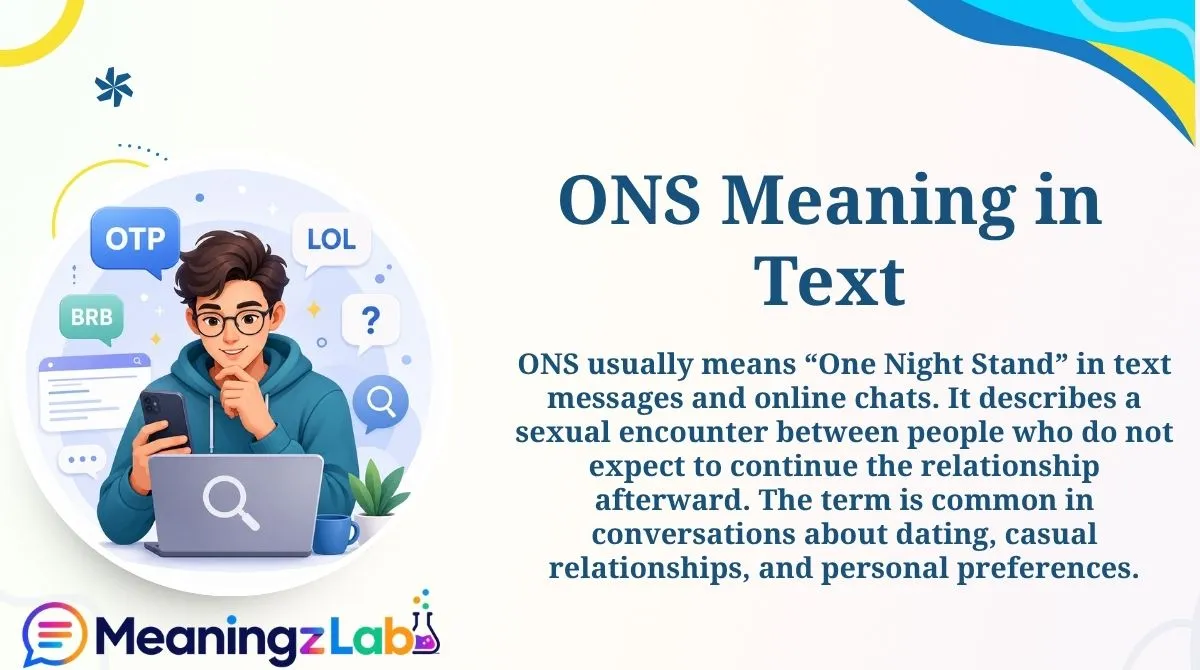
ONS usually means “One Night Stand” in text messages and online chats. It describes a sexual encounter between people who do not expect to continue the relationship afterward. The term is common in conversations about dating, casual relationships, and personal preferences.
For example, someone might ask, “Are you looking for an ONS or something serious?” They want to know whether the other person prefers a casual encounter or a longer-term relationship.
ONS is an abbreviation, so people can type it quickly instead of writing the full phrase. It may appear in dating profiles, private messages, or conversations between friends discussing relationships.
The meaning can also depend on the surrounding words. A message about dating usually points to “One Night Stand,” but a message about work, government services, or statistics may use ONS differently.
Is ONS Romantic, Casual, or Serious?
ONS is generally associated with casual sexual relationships rather than committed romance. However, the tone of a message can vary.
- Casual: “I’m not looking for anything serious, just an ONS.”
- Direct: “What do you mean by ONS?”
- Curious: “Have you ever had an ONS?”
- Potentially uncomfortable: “Come over tonight for an ONS.”
The abbreviation itself is not automatically rude or disrespectful. The way someone uses it matters. A respectful conversation allows both people to express their preferences and boundaries without pressure.
If you receive ONS in a message and feel unsure, it is perfectly reasonable to ask what the sender means.
Full Form, Stands For & Short Meaning of ONS
The most common full form of ONS in dating and texting is One Night Stand. It refers to a sexual encounter that is generally understood to be a one-time event rather than the start of an ongoing relationship.
The abbreviation saves time in casual online conversations. Instead of typing the entire phrase, someone can write ONS when discussing dating intentions or relationship expectations.
Here is a quick breakdown:
| Form | Meaning | Typical Context |
|---|---|---|
| ONS | One Night Stand | Dating and casual relationships |
| FWB | Friends With Benefits | Friendship with a sexual relationship |
| NSA | No Strings Attached | A casual arrangement without expected romantic commitment |
| LTR | Long-Term Relationship | A relationship intended to last |
| ONS? | Asking about a one-night stand | Dating chats or personal messages |
These terms are related, but they do not mean exactly the same thing. For example, friends with benefits usually describes an ongoing arrangement, while a one-night stand generally refers to a single encounter.
Does ONS Have Other Full Forms?
Yes. ONS can have other meanings outside dating conversations.
In the United Kingdom, ONS commonly refers to the Office for National Statistics, the government body responsible for producing official statistics. In business or technical discussions, the abbreviation may also have a specialized meaning.
Therefore, the surrounding topic is important. If someone mentions ONS while discussing a dating profile, “One Night Stand” is a likely interpretation. If they are talking about UK population figures or economic reports, they probably mean the Office for National Statistics.
Never assume that every use of ONS has a romantic or sexual meaning. Read the complete message before deciding what the abbreviation means.
Origin, History & First Known Use of ONS
ONS comes from the phrase “one-night stand,” which has been used in English for a long time. The phrase originally became associated with a single performance or engagement, particularly in entertainment. Over time, it also became widely associated with a sexual encounter that happens once rather than as part of an ongoing relationship.
The abbreviation ONS is a shorter form that fits the style of digital communication. Text messages, online forums, and dating platforms encourage people to use compact expressions when discussing familiar topics.
However, it is important to separate the history of the full phrase from the history of the abbreviation. The fact that “one-night stand” is an established expression does not prove exactly when ONS first appeared in online messages.
How Did ONS Become a Texting Abbreviation?
Like many internet abbreviations, ONS is convenient because it uses the first letters of the words in the full phrase. People can recognize it quickly when they already know the dating context.
Dating apps and private messaging also provide spaces where people discuss relationship goals before meeting. In these settings, ONS can communicate an intention without requiring a long explanation.
For example, a person might write, “I’m open to dating, but I’m not interested in an ONS.” This tells the reader that the person does not want a one-time sexual encounter.
Is There a Confirmed First Use of ONS Online?
There is no widely established first-use date for ONS as a texting abbreviation that can be stated confidently here. Without reliable historical evidence, assigning an exact year or naming a particular platform as its origin would be misleading.
The safest conclusion is that ONS is an abbreviation of an older English expression that became useful in modern digital conversations.
How People Use ONS in Daily Conversations
People generally use ONS when discussing casual dating, relationship expectations, or past romantic and sexual experiences. It can appear in direct questions, dating profiles, conversations between friends, and discussions about personal boundaries.
The abbreviation can communicate different intentions depending on the sentence. Someone may be asking what another person wants, describing their own preferences, or explaining why a past encounter did not develop into a relationship.
Asking About Dating Intentions
One common use is to find out whether someone wants a casual encounter or a committed relationship.
For example:
Person A: “Are you looking for an ONS or a relationship?”
Person B: “I’m hoping to find something serious.”
Here, ONS is used to distinguish a one-time encounter from a longer-term relationship.
Talking About Past Experiences
People may also mention ONS when discussing something that happened in the past.
Person A: “He told me he wasn’t ready for a relationship.”
Person B: “Maybe he was only interested in an ONS.”
The second person is suggesting a possible explanation, not stating a proven fact about the other person’s intentions.
Setting Personal Boundaries
ONS may appear when someone explains what they do or do not want.
Person A: “Just so we’re clear, I’m not interested in an ONS.”
Person B: “That’s completely fine. I’m happy to respect that.”
This is a straightforward way to communicate preferences. Clear, respectful language helps prevent misunderstandings.
Does ONS Always Mean the Same Thing?
No. Although “One Night Stand” is common in dating conversations, the abbreviation can mean something different in another setting. It is also possible for a person to use it incorrectly or assume that the reader already understands it.
When the meaning is unclear, asking a simple question is better than guessing.
ONS Meaning Across WhatsApp, Instagram, TikTok & Snapchat
ONS generally keeps the same meaning across WhatsApp, Instagram, TikTok, and Snapchat when it appears in a dating or relationship context. It usually stands for “One Night Stand.” The platform changes where people encounter the term, not its basic meaning.
| Platform | How ONS May Be Used |
|---|---|
| Private conversations about dating or relationships | |
| Direct messages, comments, or dating-related posts | |
| TikTok | Videos or comments discussing casual dating |
| Snapchat | Private chats about personal interests or dating intentions |
| Dating apps | Profiles or messages describing relationship preferences |
ONS on WhatsApp
On WhatsApp, ONS may appear in a private message between friends or between people getting to know each other. Since messages can be informal, the abbreviation may be used without any explanation.
For example: “I like you, but I’m not looking for an ONS.”
This message communicates a boundary or preference.
ONS on Instagram and TikTok
On Instagram, the abbreviation may appear in direct messages or posts about dating culture. On TikTok, people may use it in comments or videos discussing relationship expectations.
However, a comment or video might discuss ONS without suggesting that the creator personally wants one. Context matters.
ONS on Snapchat
On Snapchat, ONS may appear in a personal conversation where two people discuss what they want from each other.
If someone sends “ONS?” without any explanation, it may be a question about your interest in a one-night stand. Still, it is sensible to confirm the meaning before responding.
The key point: ONS does not have a separate standard meaning on each of these platforms. Its interpretation depends mainly on the topic and the surrounding conversation.
Different Meanings of ONS in Other Fields
Although “One Night Stand” is a common meaning in texting and dating, ONS is not limited to informal conversations. It can also represent an organization or a specialized term in professional settings.
The correct interpretation depends on what the people are discussing.
ONS in UK Statistics
In the United Kingdom, ONS stands for the Office for National Statistics. This organization produces official statistics about subjects such as population, employment, prices, and the economy.
For example:
Person A: “I found the latest ONS population figures.”
Person B: “Are they from the official statistics report?”
In this example, the abbreviation clearly refers to the government statistics organization, not a dating term.
ONS in Business and Technical Communication
Some workplaces and technical fields use ONS as an abbreviation for a specific phrase, system, or organization. These meanings may be limited to a particular industry or company.
There is no single alternative full form that applies to every professional use of ONS. A report, document, or conversation should provide enough context to identify the intended meaning.
ONS in General Online Discussions
In a general conversation, ONS may be mentioned while discussing dating culture, relationship choices, or social expectations. In these cases, “One Night Stand” is often the intended meaning.
Use the subject of the conversation as your guide:
- Dating or relationships: likely “One Night Stand.”
- UK government data: likely “Office for National Statistics.”
- A specialized workplace or technical topic: check the field-specific meaning.
When the context does not make the meaning clear, ask the writer to explain the abbreviation.
Common Confusions, Mistakes & Wrong Interpretations
ONS can cause confusion because it has more than one possible meaning. The most common mistake is assuming that it always refers to dating, even when the conversation is about statistics or another professional topic.
Another mistake is treating ONS as interchangeable with every abbreviation used for casual relationships. These expressions can describe different arrangements.
ONS vs. FWB
ONS means “One Night Stand,” which usually describes a single encounter. FWB means “Friends With Benefits,” which usually describes friends who have a sexual relationship without necessarily being romantic partners.
The main difference is that FWB commonly involves an ongoing connection, while ONS generally refers to one occasion.
ONS vs. NSA
NSA means “No Strings Attached.” In dating, it describes a casual arrangement without expected romantic commitment.
An NSA arrangement may involve more than one encounter. An ONS generally refers to a one-time encounter. The terms may overlap in casual conversation, but they are not identical.
ONS vs. Hookup
“Hookup” is a broad informal term that can refer to a casual romantic or sexual encounter. Its exact meaning varies by speaker and context.
ONS is more specific because it usually suggests a one-time encounter.
Does ONS Mean Someone Wants a Relationship?
Not usually. In dating contexts, ONS typically points to a casual, one-time encounter rather than a committed relationship. However, the abbreviation alone cannot tell you everything about a person’s intentions.
Do not assume that someone wants or has agreed to something based only on a short message. If you are discussing a personal situation, ask clear questions and make sure both people are comfortable with the conversation.
Similar Terms, Alternatives & Related Slang
Several abbreviations appear in the same conversations as ONS. Learning their differences can help you understand dating messages without confusing a one-time encounter with an ongoing relationship.
| Term | Full Form | Main Meaning |
|---|---|---|
| ONS | One Night Stand | A one-time sexual encounter |
| FWB | Friends With Benefits | Friends with an ongoing sexual arrangement |
| NSA | No Strings Attached | A casual arrangement without expected romantic commitment |
| LTR | Long-Term Relationship | A relationship intended to continue |
| DTR | Define the Relationship | A conversation to clarify a relationship’s status |
| BF | Boyfriend | A male romantic partner |
| GF | Girlfriend | A female romantic partner |
| Hookup | Not an abbreviation | An informal term for a casual encounter |
Which Term Should You Use?
Choose the term that accurately describes what you mean. If you are discussing a single encounter, ONS may be appropriate. If you mean an ongoing arrangement between friends, FWB is more specific.
If you want to understand someone’s relationship goals, a direct question is often clearer than relying on slang.
For example, you could ask, “Are you looking for something casual or a long-term relationship?” This avoids confusion and gives the other person room to explain their preferences.
Are These Terms Appropriate in Every Conversation?
No. These abbreviations are informal and may be too personal for professional conversations or situations where the other person does not welcome discussions about dating.
Use them only when the topic and relationship make them appropriate. If someone seems uncomfortable, respect their boundaries and change the subject.
Examples of ONS in Real Chat Situations
The easiest way to understand ONS is to see how it works in everyday messages. In the examples below, it means “One Night Stand” because each conversation is about dating or relationships.
Example 1: Asking About Intentions
Person A: “Before we meet, are you looking for an ONS or a relationship?”
Person B: “I’m interested in a relationship, not a one-time thing.”
Meaning: Person A is asking what kind of connection the other person wants. Person B clearly states a preference.
Example 2: Setting a Boundary
Person A: “Would you be interested in an ONS?”
Person B: “No, that’s not what I’m looking for. Thanks for understanding.”
Meaning: The first person asks a direct question, and the second person politely declines.
Example 3: A Playful Conversation
Person A: “My friend says every dating app conversation turns into an ONS discussion 😂”
Person B: “Sounds like your friend needs better conversations!”
Meaning: The laughing emoji makes the comment sound humorous rather than like a serious proposal.
Example 4: Discussing a Past Experience
Person A: “She said they weren’t going to date afterward.”
Person B: “It sounds like they both expected an ONS.”
Meaning: The speakers are discussing a possible one-time encounter. The wording suggests an interpretation, not confirmed knowledge.
Example 5: Confusion About the Abbreviation
Person A: “Someone wrote ONS in their profile. What does that mean?”
Person B: “In a dating profile, it usually means One Night Stand.”
Meaning: Person B explains the common dating-related interpretation.
Example 6: A Different Context
Person A: “The ONS published new employment figures.”
Person B: “I’ll check the report.”
Meaning: Here, ONS refers to the UK’s Office for National Statistics.
Example 7: An Uncomfortable Message
Person A: “Come over now. I only want an ONS, so don’t expect anything else.”
Person B: “That’s not what I want. Please respect my decision.”
Meaning: The first message is blunt and may feel pressuring. The second person clearly states a boundary. Nobody has to agree to a situation that makes them uncomfortable.
These examples show why context matters. The same three letters can communicate a dating preference, a joke, a boundary, or the name of an organization.
How to Reply When Someone Says ONS
Your response should depend on what the sender means and how you feel about the conversation. You do not need to accept an invitation, explain your personal history, or continue a discussion that makes you uncomfortable.
If the message is unclear, ask for clarification first.
If You Are Interested
If you are comfortable discussing a casual encounter, you can answer honestly while making your expectations clear.
Examples:
- “I’m open to something casual, but I want us to be clear about expectations.”
- “Possibly. What exactly are you looking for?”
- “Let’s talk about what we’re both comfortable with first.”
Being interested in a conversation does not mean you have agreed to anything else. You can change your mind at any time.
If You Are Not Interested
A short, polite response is enough.
Examples:
- “I’m not looking for an ONS.”
- “I’d rather get to know someone first.”
- “I’m interested in a serious relationship, not a casual encounter.”
You do not need to apologize for having different preferences.
If You Do Not Understand the Message
Ask a simple question instead of guessing.
Examples:
- “What do you mean by ONS?”
- “Do you mean One Night Stand?”
- “Can you explain what you’re asking?”
This is especially helpful when the abbreviation appears without any other context.
If the Message Feels Rude or Pressuring
You can be firm and end the conversation if necessary.
Examples:
- “I’m not comfortable with that question.”
- “I’ve already said no. Please respect that.”
- “We’re looking for different things, so I think we should leave it here.”
A respectful person should accept your answer without trying to pressure you. Your comfort and boundaries matter more than finding the perfect reply.
Is ONS Still Popular? Trends & Online Usage
ONS remains a recognizable abbreviation in dating-related conversations, but its exact popularity across platforms and age groups cannot be established without reliable, current usage data. It is better to describe it as an established piece of dating shorthand than to claim that it is trending everywhere in 2026.
People use abbreviations because they can make informal messages shorter. ONS can communicate a specific dating intention in just three letters, especially when both people already understand the term.
Why People Still Use ONS
There are several practical reasons the abbreviation appears in digital conversations:
- Convenience: It is shorter than the full phrase.
- Shared understanding: People familiar with dating slang may recognize it immediately.
- Direct communication: It can help people discuss relationship expectations.
- Privacy and brevity: Some people prefer short expressions when discussing personal topics.
However, not everyone knows the abbreviation. Someone who rarely uses dating apps or internet slang may need an explanation.
Is ONS Common on Dating Apps?
ONS is used in dating-related language, including conversations about casual encounters and relationship preferences. Still, usage can vary by app, community, location, and individual.
It would be misleading to claim that every dating app user knows the abbreviation or that it has a specific popularity ranking without supporting data.
Will the Meaning Change in the Future?
Slang can evolve, and abbreviations can develop new meanings in different communities. For now, when ONS appears in a dating conversation, “One Night Stand” is a sensible first interpretation.
The best approach is to consider the surrounding message rather than relying on the abbreviation alone.
Frequently Asked Questions
What does ONS mean in text messages?
ONS usually stands for “One Night Stand” in dating-related text messages. It refers to a sexual encounter that is generally understood to be a one-time event rather than an ongoing relationship.
What does ONS mean on WhatsApp?
On WhatsApp, ONS usually has the same dating-related meaning: “One Night Stand.” However, if the conversation is about another subject, the abbreviation may mean something different.
Is ONS a bad or rude word?
ONS is not automatically rude. It is an informal term associated with casual sexual encounters. Whether it feels appropriate depends on the conversation, the relationship between the people, and their comfort with the subject.
What should I reply when someone texts ONS?
If you are unsure, ask, “What do you mean by ONS?” If the person is asking about your preferences, answer honestly. You can accept the idea, decline politely, or explain that you want a different kind of relationship.
Does ONS mean One Night Stand on Instagram and TikTok?
Usually, yes, when the content is about dating or relationships. On both platforms, context helps determine whether the abbreviation refers to a one-time encounter or something else.
What is the difference between ONS and FWB?
ONS usually refers to a one-time sexual encounter. FWB, or Friends With Benefits, generally describes an ongoing arrangement between friends that includes a sexual relationship without necessarily being romantic.
What does ONS mean in the UK?
In dating conversations, it can mean “One Night Stand.” In UK news, government reports, and statistical discussions, ONS commonly means the Office for National Statistics.
Can ONS mean something other than One Night Stand?
Yes. The abbreviation has other meanings, including the UK’s Office for National Statistics. Some organizations and technical fields may also use it for specialized terms. The topic of the conversation determines the likely meaning.
Does ONS mean someone wants a serious relationship?
Usually not in dating slang. ONS generally refers to a one-time encounter, whereas a serious relationship involves an ongoing romantic connection. However, you should ask the person directly rather than assume their intentions.
Is ONS the same as a hookup?
Not exactly. A hookup is a broader informal term for a casual encounter, and its meaning can vary. ONS more specifically suggests a one-time encounter.
Conclusion
The most common ONS meaning in text is “One Night Stand,” especially in dating app conversations, private messages, and social media discussions about relationships. It generally refers to a sexual encounter that is not expected to become an ongoing relationship.
However, ONS does not always have a dating-related meaning. In the UK, for example, it can refer to the Office for National Statistics. The subject of the conversation and the words around the abbreviation help you understand which meaning applies.
If someone sends you ONS and you are unsure what they mean, asking for clarification is the simplest solution. If the conversation involves dating, be honest about your preferences and respect the other person’s boundaries.
Understanding common abbreviations such as ONS, FWB, NSA, and LTR can make online conversations easier to follow and help you avoid unnecessary misunderstandings.

Evan Rellmont is a content writer and researcher who specializes in internet slang, text abbreviations, and social media language. He creates clear, helpful content to make modern online communication easier to understand.