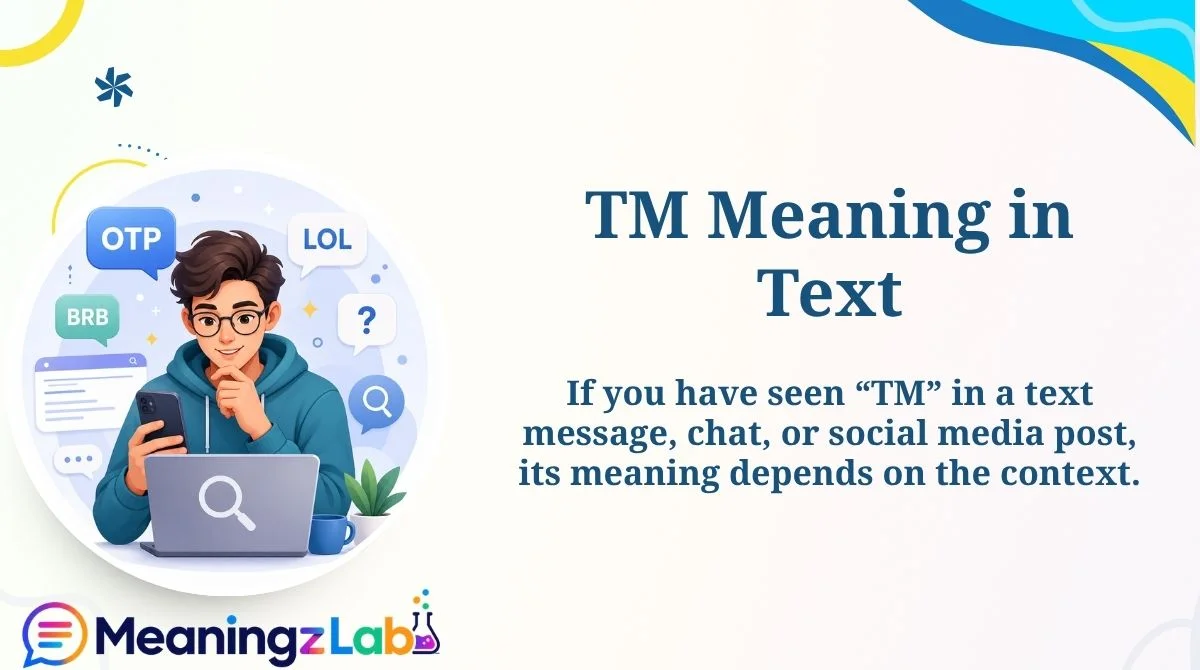
If you have seen “TM” in a text message, chat, or social media post, its meaning depends on the context.
In casual texting, TM can mean “trust me,” while in other conversations it may mean “tomorrow.” Outside casual chat, TM commonly stands for “trademark,” especially when written as ™.
People often search for the TM meaning in text because short forms can have several meanings.
The words around the abbreviation usually make the intended meaning clear.
This guide explains TM in texting, its possible full forms, social media usage, tone, common mistakes, real chat examples, and appropriate replies.
| Term | Most Common Chat Meaning | Other Common Meaning | Typical Tone | Common Usage |
|---|---|---|---|---|
| TM | Trust me | Tomorrow | Casual, neutral, or reassuring | Texting and online chat |
| TM / ™ | Trademark | — | Formal or business-related | Brands, products, websites |
Quick answer: In casual texting, TM often means “trust me,” but it can also mean “tomorrow.” If you see ™, it means “trademark.”
What Does TM Mean in Text & Chat?
TM in text can mean “trust me” or “tomorrow,” depending on the sentence. There is no single meaning that works for every conversation.
For example, someone might write:
“TM, you’ll love this movie.”
Here, TM means “trust me.” The person is expressing confidence in what they are saying.
But consider:
“I’ll call you TM.”
In this context, TM can mean “tomorrow.”
The surrounding words are important. If TM appears next to a promise, opinion, or reassurance, “trust me” may fit. If it appears with a time, appointment, or plan, “tomorrow” is more likely.
TM can have different tones
The tone may be:
- Reassuring: “TM, everything will be fine.”
- Playful: “TM 😂 this is actually hilarious.”
- Serious: “TM, I’m not joking about this.”
- Sarcastic: “TM, that went really well… 🙃”
- Neutral: “I’ll send it TM.”
- Affectionate: “TM, you’re going to love it ❤️.”
Punctuation and emojis can also change how the message feels. “TM.” may sound firm, while “TM 😂” usually feels more relaxed.
The safest approach is to read the whole sentence instead of interpreting the two letters alone.
Full Form, Stands For & Short Meaning of TM
The full form of TM in texting is often “trust me” when it is used as a casual expression. However, TM can also be shorthand for “tomorrow” in informal messages.
There is another very important meaning: TM stands for “trademark.” The trademark symbol is ™, and it is commonly associated with brand names, slogans, logos, and products.
| TM Usage | Meaning | Example |
|---|---|---|
| TM | Trust me | “TM, this is worth watching.” |
| TM | Tomorrow | “Can we talk TM?” |
| ™ | Trademark | “BrandName™” |
| TM | Context-dependent abbreviation | Meaning depends on surrounding words |
These meanings should not be treated as interchangeable.
If someone says, “TM, I know what I’m doing,” “trust me” makes sense.
If they say, “See you TM,” “tomorrow” may be intended.
If you see “™” attached to a name, it is normally related to trademark identification rather than texting slang.
One useful clue is capitalization. Texting abbreviations are often typed in uppercase because they are short forms. The trademark symbol, however, is a specific character and is usually placed after a name or phrase.
When the sentence is unclear, asking the person what they meant is better than guessing.
Origin, History & First Known Use of TM
There is no single confirmed origin or first-use date for TM as a texting abbreviation that can safely explain every casual use. Different meanings developed from different forms of shorthand.
The trademark meaning has a much older history than modern text messaging. TM as “trademark” is connected to the established legal and commercial use of trademark terminology, while casual texting abbreviations became popular with digital communication and character-limited messaging.
“Trust me” is a natural phrase to shorten because both words are common in informal conversation. Similarly, “tomorrow” is often shortened in quick messages because it is a frequent word in scheduling.
The important point is that TM does not have one universal origin as internet slang. Its meaning can come from the communication setting.
For example, a person discussing a business name may use TM in a completely different way from someone chatting with a friend.
It is also risky to assume that every abbreviation has a single inventor, website, or exact date of creation. Informal texting language often spreads through everyday use rather than through a clearly documented launch.
So, when explaining TM, it is more accurate to focus on its established meanings and present-day context rather than claiming a specific “first text” or unsupported origin story.
How People Use TM in Daily Conversations
People use TM in everyday messages mainly when they want to save time or keep a conversation informal.
When TM means “trust me,” it usually introduces reassurance, confidence, or a strong personal opinion.
For example:
Person A: “Should I try that new restaurant?”
Person B: “TM, the food is amazing.”
Here, the speaker is saying, “Trust me, the food is amazing.”
When TM means “tomorrow,” it is usually connected with plans, deadlines, meetings, or future activities.
Person A: “Are you free today?”
Person B: “Not today. Let’s meet TM.”
In this case, the intended meaning is likely “tomorrow.”
Context usually solves the mystery
Look at the words around TM:
- “TM, you’ll understand.” → likely “trust me”
- “See you TM.” → likely “tomorrow”
- “TM, this is worth it.” → likely “trust me”
- “I’ll finish it TM.” → likely “tomorrow”
The relationship between the speakers matters too. Friends may use TM casually, while coworkers may avoid it if there is a chance of confusion.
In a professional message, writing “tomorrow” or “trust me” in full is often clearer.
TM Meaning Across WhatsApp, Instagram, TikTok & Snapchat
The meaning of TM generally does not change simply because it appears on WhatsApp, Instagram, TikTok, or Snapchat. The surrounding conversation still determines what the abbreviation means.
On WhatsApp, TM may appear in quick personal messages:
“TM, you’ll get it once you see it 😂”
Here, “trust me” is likely.
On Instagram, it may appear in comments or direct messages:
“TM this outfit looks better in person.”
Again, “trust me” fits the sentence.
On TikTok, users may use abbreviations in comments and replies. The exact meaning depends on the video and the surrounding comment.
On Snapchat, short forms are common because conversations tend to be quick and informal. A message such as “See you TM” may use TM to mean “tomorrow.”
Platform does not determine the meaning
| Platform | Possible Meaning | Context |
|---|---|---|
| Trust me / Tomorrow | Private chats and plans | |
| Trust me / Tomorrow | DMs and comments | |
| TikTok | Trust me / Tomorrow | Comments and replies |
| Snapchat | Trust me / Tomorrow | Quick conversations |
One exception is ™, which is not normally texting slang. It is a trademark symbol and can appear on any platform when someone identifies a brand or product.
So, do not assume that TM has a special Instagram, TikTok, WhatsApp, or Snapchat definition. Context remains the strongest clue.
Different Meanings of TM in Other Fields
Outside texting, TM has several established meanings, so the context becomes even more important.
The most widely recognized formal use is “trademark.” The symbol ™ is used to identify a word, name, phrase, or design as a claimed trademark. It is commonly seen next to brand names or product names.
In business and branding, TM can therefore have nothing to do with texting.
Other fields may also use TM as an abbreviation. For example, a specific organization, course, technical system, job title, or industry may define TM differently. These specialized meanings should not be assumed without context.
A useful distinction is:
| Context | Likely Meaning |
|---|---|
| Casual texting | Trust me |
| Scheduling | Tomorrow |
| Branding | Trademark |
| Business documents | Context-dependent |
| Technical or professional writing | Field-specific |
The ™ symbol is especially easy to identify because it has a different visual form from ordinary “TM.”
If someone writes:
“MyNewBrand™”
they are almost certainly referring to a trademark.
If someone writes:
“TM, you need to watch this.”
they are likely using casual shorthand for “trust me.”
When TM appears in a specialized document, avoid applying a texting definition automatically. The subject matter should guide the interpretation.
Common Confusions, Mistakes & Wrong Interpretations
The biggest mistake people make with TM is assuming that it always means the same thing.
For example, if someone writes:
“I’ll finish it TM.”
Interpreting TM as “trust me” would make the sentence confusing. In a scheduling context, “tomorrow” is much more likely.
Another common mistake is confusing TM with ™. The two letters “TM” can be casual shorthand, while ™ is a trademark symbol.
Why context matters
Consider these two messages:
“TM, this will work.”
“I’ll see you TM.”
The first naturally suggests “trust me.” The second can suggest “tomorrow.”
Emojis can provide another clue:
- “TM 😂” → likely playful or humorous
- “TM ❤️” → reassuring or affectionate
- “TM!!!” → strong confidence or excitement
- “TM?” → could indicate uncertainty or a question about the abbreviation
Capitalization alone does not guarantee the meaning.
There is also a common mistake of treating rare meanings as universal slang. TM may have specialized meanings in particular fields, but that does not mean those definitions apply to an ordinary text message.
If the message is genuinely unclear, a simple “Do you mean trust me or tomorrow?” can solve the problem quickly.
Similar Terms, Alternatives & Related Slang
Several abbreviations and expressions can appear in similar situations, but they do not all mean the same thing as TM.
When TM means “trust me,” related expressions include:
- Believe me — asks someone to accept what you are saying.
- Trust me — the full version of TM.
- I swear — emphasizes confidence or sincerity.
- TBH — “to be honest,” often used to introduce an opinion.
- FR — “for real,” often used to emphasize agreement or seriousness.
When TM means “tomorrow,” related shortcuts include:
- Tmrw — informal spelling of tomorrow.
- Tomo — casual shorthand sometimes used for tomorrow.
- Tomorrow — the clearest option in formal communication.
These alternatives can sound different.
For example, “FR” often shows agreement, while “TM” meaning “trust me” asks the reader to believe the speaker.
Likewise, “tmrw” is much easier to understand as a time reference than TM when there is a risk of confusion.
The best abbreviation depends on the audience. Close friends may understand very short forms immediately. A teacher, client, manager, or new contact may prefer complete words.
In other words, abbreviations are useful when they improve speed without reducing clarity. If the reader has to stop and guess, writing the full word is usually better.
Examples of TM in Real Chat Situations
Here are realistic examples showing how context and tone can change the meaning of TM.
Example 1: Trust me
Person A: “Do you think this movie is worth watching?”
Person B: “TM, the ending is incredible. 🍿”
Meaning: “Trust me.” The tone is confident and friendly.
Example 2: Tomorrow
Person A: “When should we finish the project?”
Person B: “I can do it TM.”
Meaning: “Tomorrow.” The scheduling context makes the intended meaning clear.
Example 3: Playful
Person A: “You really think I should try karaoke?”
Person B: “TM 😂 you’ll be amazing.”
Meaning: “Trust me.” The laughing emoji makes the message playful rather than formal.
Example 4: Serious
Person A: “Are you sure this is the right decision?”
Person B: “TM. I’ve thought about it carefully.”
Meaning: “Trust me.” The period and serious wording make the reply firm and reassuring.
Example 5: Ambiguous
Person A: “Can you send me the details TM?”
Person B: “Do you mean trust me or tomorrow?”
Meaning: The abbreviation is unclear because both interpretations are possible. Asking is better than guessing.
These examples show why the words around TM matter more than the abbreviation by itself.
How to Reply When Someone Says TM
Your response to TM depends on what the person means and how they are using it.
If TM means “trust me” and the speaker is being reassuring, you can respond naturally:
“Okay, I trust you!”
If they sound playful:
“Haha, now I’m curious 😂”
If you are not convinced:
“I’ll believe you when I see it 😄”
If TM appears to mean “tomorrow,” you can confirm the plan:
“Sure, tomorrow works for me.”
If the meaning is unclear
Ask directly:
“TM as in trust me or tomorrow?”
That is especially useful in work chats or conversations where timing matters.
Matching your reply to the tone
| Situation | Suitable Reply |
|---|---|
| Reassuring | “Okay, I trust you.” |
| Playful | “Haha, we’ll see 😂” |
| Serious | “Alright, I’ll take your word for it.” |
| Tomorrow | “Sure, tomorrow works.” |
| Confusing | “What do you mean by TM?” |
| Potentially rude | “Can you explain what you mean?” |
If someone uses TM in a dismissive or sarcastic way, avoid escalating the conversation. A calm question can clarify their intention.
Is TM Still Popular? Trends & Online Usage
TM remains understandable as an abbreviation, but its meaning is highly context-dependent. It is not safe to treat every appearance of TM as one fixed piece of internet slang.
Modern messaging uses many short forms, but people also mix abbreviations with normal words, emojis, GIFs, voice notes, and reaction features. As a result, very short abbreviations can sometimes become less clear than the full phrase.
TM can still appear in casual conversations, especially when the intended meaning is obvious from the sentence. However, there is an important difference between being used and being universally understood.
For example:
“TM, you’ll love it.”
is relatively easy to interpret as “trust me.”
But:
“I’ll do it TM.”
requires more context because the reader may need to decide whether TM means “tomorrow” or something else.
In professional communication, clarity usually matters more than saving two or three characters. Writing “tomorrow” or “trust me” in full can prevent misunderstandings.
The trademark meaning is different. TM/™ remains relevant in branding and business contexts because it is not dependent on internet slang trends.
So, when you see TM online in 2026, look at the complete sentence, the platform, the relationship between the speakers, and any punctuation or emojis before deciding what it means.
Frequently Asked Questions
What does TM mean in text?
TM can mean “trust me” or “tomorrow” in casual texting. The sentence and surrounding context determine which meaning is intended.
What is the most common meaning of TM in chat?
When used as a casual expression, “trust me” is a common interpretation. However, TM can also mean “tomorrow,” especially when discussing plans or dates.
Does TM mean tomorrow in texting?
Yes. TM can be shorthand for “tomorrow,” particularly in messages about meetings, plans, deadlines, or future activities.
Does TM mean trust me?
Yes. TM can mean “trust me” when it introduces reassurance, confidence, advice, or a strong personal opinion.
What does TM mean on WhatsApp?
On WhatsApp, TM can mean “trust me” or “tomorrow.” WhatsApp itself does not give TM one special meaning, so context is important.
What does TM mean on Instagram or TikTok?
On Instagram and TikTok, TM can have the same casual meanings as in other chats, including “trust me” and “tomorrow.” The surrounding comment or message provides the clue.
What does the TM symbol ™ mean?
The symbol ™ means “trademark.” It is commonly placed next to a brand, product name, phrase, or other mark that is being identified as a trademark.
How should I reply if someone texts TM?
First determine the meaning. If it means “trust me,” you can say “Okay, I trust you.” If it means “tomorrow,” you can confirm the plan. If it is unclear, ask what they mean.
Is TM formal or informal?
TM as texting shorthand is generally informal. In professional communication, using the complete phrase is often clearer. The trademark symbol, however, belongs to a formal branding and commercial context.
Conclusion
The TM meaning in text depends on context. In casual conversations, TM can mean “trust me,” especially when someone is reassuring you or expressing strong confidence. It can also mean “tomorrow” when the conversation is about plans, schedules, or deadlines.
Outside texting, TM or ™ commonly relates to “trademark,” which is a completely different use. That is why the surrounding words, punctuation, emojis, and subject of the conversation matter.
If you see “TM” in a message and the meaning is unclear, do not assume. Read the full sentence or simply ask the sender. Once you understand the context, the intended meaning is usually easy to identify.
Learning common abbreviations like TM can make online conversations much easier to understand. For other texting slang and short forms, always consider context before settling on a definition.

Evan Rellmont is a content writer and researcher who specializes in internet slang, text abbreviations, and social media language. He creates clear, helpful content to make modern online communication easier to understand.