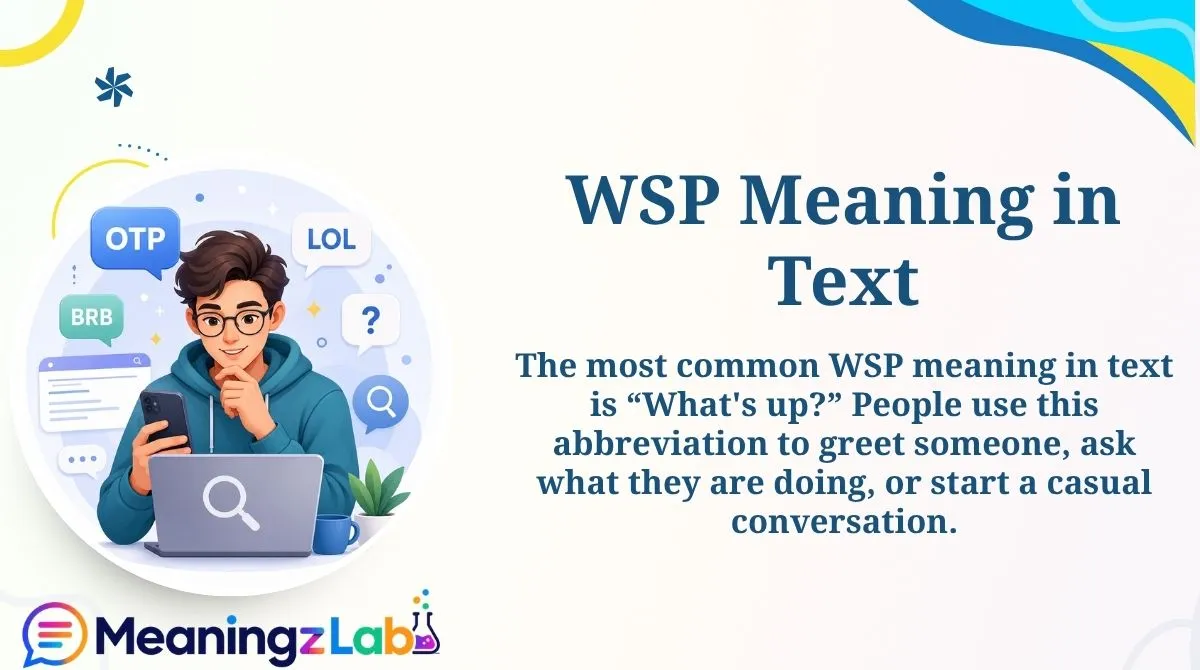
The most common WSP meaning in text is “What’s up?” People use this abbreviation to greet someone, ask what they are doing, or start a casual conversation.
Instead of typing the full question, they simply send “WSP” to a friend or someone they know.
You may see WSP in text messages, WhatsApp chats, Instagram DMs, Snapchat messages, TikTok comments, and other online conversations.
For example, if someone texts “Hey, wsp?”, they are usually asking how you are or what you are doing.
WSP is informal and friendly in most situations. However, its exact meaning can depend on the conversation and the relationship between the people.
This guide explains the full form of WSP, how people use it, what it means on different platforms, and how to reply naturally.
| Quick detail | Meaning |
|---|---|
| Abbreviation | WSP |
| Most common meaning | What’s up? |
| Full form | What’s up? |
| Typical tone | Casual, friendly, informal |
| Common usage | Greetings and starting conversations |
What Does WSP Mean in Text & Chat?
In text messages and online chats, WSP usually means “What’s up?” It is a shortened greeting that people use to start a conversation or ask what someone is doing.
The expression “What’s up?” can have several related meanings. Depending on the situation, it may mean “How are you?”, “What are you doing?”, or “What’s happening?”
For example, a friend might send “WSP bro” when they want to talk. They may not need a specific answer. They could simply be opening the conversation.
Here are the most common ways people use WSP:
- Greeting someone: Saying hello in a casual way.
- Asking what someone is doing: Finding out whether a friend is busy.
- Starting a conversation: Opening a chat without a specific question.
- Checking in: Asking how someone is doing.
- Showing interest: Inviting someone to share what is happening in their life.
The tone is usually relaxed and informal. It is common in conversations between friends, classmates, family members, and people who communicate casually online.
However, WSP does not always mean the sender wants a detailed update. Sometimes, they simply want to say hello.
Quick answer: If someone texts you “WSP?”, they most likely mean “What’s up?” You can reply with what you are doing, how you feel, or a simple greeting such as “Not much, you?”
Full Form, Stands For & Short Meaning of WSP
The most common full form of WSP in texting is “What’s up?” It is an informal abbreviation used in digital conversations.
Unlike some abbreviations that represent several words through their first letters, WSP is a shortened written form of a familiar greeting. People use it because it is quick to type and easy to recognize in casual chats.
Here is a simple breakdown of its meaning and related expressions.
| Expression | Meaning | Example |
|---|---|---|
| WSP | What’s up? | “WSP?” |
| WSP bro | What’s up, bro? | “Yo, wsp bro?” |
| WSP with you? | What’s up with you? | “Hey, wsp with you?” |
| WSP rn? | What’s up right now? | “Wsp rn?” |
| WSP 👀 | What’s up? or what’s happening? | “Wsp 👀” |
These variations can have slightly different intentions.
For example, “WSP rn?” is more focused on what someone is doing at the moment. In contrast, “WSP bro?” may simply be a friendly greeting.
WSP can also appear in lowercase as “wsp.” Both forms generally carry the same meaning. The choice between uppercase and lowercase often comes down to personal typing habits.
It is important to remember that abbreviations can have different meanings in specialized fields. In everyday texting, however, “What’s up?” is the most useful interpretation to consider first.
If you are unsure what someone means, read the surrounding message. In a casual greeting, WSP almost always functions as a conversation starter rather than a technical term.
Origin, History & First Known Use of WSP
WSP comes from the informal expression “What’s up?”, a familiar way to greet someone or ask what is happening. The abbreviation fits the wider habit of shortening everyday language in text messages and online conversations.
People often use short forms when typing on mobile phones, chatting quickly, or sending brief messages on social media. Other examples include “wyd” for “what are you doing?” and “hru” for “how are you?”
These expressions help people communicate with fewer characters. They also reflect the relaxed style of digital conversation.
However, the exact date when WSP first appeared as a texting abbreviation is not firmly established here. It would be misleading to name a specific person, platform, or year as its origin without reliable historical evidence.
Several factors help explain why WSP is useful in modern communication:
- Speed: It takes less time to type than the full greeting.
- Convenience: It works well in quick messages.
- Informal tone: It makes a conversation feel casual.
- Easy recognition: Many people can understand it from context.
- Conversation flow: It gives the other person an easy way to respond.
The expression “What’s up?” can be used in spoken conversations as well as written messages. WSP is the abbreviated form commonly associated with informal digital communication.
It is also worth separating the history of the expression from the history of the abbreviation. The greeting existed before modern texting, but the exact timeline of WSP’s adoption online should not be guessed.
The important point is that WSP serves a simple purpose: it helps people greet each other and begin a conversation quickly.
How People Use WSP in Daily Conversations
People use WSP in daily conversations to greet friends, check what someone is doing, or start chatting without a specific topic. It is especially useful when someone wants to talk but does not know what to say first.
The meaning often depends on the situation.
Greeting a friend
Person A: “Yo, wsp?”
Person B: “Not much, just chilling. You?”
Meaning: Person A is opening a casual conversation.
Asking about someone’s activities
Person A: “Wsp rn?”
Person B: “Just watching a movie.”
Meaning: The sender wants to know what the other person is doing right now.
Checking in with someone
Person A: “Hey, wsp? Haven’t talked to you in a while.”
Person B: “I’m good! How have you been?”
Meaning: WSP is being used as a friendly way to reconnect.
Starting a conversation with someone new
Person A: “Hey, wsp?”
Person B: “Hey! Nothing much, what’s up with you?”
Meaning: The sender is trying to start a conversation. Depending on the relationship, this may be friendly or an attempt to get to know someone.
Asking what happened
Person A: “Everyone seems upset. Wsp?”
Person B: “We had a misunderstanding earlier.”
Meaning: In this context, WSP asks what is happening rather than simply greeting someone.
WSP can also be used in a playful or affectionate way. For example, “Wsp bestie? 😊” sounds warm and friendly because of the nickname and emoji.
In contrast, “WSP??” might show surprise or urgency if something unexpected has happened. The punctuation does not change the basic meaning, but it can affect the tone.
Overall, WSP is a flexible expression. It can begin a chat, ask for an update, or invite someone to explain what is happening.
WSP Meaning Across WhatsApp, Instagram, TikTok & Snapchat
On WhatsApp, Instagram, TikTok, and Snapchat, WSP usually means “What’s up?” Its basic meaning generally stays the same across these platforms. The main difference is the type of conversation in which people use it.
WSP on WhatsApp
People may use WSP in private chats or group conversations to greet friends and ask what they are doing.
Example:
Person A: “Wsp? Are you free today?”
Person B: “Yeah, what’s the plan?”
Here, WSP starts the conversation before the sender asks about availability.
WSP on Instagram
On Instagram, WSP may appear in direct messages when someone wants to start chatting or get to know another person.
Example:
Person A: “Hey, wsp?”
Person B: “Nothing much, just scrolling.”
The message is a casual opener. It does not automatically mean the sender is flirting.
WSP on TikTok
People may use WSP in comments or direct messages to ask what is happening or begin a conversation.
Example:
Person A: “Wsp with this trend? 😂”
Person B: “Everyone’s trying it today!”
Here, the phrase asks about what is happening around a trend.
WSP on Snapchat
WSP is useful in quick chats when friends want to check in or see whether someone is available.
Example:
Person A: “Wsp rn?”
Person B: “Just got home.”
The sender is asking what the other person is doing at the moment.
The table below summarizes the differences.
| Platform | Common use | Typical tone |
|---|---|---|
| Greeting friends and checking in | Casual | |
| Starting a DM | Friendly or conversational | |
| TikTok | Asking about a trend or starting a chat | Casual, context-dependent |
| Snapchat | Quick greetings and activity checks | Informal |
The abbreviation itself does not have a separate meaning on each platform. Context determines whether it is a greeting, a question about someone’s activities, or a request for an update.
Different Meanings of WSP in Other Fields
Although WSP most commonly means “What’s up?” in casual texting, the same letters can stand for different things in professional, technical, or specialized settings.
The correct meaning depends on the subject being discussed. A message from a friend is different from a technical report or a workplace document.
For example, WSP can refer to the following in other contexts:
| Context | Possible meaning |
|---|---|
| Casual texting | What’s up? |
| Business and engineering | Water and Sanitation Program, in relevant organizational contexts |
| Construction and engineering | Welding procedure specification |
| Technical writing | A field-specific abbreviation defined by the document |
These alternatives are not interchangeable with the texting meaning. They are relevant only when the surrounding subject supports that interpretation.
For example, if someone writes “WSP bro, you free?”, the abbreviation is almost certainly a greeting. If an engineering document discusses welding procedures, WPS is a common abbreviation for “Welding Procedure Specification”; do not automatically replace WPS with WSP, since the letter order matters.
This distinction is important because not every combination of three letters has one universal meaning. A specialized abbreviation may be meaningful only within a particular industry, organization, or document.
When interpreting WSP, ask yourself three questions:
- Is this a casual conversation or a professional document?
- What topic is being discussed?
- Does the surrounding sentence support the usual texting meaning?
If the message comes from a friend, “What’s up?” is usually the best starting point. If WSP appears in a technical document, check the document’s definitions or ask the writer what it stands for.
Common Confusions, Mistakes & Wrong Interpretations
One common mistake is assuming that WSP always asks what someone is doing. In reality, it can also be a greeting, a general check-in, or a question about what is happening.
The exact meaning depends on the words around it.
Confusing WSP with WYD
WSP and WYD are related, but they are not exactly the same.
- WSP: What’s up? It can be a greeting or a general question.
- WYD: What are you doing? It focuses more directly on someone’s current activity.
For example, “WSP?” may simply mean hello, while “WYD rn?” more clearly asks what the person is doing right now.
Assuming WSP always means flirting
Someone sending WSP does not automatically mean they are romantically interested in you. Friends, classmates, relatives, and acquaintances can all use it.
The message may be an attempt to start a conversation, but additional context is needed before deciding whether it is flirtatious.
Thinking a short message is rude
A message such as “wsp” may look brief, but it is often just a casual greeting. Some people naturally send short messages.
However, repeated question marks or a tense conversation may make the message feel more urgent or confrontational.
Misreading the punctuation
Compare these examples:
| Message | Possible interpretation |
|---|---|
| “Wsp 😊” | Friendly greeting |
| “WSP??” | Surprise or urgency |
| “Wsp lol” | Casual or playful |
| “Wsp with you?” | Asking for an update |
These are possible interpretations, not fixed rules. The sender’s normal communication style matters.
Ignoring the context
If someone asks “WSP?” after hearing unexpected news, they may be asking what happened. If they send it at the beginning of a conversation, they are probably just greeting you.
Best tip: Start with the common meaning, then consider the conversation. Do not assume that WSP signals anger, flirting, or a specific emotion without further clues.
Similar Terms, Alternatives & Related Slang
Several texting abbreviations have meanings similar to WSP. They can help people greet someone, ask about their activities, or check how they are doing.
However, each expression has a slightly different purpose.
| Term | Full form | Main purpose |
|---|---|---|
| WSP | What’s up? | Greeting or general check-in |
| WYD | What are you doing? | Asking about current activity |
| HRU | How are you? | Asking about someone’s well-being |
| SUP | What’s up? | Casual greeting |
| HYD | How are you doing? | Checking how someone feels |
| WYA | Where you at? | Asking someone’s location |
| HBU | How about you? | Asking for the other person’s answer |
| GM | Good morning | Greeting someone in the morning |
WSP vs. WYD
WSP is broader than WYD. It can simply mean hello, while WYD more directly asks about the other person’s activity.
Example:
Person A: “WSP?”
Person B: “Not much, just relaxing.”
The reply works because WSP does not require a specific answer.
WSP vs. HRU
HRU focuses on how someone is feeling or doing. WSP may ask the same thing, but it can also be a general conversation starter.
If you want to check on a friend who has had a difficult day, HRU may sound more direct and caring.
WSP vs. WYA
WYA asks where someone is. WSP does not usually ask for a location.
For example, “WSP?” might start a chat, while “WYA? We’re waiting outside” asks for a specific piece of information.
WSP vs. SUP
SUP is another informal way to write “What’s up?” The two expressions have very similar meanings and can often be used in the same casual situations.
The best choice depends on your personal style and the person you are messaging. If you are talking to someone in a formal setting, a complete greeting such as “Hi, how are you?” is usually more appropriate.
Examples of WSP in Real Chat Situations
The following examples show how WSP works in different conversations. Each one uses the abbreviation naturally and demonstrates how the surrounding words affect the tone.
1. A casual greeting
Person A: “Hey, wsp?”
Person B: “Not much, just relaxing. You?”
Meaning: The sender is starting a friendly conversation.
2. Asking about current activities
Person A: “Wsp rn?”
Person B: “I’m doing my homework.”
Meaning: The sender wants to know what the other person is doing right now.
3. Checking in with a friend
Person A: “Wsp bro? You been quiet lately.”
Person B: “Just been busy with school.”
Meaning: The sender is checking in and inviting the friend to share an update.
4. A playful message
Person A: “Wsp bestie 😂”
Person B: “Nothing, waiting for you to text me!”
Meaning: The nickname and laughing emoji make the greeting playful.
5. A potentially flirtatious conversation
Person A: “Heyy, wsp? 😊”
Person B: “Nothing much. What about you?”
Meaning: The sender may be trying to start a friendly or flirtatious conversation. The message alone does not prove romantic interest.
6. Asking about unexpected news
Person A: “I heard you left the party early. WSP?”
Person B: “I wasn’t feeling well, so I went home.”
Meaning: Here, WSP asks what happened rather than serving only as a greeting.
7. Checking someone’s availability
Person A: “Wsp? Wanna play a game?”
Person B: “Sure, give me ten minutes.”
Meaning: The sender starts casually and then invites the other person to do something.
8. A brief reply with unclear tone
Person A: “WSP?? You disappeared!”
Person B: “Sorry, my phone died.”
Meaning: The repeated question marks suggest surprise or urgency. They do not necessarily mean the sender is angry.
These examples show that WSP can be friendly, playful, curious, or urgent. Emojis, punctuation, and the conversation’s subject can influence how the message feels.
How to Reply When Someone Says WSP
When someone texts WSP, the easiest response is to answer naturally. You can tell them what you are doing, ask the same question back, or explain what is happening.
You do not need to use another abbreviation if you prefer writing complete words.
| Situation | Suggested reply |
|---|---|
| Casual greeting | “Not much, you?” |
| Busy at the moment | “Just finishing some work.” |
| Feeling good | “I’m good! What’s up with you?” |
| Want to make plans | “Nothing much. Wanna hang out?” |
| Playful conversation | “Waiting for you to say something interesting 😂” |
| Need clarification | “Do you mean what am I doing?” |
| Someone seems concerned | “I’m okay. Is everything alright?” |
If a friend sends WSP
A simple response is usually enough.
Person A: “Wsp bro?”
Person B: “Just chilling, what’s up?”
This answers the greeting and gives the other person a chance to continue.
If someone sends WSP playfully
You can match their energy.
Person A: “Wsp 😂”
Person B: “Nothing much, causing trouble as usual 😭”
This response works when both people are comfortable joking with each other.
If someone sends WSP during a serious situation
Try to understand why they are asking.
Person A: “Hey, wsp? I heard you had a rough day.”
Person B: “Yeah, it’s been a lot. Thanks for checking in.”
This answer recognizes the other person’s concern.
If the message seems rude or urgent
Do not assume the worst. Ask what they mean or what they need.
For example, you could reply, “Is everything okay? You sound worried.”
The best response depends on your relationship and the situation. Most of the time, “Not much, you?” is a perfectly natural reply to WSP.
Is WSP Still Popular? Trends & Online Usage
WSP remains a recognizable abbreviation for “What’s up?” in informal digital communication. However, its exact popularity in 2026 cannot be confirmed here with reliable usage statistics, so it would be inaccurate to claim that it is the leading greeting or that its use is increasing.
People choose abbreviations based on their habits, friends, and preferred messaging style. Some people write WSP, while others prefer SUP, WYD, or the complete phrase “What’s up?”
The abbreviation continues to make practical sense in casual conversations because it is short and easy to understand.
Here are a few reasons someone might choose WSP:
- Quick communication: It takes little time to type.
- Casual greetings: It works well when messaging friends.
- Flexible meaning: It can ask how someone is or what is happening.
- Easy replies: The recipient can answer in many different ways.
- Informal style: It fits everyday online conversations.
WSP is generally better suited to personal messages than formal writing. In professional communication, a greeting such as “Hi, how are you?” or a direct question is often clearer.
For example, “WSP, are you free?” may work well in a chat with a friend. In a workplace email, “Hello, are you available for a short meeting?” sounds more appropriate.
Ultimately, you do not need to know whether WSP is trending to understand it. Knowing its meaning, tone, and common uses is enough to recognize it in everyday conversations.
Frequently Asked Questions
What does WSP mean in text messages?
WSP usually means “What’s up?” It is a casual greeting that people use to start conversations, ask what someone is doing, or check in with a friend.
What does WSP mean from a girl or a guy?
The abbreviation generally means the same thing regardless of who sends it. It usually means “What’s up?” The sender may want to chat, but the message alone does not prove romantic interest.
What does WSP mean on WhatsApp?
On WhatsApp, WSP is commonly used to greet someone or ask what they are doing. It is an informal expression used in private messages and group chats.
What does WSP mean on Snapchat?
On Snapchat, WSP usually means “What’s up?” People may use it to start a quick conversation, check in with friends, or ask what someone is doing.
Is WSP the same as WYD?
No. WSP means “What’s up?” and can be a general greeting. WYD means “What are you doing?” and focuses more directly on someone’s current activity.
How should I reply to WSP?
You can reply with “Not much, you?”, “Just chilling,” or “I’m good, what’s up?” Choose a response that fits the conversation and your relationship with the sender.
Does WSP mean someone likes you?
Not necessarily. Someone may send WSP because they want to talk, but it is also a common greeting between friends and acquaintances. Look at the wider conversation before interpreting it as flirting.
Can WSP sound rude?
WSP is not inherently rude. It is usually casual and neutral. However, punctuation, the surrounding conversation, and the sender’s communication style can make it sound impatient or urgent.
What does WSP mean with a question mark?
“WSP?” usually means “What’s up?” The question mark simply presents it as a question. Repeated question marks may suggest surprise or urgency, depending on the situation.
What is the difference between WSP and SUP?
Both usually mean “What’s up?” and work as casual greetings. They can often be used interchangeably in informal messages.
Conclusion
The most common WSP meaning in text is “What’s up?” It is a short, informal expression people use to greet friends, ask what someone is doing, or start a conversation. You may see it in WhatsApp messages, Instagram DMs, Snapchat chats, TikTok comments, and other online conversations.
WSP usually has a friendly or neutral tone, but its exact meaning depends on the situation. It can be a simple hello, a question about someone’s activities, or a request to explain what is happening. Emojis, punctuation, and the relationship between the people can also affect how the message feels.
If someone sends you WSP, a natural response is “Not much, you?” You can also share what you are doing or ask why they messaged you. Understanding this abbreviation makes casual online conversations easier and helps you recognize related texting terms.

Evan Rellmont is a content writer and researcher who specializes in internet slang, text abbreviations, and social media language. He creates clear, helpful content to make modern online communication easier to understand.