DM meaning on social media is most commonly “Direct Message.” It refers to a private message sent to another person through a social media platform or messaging service.
Unlike a public comment or post, a DM is usually meant for a private conversation between individuals or within a private group.
You may see “DM me,” “Send me a DM,” or “Check your DMs” on Instagram, TikTok, Snapchat, X, Facebook, and other platforms.
People use DM when they want to continue a conversation privately, share information, ask a question, make an offer, or simply chat away from a public feed.
In this guide, you will learn what DM means in text and chat, its full form, how people use it, whether its meaning changes across platforms, common misunderstandings, realistic examples, and natural ways to reply.
| Term | Most Common Meaning | Full Form | Typical Tone | Common Usage |
|---|---|---|---|---|
| DM | Direct Message | Direct Message | Neutral, friendly, or professional | Private online conversations |
Quick answer:
When someone says “DM me,” they normally mean “Send me a private message.”
What Does DM Mean in Text & Chat?
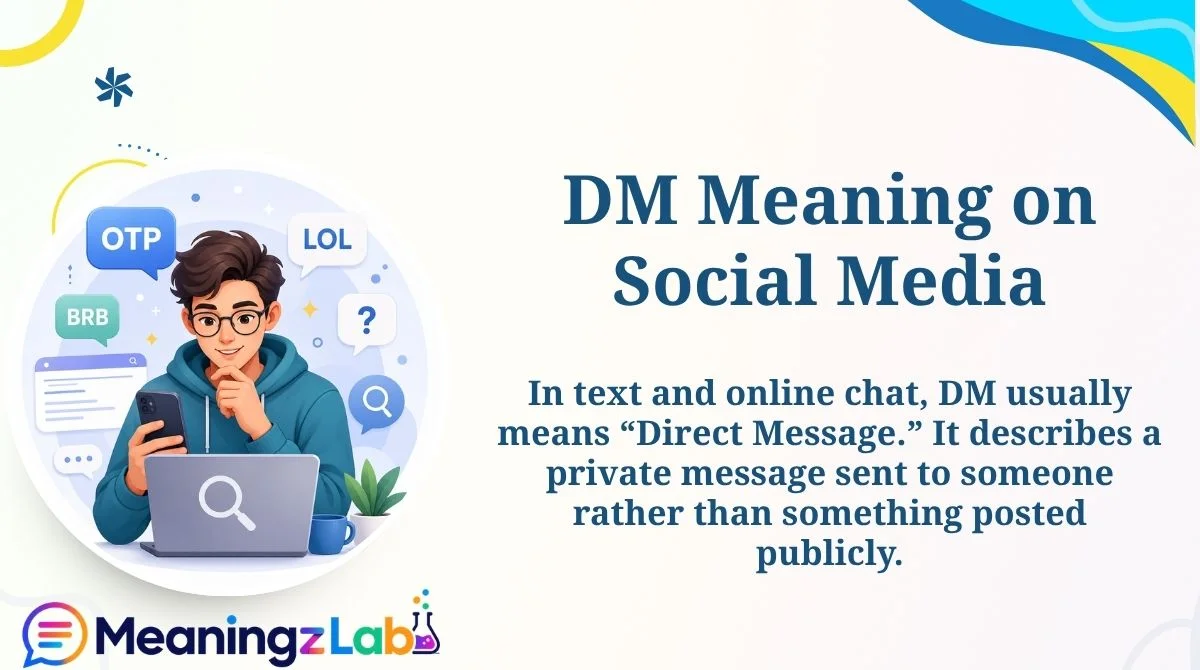
In text and online chat, DM usually means “Direct Message.” It describes a private message sent to someone rather than something posted publicly.
For example, if someone comments, “DM me the details,” they are asking you to contact them privately. They may not want personal information, prices, contact details, or other conversation content visible to everyone.
The word can work as both a noun and a verb.
- Noun: “I got a DM from Sarah.”
- Verb: “DM me when you get home.”
- Plural: “I have several DMs to answer.”
- Common phrase: “Check your DMs.”
The basic meaning stays the same, but the tone depends on the situation. A friend might use it casually, while a business might use it to invite a customer into a private conversation.
What Does “DM Me” Mean?
“DM me” means “send me a direct message.”
It is common when someone wants to move a public conversation into a private space.
For example:
“That sounds interesting. DM me the address.”
Here, the person is simply asking for the address privately.
Does DM Always Mean Private?
Usually, yes. However, the exact privacy features depend on the platform. Some services have message requests, group messages, filtered inboxes, or other controls.
So, the safest interpretation is that a DM is a direct or private online message, rather than a public reply.
Full Form, Stands For & Short Meaning of DM
The full form of DM is Direct Message.
In simple English, it means a private message sent directly to another user. The abbreviation became useful because typing “direct message” repeatedly is slower than using two letters.
Here are the most common expressions:
| Expression | Meaning |
|---|---|
| DM me | Send me a private message |
| Send me a DM | Contact me privately |
| Check your DMs | Look at your private messages |
| I sent you a DM | I sent you a private message |
| Slide into my DMs | Contact me privately, often casually or flirtatiously |
| Reply to my DM | Respond to my private message |
| DMs are open | People can send private messages |
The tone can range from completely neutral to playful. For example, a company saying “DM us for support” sounds professional. A friend saying “DM me 😂” is much more casual.
The phrase “slide into my DMs” has a more social or playful flavor. It can describe someone initiating a private conversation, sometimes with romantic or flirtatious intent. Still, the phrase does not automatically mean flirting; context matters.
It is also worth remembering that DM does not always refer to social media alone. Some online communities and digital services use similar language for private messaging.
For most social-media searches, though, Direct Message is by far the intended meaning.
Origin, History & First Known Use of DM
The idea behind a DM is older than the abbreviation itself. Online communication has long included ways for users to contact one another privately rather than posting messages for everyone to see.
As internet communities, social networks, and messaging systems developed, platforms needed simple ways to describe private communication. “Direct message” became a natural phrase for this type of communication, and DM became its convenient short form.
It is difficult to assign one universally accepted person, platform, or exact date as the single origin of the abbreviation. Different online services have developed private-message systems at different times, so claims that one particular website definitively invented “DM” should be treated carefully.
The meaning became especially familiar as social networking grew. Platforms such as Twitter, Instagram, Facebook, and later services made private messaging a normal part of online interaction.
Today, people often use DM as both a noun and a verb. That flexibility helped the term fit naturally into everyday internet language.
For example:
- “I received a DM.”
- “I’ll DM you.”
- “Did you see my DM?”
- “DM us for more information.”
The important point is not a specific historical date. It is how the term evolved into a common shorthand for private online communication.
How People Use DM in Daily Conversations
People use DM whenever they want to refer to a private online conversation quickly. It is especially common when a public post, comment, or video leads to a conversation that should continue privately.
A creator might say, “DM me your questions.” A friend may write, “I found the tickets. I’ll DM you the details.” A customer may send a business a DM instead of leaving personal information in a public comment.
The context determines why the conversation is private.
Common Reasons People Use DMs
People commonly send DMs to:
- Ask personal questions
- Share contact or location details
- Discuss prices or purchases
- Continue a conversation privately
- Send links or files
- Contact a creator or business
- Make plans with friends
- Ask about collaborations
- Respond to someone they do not know personally
- Discuss something they do not want to post publicly
The tone is usually neutral. However, the relationship between the people can make the interaction friendly, professional, romantic, playful, or uncomfortable.
For example, “DM me the recipe” is casual and harmless. “Please DM your order number” sounds more professional.
The phrase “check your DMs” can also create urgency. A friend might say it because they have sent something important. A creator might say it after responding to a follower.
In short, DM describes the communication method, not the emotional tone. The surrounding words tell you how the message should be understood.
DM Meaning Across WhatsApp, Instagram, TikTok & Snapchat
The basic idea behind DM meaning on social media remains consistent across major platforms: it refers to a private or direct message.
The exact feature name and privacy settings can differ, but users generally understand DM as a way to communicate privately.
| Platform | How DM Is Commonly Understood | Typical Uses |
|---|---|---|
| Direct/private message | Friends, creators, businesses, shared posts | |
| TikTok | Private/direct message | Friends, creators, videos, casual chats |
| Snapchat | Private chat/message | Friends and personal conversations |
| X | Direct Message | Private conversations and networking |
| Private message | Friends, pages, groups, businesses | |
| Private chat, though “DM” is less central | Personal and group messaging |
On Instagram, DM is extremely common. Someone may say, “DM me the link,” “Check your DMs,” or “Send me a DM.”
TikTok
TikTok users may use DM when they want to move a conversation away from public comments or contact someone privately.
Snapchat
People often refer to private chats simply as chats or messages, but “DM” can still be understood as a general term for direct messaging.
On WhatsApp, users are more likely to say “message me” or “text me” than “DM me.” Still, the phrase can be understood because DM is a broader internet term for private communication.
So, the meaning normally does not change by platform. What changes is the platform’s messaging system and the vocabulary users prefer.
Different Meanings of DM in Other Fields
Although Direct Message is the dominant meaning in social media and online conversations, DM can represent other things in different fields.
This is where context becomes important.
In medicine, business, education, gaming, science, and other technical areas, the same two letters may have completely different meanings. For example, in a medical context, DM can refer to diabetes mellitus. In music, it can refer to a D minor chord or key, depending on how it is written and discussed.
These meanings should not be confused with social-media usage.
| Context | Possible Meaning of DM |
|---|---|
| Social media | Direct Message |
| Online communication | Direct Message |
| Medicine | Diabetes mellitus |
| Music | D minor |
| Business/technical contexts | Meaning depends on the field |
The surrounding words usually make the intended meaning clear.
For example:
“DM me on Instagram.”
Here, DM obviously means Direct Message.
But:
“The patient has a history of DM.”
In a medical context, the abbreviation may mean diabetes mellitus.
This is why an abbreviation should never be interpreted in isolation. If you see DM in a social-media comment, caption, text, or chat, Direct Message is normally the appropriate interpretation. In a professional or specialist document, check the surrounding terminology before assuming its meaning.
Common Confusions, Mistakes & Wrong Interpretations
One common mistake is assuming that DM always has a romantic or flirtatious meaning. It does not.
A DM is simply a private message. Friends, customers, coworkers, creators, businesses, and strangers can all communicate through DMs.
Another misunderstanding comes from phrases such as “slide into my DMs.” This expression can sound flirtatious, but its exact meaning depends on the situation. Someone can use it jokingly, socially, or romantically.
Common DM Mistakes
Mistake 1: Assuming DM means flirting
“DM me” does not automatically suggest romantic interest. It usually means nothing more than “message me privately.”
Mistake 2: Thinking every DM is completely private
The word indicates direct communication, but privacy features vary between services. Message requests, screenshots, forwarding, and other features can affect how private a conversation really is.
Mistake 3: Confusing DM with a public comment
A comment is normally visible within the relevant public or semi-public conversation. A DM is intended for direct communication.
Mistake 4: Assuming the tone from the abbreviation alone
DM itself is neutral. Words, emojis, punctuation, and the relationship between the people determine whether the message feels friendly, serious, playful, or rude.
Mistake 5: Assuming DM has only one meaning everywhere
In social media, Direct Message is the standard interpretation. In specialist contexts, however, DM can mean something else.
The best approach is simple: look at the platform, surrounding words, and conversation context before interpreting the abbreviation.
Similar Terms, Alternatives & Related Slang
Several terms can refer to the same general idea as DM, although they are not always perfect substitutes.
| Term | Basic Meaning | Typical Context |
|---|---|---|
| PM | Private Message | Forums, communities, older online terminology |
| Message | A sent communication | General |
| Private message | A message not intended as a public post | General online use |
| Inbox message | A message received in an inbox | Social platforms |
| Chat | A conversation through messaging | Casual communication |
| Text | A message, often through phone messaging | Personal communication |
| Slide into my DMs | Contact me privately | Informal/social |
PM, or Private Message, is probably the closest related term. In some online communities, PM has traditionally been used for private communication.
The terms message and chat are broader. They do not necessarily tell you whether the communication is public or private.
For example:
“Message me.”
This often means the same practical thing as “DM me,” but the exact method may depend on the platform.
“Slide into my DMs” is different because it carries more personality. It is informal slang and can suggest confidence, social interest, or flirting.
Knowing these related expressions can help you understand social-media conversations without assuming that every private message has the same emotional meaning.
Examples of DM in Real Chat Situations
Seeing DM in realistic conversations makes its meaning easier to understand. The same abbreviation can appear in friendly, professional, playful, or serious situations.
Example 1: Sharing Information
Person A: “Can you send me the address for the event?”
Person B: “Sure, I’ll DM you the location in a minute. 😊”
Meaning: Person B will send the information privately rather than posting it publicly.
Example 2: Casual Conversation
Person A: “I found the movie you were looking for!”
Person B: “No way 😂 DM me the name!”
Meaning: The second person wants the movie title sent privately. The laughing emoji makes the request feel playful.
Example 3: Business Inquiry
Person A: “How much is the custom order?”
Person B: “Please DM us with the details, and we’ll send you the price.”
Meaning: The business wants to discuss the order privately.
Example 4: Creator and Follower
Person A: “Do you have a link to that jacket?”
Person B: “Yes! I’ll DM you the link.”
Meaning: The person will send the requested link through a private message.
Example 5: Playful Use
Person A: “I have some gossip, but I can’t say it here.”
Person B: “Okay, DM me 👀”
Meaning: The person wants to hear the information privately. The eyes emoji adds curiosity and a playful tone.
Example 6: Potentially Rude Situation
Person A: “Why didn’t you answer my question?”
Person B: “Stop commenting about it and DM me.”
Meaning: The person wants the conversation moved to private messages, but the wording may sound impatient or rude.
Notice that DM itself remains neutral in all these examples. The surrounding language creates the emotional tone.
How to Reply When Someone Says DM
How you should reply to DM depends on what the person is asking and your relationship with them.
If someone says “DM me,” you can simply send a private message. If you are unsure why they want to speak privately, it is also reasonable to ask.
If You Want to Continue the Conversation
You can reply:
- “Sure, I’ll DM you.”
- “Okay, sending you a message now.”
- “Sure! Check your inbox.”
- “Got it. I’ll message you privately.”
If You Are Confused
Try:
- “Sure, what did you want to discuss?”
- “Do you mean you want me to message you privately?”
- “Okay, should I send you the details?”
If the Situation Is Playful
You might say:
- “Haha, okay 😂”
- “On my way to the DMs 👀”
- “Sure, sending it now!”
If You Do Not Want to Continue Privately
You do not have to move a conversation into DMs simply because someone asks. A polite response could be:
- “I’d rather keep the conversation here, if that’s okay.”
- “I’m not comfortable discussing that privately.”
- “You can ask me here.”
The key point is that a DM request does not require a particular emotional response. Choose your reply based on the context and your comfort level.
Is DM Still Popular? Trends & Online Usage
DM remains a widely understood term in online communication in 2026. It is short, easy to type, and useful across many social platforms.
However, the way people use the word can vary by platform and age group. Some users may say “message me,” “text me,” “inbox me,” or simply “chat me” instead.
This does not make DM outdated. Instead, it shows how online language adapts to different platforms and communities.
The abbreviation is particularly useful because it describes an action and a communication channel in just two letters:
“DM me.”
That can replace a longer sentence such as:
“Please send me a private message through this platform.”
People also use related phrases such as “my DMs are open” to signal that they welcome private messages. Creators, businesses, and public accounts may use the phrase when they want followers or customers to contact them.
At the same time, context still matters. A DM from a friend, a customer-service account, a potential client, or a stranger can have very different purposes.
So, while online slang changes quickly, the basic meaning of DM as Direct Message remains clear and useful. It is best understood as a general term for contacting someone privately online rather than as slang with one specific emotional meaning.
Frequently Asked Questions
What does DM mean on social media?
DM means Direct Message. It usually refers to a private message sent directly to another person or account rather than a public comment or post.
What does “DM me” mean?
“DM me” means “send me a direct or private message.” The person is asking you to continue the conversation through private messaging.
Is DM the same as a private message?
In most social-media contexts, yes. DM is short for Direct Message and is commonly used to describe private communication between users.
Does DM mean flirting?
Not necessarily. A DM is simply a private message. It can be friendly, professional, casual, serious, or flirtatious depending on the conversation and relationship.
What does “slide into my DMs” mean?
“Slide into my DMs” is informal slang for contacting someone privately. It can be playful or flirtatious, but the exact meaning depends on the context.
Does DM mean the same thing on Instagram and TikTok?
Generally, yes. On both platforms, DM refers to direct or private messaging. The specific messaging features and terminology can vary by platform.
What is the difference between DM and PM?
Both can refer to private online communication. DM means Direct Message, while PM commonly means Private Message. The preferred term depends on the platform or community.
How should I reply when someone says “DM me”?
If you want to continue privately, you can say, “Sure, I’ll DM you.” If you are unsure why, ask what they want to discuss before sending a message.
Can DM have another meaning?
Yes. In specialized contexts, DM can mean other things. For example, it can refer to diabetes mellitus in medicine. On social media and in ordinary online chats, however, Direct Message is the usual meaning.
Is DM still commonly used in 2026?
Yes. DM remains a familiar term for private online messaging, although some people prefer simpler expressions such as “message me” or “text me.”
Conclusion
The most common DM meaning on social media is Direct Message. It refers to a private message sent directly to another person or account instead of communicating through a public post or comment.
You may see DM used in phrases such as “DM me,” “send me a DM,” “check your DMs,” and “my DMs are open.” The abbreviation itself is usually neutral, but the conversation around it can make the tone friendly, professional, playful, serious, sarcastic, or flirtatious.
The meaning generally stays the same across platforms such as Instagram, TikTok, Snapchat, X, and Facebook, although users may use different terms for private messaging.
When you see DM, look at the platform, surrounding words, emojis, punctuation, and relationship between the people. That context will usually tell you exactly what the sender means.
If you enjoy learning internet slang, explore more common abbreviations and text-message meanings to make online conversations easier to understand.

Evan Rellmont is a content writer and researcher who specializes in internet slang, text abbreviations, and social media language. He creates clear, helpful content to make modern online communication easier to understand.