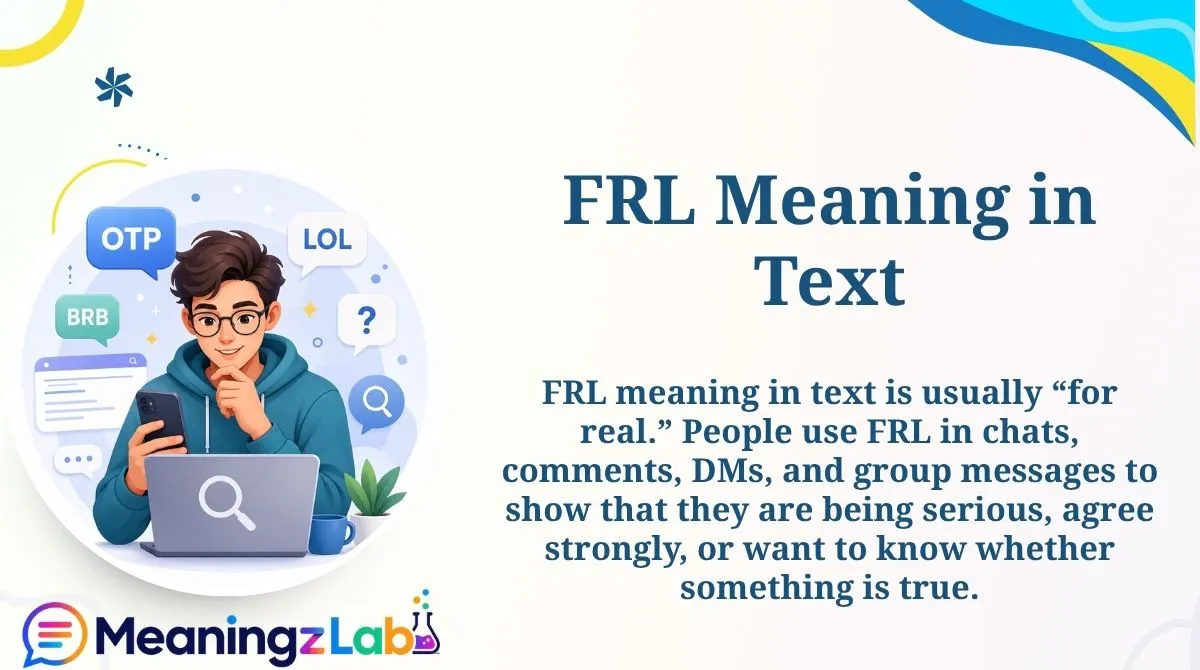
FRL meaning in text is usually “for real.” People use FRL in chats, comments, DMs, and group messages to show that they are being serious, agree strongly, or want to know whether something is true.
When written as “FRL?”, it often means “For real?”, “Seriously?”, or “Are you serious?”
You may see FRL on platforms such as WhatsApp, Instagram, TikTok, Snapchat, Discord, and ordinary text messages.
Its meaning normally stays the same, but punctuation and context can change its tone.
This guide explains the full meaning of FRL, its uses in everyday conversations, its history, platform context, related slang, realistic examples, and natural ways to reply.
| Term | Most Common Meaning | Full Form | Typical Tone | Common Usage |
|---|---|---|---|---|
| FRL | For real | For Real | Casual, sincere, surprised, emphatic | Texts, chats, comments, DMs |
Quick answer: FRL = “For Real.” In a statement, it usually emphasizes sincerity or agreement. In a question, “FRL?” usually asks for confirmation or expresses surprise.
What Does FRL Mean in Text & Chat?
In text messages and online chats, FRL usually means “for real.” It is an informal shortened form of the phrase and is used when someone wants to sound sincere, emphasize a point, agree with another person, or react to surprising information.
The easiest way to understand FRL is to look at how it appears in the sentence.
When someone writes:
“That restaurant is amazing frl.”
They are saying something like:
“That restaurant is amazing, for real.”
Here, FRL adds emphasis. The person is making it clear that the statement is genuine.
FRL can also appear alone:
“FRL?”
In this form, it normally becomes a question. The sender may be asking whether something is actually true or reacting because they cannot believe what they have just heard.
For example:
Friend: “I got tickets to the concert.”
You: “FRL?”
That response means “For real?” or “Seriously?”
FRL can also show agreement:
Friend: “This week has been exhausting.”
You: “FRL.”
In that context, it means “For real. I totally agree.”
So, while the basic meaning stays the same, the function changes with the sentence. FRL may work as an emphasis marker, agreement, confirmation request, or surprised reaction.
The surrounding conversation matters. A friendly “FRL 😭” may show strong agreement or amusement, while “FRL??” after an unbelievable claim may sound shocked or doubtful.
Full Form, Stands For & Short Meaning of FRL
The full form of FRL in casual texting is “For Real.” It is commonly treated as an online abbreviation or initialism built from the words in the phrase.
Its short meanings can include:
| FRL in a Message | Likely Meaning |
|---|---|
| “FRL.” | For real / I agree |
| “FRL?” | For real? / Are you serious? |
| “FRL!” | For real! / Seriously! |
| “That was wild frl.” | That was genuinely wild |
| “FRL, same.” | I seriously agree / Same |
The phrase “for real” itself can carry slightly different meanings depending on the sentence.
As a statement, it can mean:
“I am serious.”
“I genuinely mean this.”
“This is true.”
As a question, it can mean:
“Is that really true?”
“Are you serious?”
“Really?”
That difference is important because the exact same three letters can serve two different conversational roles.
For example, “FRL, you did great” is a statement of sincerity. The sender is reinforcing the compliment.
By contrast, “FRL? You won?” is a reaction. The sender is asking for confirmation because the news sounds surprising.
FRL is closely related to other expressions such as FR and FRFR, which are also connected to the idea of being genuine or serious. However, people do not always use these forms in exactly the same way.
One useful rule is simple: read FRL as “for real” first, then use the surrounding words and punctuation to understand the intended tone.
Origin, History & First Known Use of FRL
The meaning of FRL is easier to explain than its exact history.
The underlying phrase “for real” is an ordinary English expression used to question whether something is genuine or to emphasize that a person is being serious. The digital form FRL is a shortened version that fits the wider pattern of using compact forms in texting and online communication.
However, there is no reliably established single date for the first use of FRL as internet shorthand that can be stated with confidence. Current slang references describe FRL as a shortened form of “for real,” but they do not provide a dependable, authoritative record showing one specific person or one exact moment when the abbreviation began.
That distinction matters. It is easy for online articles to attach a precise origin story to slang, but an exact first-use claim needs strong historical evidence.
What can be said more safely is that FRL belongs to a broader style of digital shorthand. Online conversations often compress familiar phrases so people can type and respond quickly. FRL works especially well because the original phrase is already widely understood.
You may also encounter related forms such as FR, FRFR, and occasionally other shortened spellings. These variations all revolve around the same general idea of sincerity, agreement, or confirmation.
So, the practical history is straightforward: “for real” is the source phrase, while FRL is its compact texting form. The exact birth date of the abbreviation is not firmly documented.
How People Use FRL in Daily Conversations
People use FRL in everyday conversations mainly to make their words sound more genuine or to react strongly to something someone else said.
One common use is agreement.
Person A: “That class felt endless.”
Person B: “FRL 😭”
Here, Person B is not asking a question. They are agreeing and adding emotional emphasis.
Another use is sincerity.
“I was nervous before the interview frl.”
The sender means they were genuinely nervous.
FRL can also show surprise.
Person A: “She moved to another city.”
Person B: “FRL?”
The question mark makes the abbreviation function like “Really?”
Tone can shift depending on punctuation:
| Form | Possible Tone |
|---|---|
| frl | Relaxed, casual |
| FRL | Stronger emphasis or neutral shorthand |
| FRL? | Surprise, doubt, request for confirmation |
| FRL! | Excitement or strong agreement |
| FRL 😭 | Amused agreement, disbelief, or emotional reaction |
| FRL 🙄 | Agreement mixed with annoyance or sarcasm |
The relationship between the speakers matters too.
Between close friends, FRL may sound warm and playful. In a disagreement, “FRL?” can sound challenging even though the words themselves are not rude.
It is also possible to use FRL affectionately:
“You really stayed up to help me frl ❤️”
Here, the abbreviation emphasizes genuine appreciation.
In most situations, FRL is best understood as a tone marker rather than a completely new idea. It strengthens the message that comes before or after it.
FRL Meaning Across WhatsApp, Instagram, TikTok & Snapchat
On WhatsApp, Instagram, TikTok, Snapchat, and other casual messaging platforms, FRL generally keeps the same core meaning: “for real.” The platform itself usually does not create a separate definition.
What changes is the way people use it.
On WhatsApp, FRL is likely to appear in private chats and group conversations.
“FRL, I need a vacation.”
Here, it means “For real, I need a vacation.”
On Instagram, FRL may appear in comments or DMs.
“This outfit is perfect frl.”
The sender is emphasizing genuine approval.
TikTok
On TikTok, FRL can work as a quick reaction to a video or comment.
“FRL 😭”
Depending on the video, this might mean “Seriously, this is so true” or “Seriously, I cannot believe this.”
Snapchat
Snapchat messages often rely heavily on short, casual replies.
“FRL?” may simply mean “Are you serious?”
The important point is that FRL usually does not become a different slang term when it moves from WhatsApp to Instagram or TikTok. Context determines its role more than the app does.
A helpful reading strategy is to look at three things:
What came before FRL?
Is there a question mark or exclamation point?
What relationship do the speakers have?
These clues can tell you whether FRL is expressing agreement, surprise, disbelief, excitement, sarcasm, or simple sincerity.
Different Meanings of FRL in Other Fields
When you leave casual texting, FRL can have completely different meanings.
This is why context is essential.
For example, in pneumatic and industrial systems, FRL can stand for “Filter, Regulator, Lubricator.” These components are used to prepare compressed air by filtering contaminants, regulating pressure, and providing lubrication where required.
In environmental and technical documents, FRL may also refer to “Final Remediation Level.” The U.S. Department of Energy lists FRL with that meaning in its acronym resources.
A U.S. Department of Justice financial report also uses FRL for “Fire Research Laboratory,” showing another specialized meaning.
There are other documented expansions as well, including “Free and Reduced Price Lunch” in an education context.
These meanings are not normally relevant when someone texts:
“FRL, that movie was confused.”
That is clearly casual slang.
A useful context guide looks like this:
| Where You See FRL | Likely Meaning |
|---|---|
| Text message | For Real |
| Instagram comment | For Real |
| TikTok reaction | For Real |
| Snapchat chat | For Real |
| Pneumatic engineering | Filter, Regulator, Lubricator |
| Environmental documentation | Final Remediation Level |
| Fire research documentation | Fire Research Laboratory |
| School-related material | Free and Reduced Price Lunch |
So, do not assume every appearance of FRL is internet slang. If it appears in a technical manual, government document, school form, or engineering discussion, the surrounding subject should guide your interpretation.
Common Confusions, Mistakes & Wrong Interpretations
FRL is short, so it is easy to misread.
The most common mistake is assuming that “FRL?” and “FRL.” have exactly the same function. They do not necessarily.
“FRL?” usually asks for confirmation or expresses surprise.
“FRL.” can sound more like agreement or emphasis.
Another common mistake is reading FRL as automatically sarcastic. FRL itself is not inherently sarcastic. Sarcasm comes from the surrounding words, relationship, timing, and situation.
For example:
“FRL 😂 that was hilarious.”
This is likely playful agreement.
But:
“FRL? You actually believe that?”
This may sound doubtful or challenging.
Emoji choice can also change the emotional feel.
FRL ❤️ can feel warm or supportive.
FRL 😭 may show amused agreement or disbelief.
FRL 🙄 may suggest annoyance or sarcasm.
Another misunderstanding occurs when readers assume FRL always means “Are you serious?” That is only one use.
Consider:
“I’m exhausted frl.”
There is no question here. The speaker is simply emphasizing that they are genuinely exhausted.
Likewise, “FRL, same” is agreement rather than a request for information.
Finally, avoid assuming that FRL has the texting meaning when you find it in a technical document. As shown above, the abbreviation is used in several specialized fields.
Similar Terms, Alternatives & Related Slang
FRL is part of a wider group of informal expressions used to signal honesty, agreement, or strong reaction.
| Term | Meaning | Typical Function |
|---|---|---|
| FRL | For real | Sincerity, agreement, surprise |
| FR | For real | Similar, often shorter |
| FRFR | For real, for real | Extra emphasis |
| TBH | To be honest | Introduces an honest opinion |
| NGL | Not gonna lie | Introduces a candid statement |
| No cap | No lie / honestly | Emphasizes truthfulness |
| Seriously? | Are you serious? | Surprise or doubt |
FR is especially close to FRL. Both can emphasize that a statement is genuine.
FRFR usually adds more emphasis by repeating the idea.
For example:
“That was hard fr.”
and
“That was hard frl.”
both emphasize sincerity, although individual texting habits vary.
TBH is slightly different because it usually introduces the speaker’s honest opinion:
“TBH, I prefer the old version.”
NGL also introduces a candid statement:
“NGL, I was nervous.”
Meanwhile, “no cap” is often used to strongly signal that someone is not lying or exaggerating.
These expressions overlap, but they are not perfect substitutes in every sentence.
A useful way to think about them is that FRL reinforces the truth or seriousness of a statement, while other expressions may introduce honesty, disagreement, or a particular personal opinion.
Examples of FRL in Real Chat Situations
The best way to understand FRL meaning in text is to see how it behaves in real conversations.
Serious and sincere
Person A: “I was really worried when you stopped replying.”
Person B: “I’m sorry. I was dealing with a lot, frl.”
Tone: Serious and sincere. FRL reinforces that the second person genuinely means what they are saying.
Strong agreement
Person A: “That exam was way harder than I expected.”
Person B: “FRL 😭 I barely finished.”
Tone: Casual agreement. The crying emoji adds an emotional, humorous feel.
Surprise
Person A: “He actually apologized.”
Person B: “FRL?”
Tone: Surprised. The question mark makes FRL mean “For real?”
Excited reaction
Person A: “I finally got the job!”
Person B: “FRL?! That’s amazing! 🎉”
Tone: Excited and supportive. The punctuation shows strong surprise followed by happiness.
Playful
Person A: “You said you were only going to buy one shirt.”
Person B: “FRL, I showed incredible self-control.”
Tone: Playful and sarcastic. The humor comes from the situation, not from FRL itself.
Affectionate
Person A: “You waited outside for me in the rain?”
Person B: “Of course. FRL, I wasn’t leaving you alone.”
Tone: Caring and sincere. Here, FRL strengthens the emotional statement.
Potentially rude or challenging
Person A: “You never listen to me.”
Person B: “FRL? You really think that?”
Tone: Tense or challenging. FRL is not automatically rude, but the surrounding wording makes the response confrontational.
These examples show why translation alone is not enough. The three letters are simple, but context determines the emotional meaning.
How to Reply When Someone Says FRL
Your response should match what the sender is doing with FRL.
If they are asking “FRL?”, they probably want confirmation.
You can answer:
“Yeah, seriously.”
“Yep, I’m not joking.”
“For real 😂”
If they use FRL to agree with you, you can continue the conversation normally.
Person A: “I’m so tired today.”
Person B: “FRL 😭”
Person A: “I need a whole weekend to recover.”
Here, there is no need to explain the abbreviation. The second person is simply agreeing.
If the message is unclear, ask for clarification.
“FRL about what?”
That is especially useful when the sender gives very little context.
Replies for different situations
| Situation | Natural Reply |
|---|---|
| They are surprised | “Yeah, seriously!” |
| They want confirmation | “Yep, it’s true.” |
| They agree with you | “Exactly 😂” |
| They are joking | “FRL 😂” |
| You are confused | “Wait, what do you mean?” |
| Their message sounds confrontational | “What are you asking exactly?” |
With friends, informal replies work well. In a tense conversation, a clear sentence is usually safer than another abbreviation because it removes ambiguity.
Also remember that you do not need to copy someone else’s slang. If FRL is not part of your normal texting style, saying “Really?” or “Seriously?” is completely natural.
Is FRL Still Popular? Trends & Online Usage
FRL remains recognizable as an informal “for real” abbreviation in current online slang references and recent 2026 explainers. It continues to be documented for texting, online chat, comments, and social-media communication.
However, there is no reliable universal statistic that can show exactly how often every internet user uses FRL. Online slang varies by age group, community, platform, region, and personal texting style.
That means it is better to describe FRL as a current and recognizable piece of informal internet shorthand rather than claim that everyone uses it or that it is the most popular abbreviation online.
Its continued usefulness is easy to understand. The phrase “for real” is common in conversation, and FRL provides a compact way to type it.
You may also see related forms such as FR and FRFR. Different users may prefer different versions, and one person may switch between them depending on how strongly they want to emphasize a statement.
The lowercase form “frl” often feels relaxed and conversational, while uppercase “FRL” can stand out more strongly. Punctuation can further shape the message:
frl → casual
FRL → emphasis
FRL? → surprise or doubt
FRL! → excitement or strong agreement
So, in 2026, the key takeaway is not that every person uses FRL. It is that the abbreviation remains understandable within the broader language of casual digital communication, especially when the context clearly points to “for real.”
Frequently Asked Questions
What does FRL mean in text?
FRL usually means “For Real.” It can express sincerity, strong agreement, emphasis, or surprise. When written as “FRL?”, it often means “For real?” or “Are you serious?”
What does FRL mean on Snapchat?
On Snapchat, FRL normally means “for real.” A message such as “FRL?” can be a quick way to ask whether something is actually true or express surprise.
Is FRL rude?
FRL is not inherently rude. Its tone depends on the surrounding message. “FRL ❤️” may sound supportive, while “FRL? You actually said that?” may sound challenging.
How do you reply to FRL?
When someone writes “FRL?”, you can reply with “Yeah, seriously,” “Yep, it’s true,” or another clear confirmation. When FRL is being used as agreement, you can simply continue the conversation.
What is the difference between FR and FRL?
Both commonly refer to “for real.” FR is a shorter form, while FRL uses three letters. Their practical meaning often overlaps, though individual users may have different preferences.
What is the difference between FRL and FRFR?
FRFR means “for real, for real” and is generally used for extra emphasis. FRL already communicates sincerity, while FRFR can make that emphasis feel stronger.
Can FRL mean something other than “for real”?
Yes. In technical, government, education, and industrial contexts, FRL can have unrelated meanings. For example, it can stand for Filter, Regulator, Lubricator in compressed-air systems.
Does FRL have the same meaning on Instagram and TikTok?
In casual social-media communication, FRL generally keeps the same core meaning, “for real.” The exact tone can change based on the post, comment, punctuation, emojis, and surrounding text.
Conclusion
The most common FRL meaning in text is “for real.” It is a casual abbreviation people use to show sincerity, agree strongly, emphasize a statement, or react to surprising information. When someone writes “FRL?”, the message usually means “For real?”, “Really?”, or “Are you serious?”
The surrounding context is important. A simple “frl” may sound relaxed, while “FRL?” can sound surprised or doubtful. Emojis, punctuation, and the relationship between the speakers can also change the tone.
FRL normally works well in texts, chats, comments, and DMs, but it can mean something completely different in technical or professional settings. When you see it, read the context before deciding what it means. Understanding related terms such as FR, FRFR, TBH, and NGL can also make online conversations easier to follow.

Evan Rellmont is a content writer and researcher who specializes in internet slang, text abbreviations, and social media language. He creates clear, helpful content to make modern online communication easier to understand.