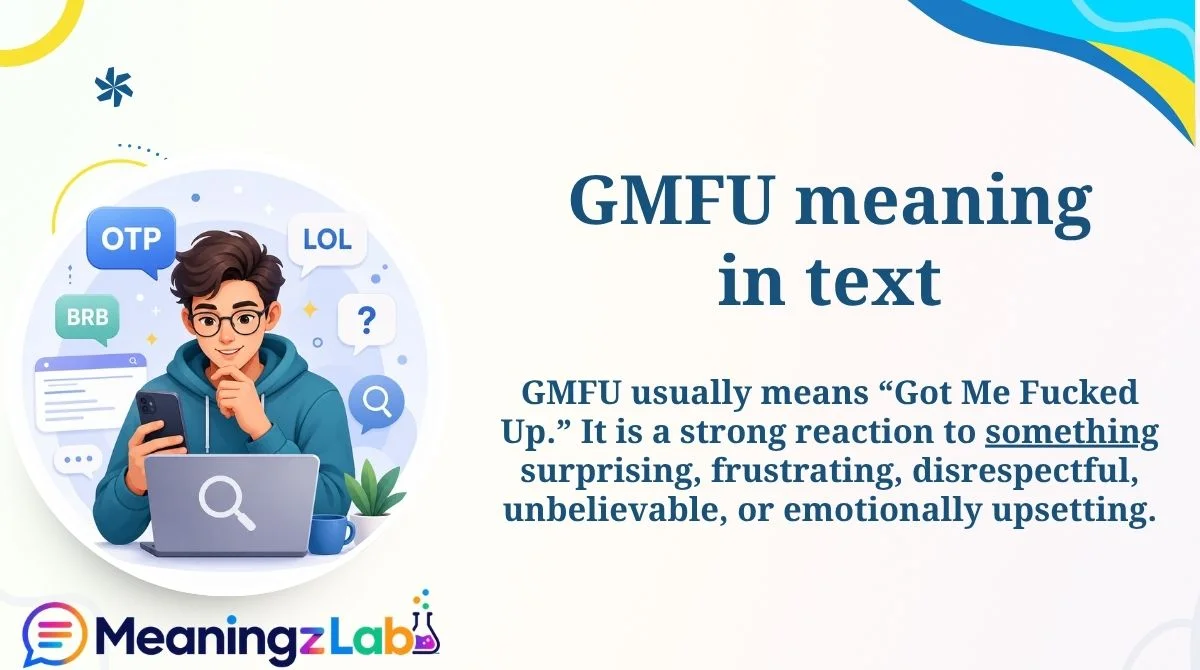
The GMFU meaning in text is usually “got me fucked up.” It is informal internet slang used to show strong disbelief, frustration, annoyance, shock, or the feeling that someone has crossed a line.
In simpler words, it can mean, “You have me messed up,” “You must be joking,” or “I cannot believe this.”
You may see GMFU in text messages, group chats, comments, captions, DMs, and casual conversations on social media.
The exact tone depends on the situation. Between close friends, it can be funny or playful.
During an argument, it can sound angry or confrontational.
This guide explains the GMFU meaning in text, its full form, history, tone, platform use, common misunderstandings, examples, and natural ways to reply.
| Term | Most Common Meaning | Full Form | Typical Tone | Common Usage |
|---|---|---|---|---|
| GMFU | Strong disbelief or frustration | Got Me Fucked Up | Strong, informal, emotional | Texts, chats, comments, DMs |
Quick answer:
GMFU usually means “Got Me Fucked Up.” It is a strong reaction to something surprising, frustrating, disrespectful, unbelievable, or emotionally upsetting.
What Does GMFU Mean in Text & Chat?
In text and chat, GMFU most commonly means “got me fucked up.” People use it when something has shocked, annoyed, offended, confused, or seriously bothered them. Dictionary.com defines the abbreviation as internet slang for “got me fucked up” and describes it as a reaction to feeling emotionally thrown off, usually in a negative way.
The phrase often carries more force than simple expressions such as “SMH,” “wow,” or “seriously?” It can suggest that a person feels someone has treated them badly or made an unreasonable assumption.
For example:
Person A: “You said I should pay for the whole trip because I invited everyone.”
Person B: “GMFU 😭”
Here, GMFU means something close to “You have got to be kidding me” or “You really think that?”
However, the abbreviation does not always mean genuine anger. Friends may use it dramatically when something is ridiculous or unexpectedly funny.
Person A: “Bro, I ate the entire pizza before you got here.”
Person B: “GMFU 😂”
The second example is much lighter.
What Emotion Does GMFU Show?
| Context | Likely feeling |
|---|---|
| Someone insults you | Anger or offense |
| Someone makes an unfair demand | Frustration |
| Something unbelievable happens | Disbelief |
| A friend does something ridiculous | Playful disbelief |
| Someone misunderstands you | “You’ve got me wrong” |
| A dramatic or funny situation | Sarcastic amusement |
Because the phrase contains profanity, GMFU is best treated as casual and somewhat vulgar slang, not formal English. It is usually more suitable for friends and informal online conversations than for professional, academic, or respectful formal communication.
Full Form, Stands For & Short Meaning of GMFU
The standard texting expansion of GMFU is “Got Me Fucked Up.” The letters are taken from the main words in that phrase:
G = Got
M = Me
F = Fucked
U = Up
The phrase may also appear in a sentence such as “You GMFU,” which can be understood as “You got me fucked up.” Some references describe the phrase as “got me all fucked up,” but the common abbreviation remains GMFU.
In everyday text, people normally do not use the phrase literally. Instead, it works as an emotional reaction.
For example:
“GMFU if you think I’m doing that.”
This can mean:
“You must be seriously mistaken if you think I’m doing that.”
Another example is:
“That price GMFU.”
Depending on the conversation, the sender may mean:
“That price is ridiculous and has me seriously annoyed.”
Is the “F” Always Meant Literally?
No. In slang, the profanity mainly adds emotional intensity. It does not necessarily refer to anything sexual or literal.
That is why GMFU can appear after something as simple as a surprise bill, a strange comment, a disappointing sports result, or a friend making an outrageous suggestion.
The abbreviation is also sometimes softened in public posts as “got me f*ed up,” “got me f’d up,”** or “got me messed up.” These versions preserve the emotional idea while reducing the amount of visible profanity.
Origin, History & First Known Use of GMFU
The phrase behind GMFU appears to be older than the abbreviation itself. Dictionary.com says “got me fucked up” comes from urban slang and notes that the acronym was popularized online in the 2000s. It also records an Urban Dictionary entry for GMFU from 2009, while emphasizing that the underlying phrase existed earlier.
An Urban Dictionary page contains a GMFU definition dated October 11, 2009, giving a meaning equivalent to “got me fucked up.” This provides an early documented online record of the abbreviation, although a user-submitted dictionary entry cannot prove that it was the absolute first use.
The phrase itself has also been associated with urban slang and rap culture. However, tracing slang to one exact person, website, song, or date is difficult. Internet slang often develops through spoken language, music, communities, forums, and social media at the same time.
Know Your Meme describes GMFU as an internet catchphrase that gained broader viral use online after 2016.
What We Can Say With Confidence
A careful summary is:
- The underlying phrase predates the internet acronym.
- GMFU had a documented Urban Dictionary entry by 2009.
- The abbreviation became more visible through internet culture and social media.
- There is no reliable basis for claiming one single person invented GMFU.
So, when discussing the first known use of GMFU, it is more accurate to say that an early documented online example appears in 2009 rather than calling 2009 the unquestionable birth date of the slang.
How People Use GMFU in Daily Conversations
People use GMFU mainly as a reaction. It can stand alone or appear inside a longer sentence.
The most common idea is:
“You have seriously upset me.”
But the exact message can shift depending on what happened.
Someone may use GMFU after a rude comment:
“You really said that to me? GMFU.”
Here, the tone is confrontational.
It can also express disbelief:
“He wants $500 for that? GMFU 😭.”
Here, the sender may simply be shocked by the price.
Friends may even use it jokingly:
Person A: “I finished your fries too.”
Person B: “GMFU 😂”
The second person is probably not genuinely angry.
Tone Depends on Context
The words around GMFU matter a lot.
“GMFU.” with a period can look firm or irritated.
“GMFU 😭😂” is much more likely to be humorous.
“nah u gmfu” can sound playful between friends, while the same words during an argument may sound hostile.
Capitalization can also add emphasis:
“GMFU” feels stronger than “gmfu lol.”
The relationship between the speakers matters too. A close friend may understand GMFU as harmless dramatic slang. A stranger may read it as an insult.
For that reason, it is better to interpret GMFU as a strong emotional reaction, not as a fixed statement with only one emotional meaning.
GMFU Meaning Across WhatsApp, Instagram, TikTok & Snapchat
The basic GMFU meaning does not usually change across platforms. On WhatsApp, Instagram, TikTok, Snapchat, and similar services, it generally refers to “got me fucked up.”
What changes is the setting.
On WhatsApp, GMFU is often seen in private chats and group conversations. Because the audience is usually smaller, friends may use it very casually.
On Instagram, it may appear in DMs, comment replies, captions, or reactions to posts. A public comment can feel harsher because more people can see it.
On TikTok, GMFU may appear in comments reacting to a surprising story, relationship situation, unpopular opinion, or funny event. In meme-style conversations, it can be exaggerated for humor.
On Snapchat, it is more likely to appear in quick messages or reactions between friends.
Platform Comparison
| Platform | Typical setting | Possible tone |
|---|---|---|
| Private chats and groups | Casual or emotional | |
| DMs, comments, captions | Casual, sarcastic, or confrontational | |
| TikTok | Comments and reactions | Humorous, shocked, dramatic |
| Snapchat | Quick private messages | Playful or emotional |
The key point is that the platform does not create a different official meaning. Context creates the difference.
A TikTok comment saying “GMFU 😂” can be joking. A private message saying “You GMFU” after an argument may be serious.
When reading GMFU online, look at the sentence, emojis, punctuation, previous messages, and relationship between the speakers before deciding how strong the reaction is.
Different Meanings of GMFU in Other Fields
In everyday slang, “Got Me Fucked Up” is by far the most relevant meaning. However, GMFU can appear as an acronym for unrelated phrases in specialized contexts.
Abbreviations.com lists several alternative expansions, including “Grand Military Foul Up” and “Google Mobile-Friendly Update,” along with other less common definitions.
These alternatives are important because acronyms can belong to many different fields. The surrounding topic tells you which expansion makes sense.
For example, if GMFU appears in a casual group chat:
“You think I’m paying for that? GMFU.”
The slang meaning is clearly the natural interpretation.
But if the abbreviation appears in a technical document, military discussion, or another specialized setting, the intended meaning may be completely different.
Less Common Meanings at a Glance
| Meaning | Where it may appear | Relevance to everyday texting |
|---|---|---|
| Got Me Fucked Up | Slang, texting, social media | Very high |
| Grand Military Foul Up | Military-related material | Low |
| Google Mobile-Friendly Update | Technology or SEO discussions | Low |
| Other acronym expansions | Specialized contexts | Context-dependent |
One unusual Urban Dictionary entry also lists “Good Morning, Fuck You” as a joking expansion. User-submitted slang dictionaries can contain creative or highly niche definitions, so such alternatives should not be treated as the standard meaning.
The safest approach is simple: use the surrounding conversation to identify the meaning. In ordinary social texting, GMFU almost always points to the slang phrase.
Common Confusions, Mistakes & Wrong Interpretations
GMFU is easy to misunderstand because the four letters do not reveal the emotion behind them.
One common mistake is assuming that every GMFU message means serious anger. That is not always true. Close friends often use the abbreviation jokingly to react to something ridiculous.
Another mistake is assuming that “fucked up” always means emotionally damaged or physically harmed. In GMFU, the phrase often works as slang for being offended, shocked, frustrated, or strongly affected.
People can also confuse the abbreviation with other phrases beginning with G, M, F, and U. Those alternatives exist, but they are much less likely in normal texting.
Context Changes the Message
Compare these two examples:
“You GMFU 😭😂”
This could be playful teasing.
“You GMFU. Don’t talk to me.”
This is much more serious.
The same abbreviation can carry very different emotional weight.
Another clue is whether the sender adds words such as:
- “nah”
- “bro”
- “seriously”
- “right now”
- “if you think”
- “after all that”
These surrounding words can make the intended meaning clearer.
Emojis matter too. Laughing or crying emojis can soften a message, although they do not guarantee that the sender is joking.
Finally, do not assume that GMFU always means “you are wrong.” Sometimes it is simply a reaction to a situation.
For example:
“This traffic GMFU.”
The speaker is likely saying that the traffic is extremely frustrating, not accusing another person of doing something wrong.
Similar Terms, Alternatives & Related Slang
GMFU belongs to a group of internet expressions used to communicate disbelief, frustration, or strong reactions.
Understanding nearby slang can help you see the difference in intensity.
| Term | General meaning | Typical intensity |
|---|---|---|
| GMFU | Strong disbelief, frustration, or offense | High |
| SMH | Disappointment or disbelief | Low–medium |
| WTF | Shock, confusion, or disbelief | High |
| FR? | “For real?” | Low |
| Nah | Refusal or disagreement | Low–medium |
| GTFO | Strong rejection or disbelief | High |
| WTH | Milder shock or confusion | Medium |
GMFU often has more emotional weight than SMH. Someone saying “smh” may simply be rolling their eyes. Someone saying “GMFU” may feel that a person has crossed a line.
It can overlap with WTF when the main emotion is shock. However, GMFU more directly suggests that the sender feels personally affected or believes someone has treated them badly.
A milder alternative is “you’ve got me messed up.” This keeps the basic idea while removing the profanity.
Another option is “you must be joking,” which works when the main emotion is disbelief rather than anger.
Choosing between these expressions depends on the audience. GMFU sounds casual, blunt, and emotional. A softer expression is usually better for unfamiliar people, professional conversations, or situations where you want to avoid sounding aggressive.
Examples of GMFU in Real Chat Situations
Real chat context is one of the easiest ways to understand GMFU. The meaning can shift from angry to playful based on the situation.
Example 1: Serious frustration
Person A: “They canceled your booking and still kept the fee.”
Person B: “GMFU. That’s seriously unfair.”
Tone: Serious and frustrated. The speaker feels that the situation is unacceptable.
Example 2: Playful reaction
Person A: “I watched the whole season in one night.”
Person B: “GMFU 😂”
Tone: Playful disbelief. The sender is joking about how extreme the satiate-watching was.
Example 3: Shock
Person A: “He sold his car because he wanted a gaming setup.”
Person B: “Bro, GMFU 😭”
Tone: Shock and disbelief rather than direct anger.
Example 4: Personal disagreement
Person A: “You should lend me your laptop for the weekend.”
Person B: “Nah, GMFU if you think I’m handing over my laptop.”
Tone: Firm refusal with an attitude.
Example 5: Sarcastic use
Person A: “Guess what? The meeting is at 7 a.m. tomorrow.”
Person B: “GMFU 💀”
Tone: Sarcastic frustration. The speaker is probably not literally furious.
Example 6: Feeling misunderstood
Person A: “So you never wanted to help me?”
Person B: “That’s not what I said. You GMFU.”
Tone: Defensive. Here, the expression suggests that the other person has misunderstood the speaker.
The important lesson is that the phrase is emotional, but the exact emotion comes from the conversation around it.
How to Reply When Someone Says GMFU
How you answer GMFU depends on whether the sender is joking, annoyed, confused, or genuinely upset.
First, look at the surrounding messages. Do not immediately assume the person is attacking you.
When They Are Joking
You can match the playful energy:
“LMAO, you’ll survive 😂”
or:
“I knew you were gonna say that 😭.”
When They Sound Seriously Upset
A calm reply is safer:
“Wait, what did I do? Tell me what bothered you.”
This gives them a chance to explain instead of turning the conversation into a bigger argument.
When You Do Not Understand
Ask directly:
“What do you mean by GMFU here?”
That is especially useful when the conversation is unclear.
When the Message Feels Rude
You can stay calm and set a boundary:
“I’m happy to talk about it, but let’s keep the conversation respectful.”
Quick Reply Guide
| Situation | Natural reply |
|---|---|
| Friend joking | “LMAO 😭” |
| Someone is angry | “What happened?” |
| You are confused | “What do you mean?” |
| You want to apologize | “My bad. I didn’t mean it that way.” |
| The person is being rude | “Let’s talk about it calmly.” |
A useful rule is to match the emotion without matching unnecessary aggression.
If someone uses GMFU jokingly, a playful answer may fit. If they are genuinely upset, a defensive response may make things worse.
Is GMFU Still Popular? Trends & Online Usage
GMFU remains recognizable as internet slang in 2026, and current slang-reference pages continue to document “got me fucked up” as its primary meaning.
It has also appeared beyond ordinary texting. For example, “GMFU” was used as the title of a 2023 single by Odetari and 6arelyhuman, showing that the acronym has also been used in contemporary music and internet culture.
However, there is an important distinction between being widely recognizable and being able to prove an exact popularity level. There is no single authoritative public measure that shows how frequently people use GMFU across every messaging app, platform, and region.
Internet slang is also highly fluid. Some users prefer longer phrases, censored spellings, newer reaction slang, or milder alternatives. Others continue to use older abbreviations because they are short and expressive.
What This Means for 2026
You can still encounter GMFU in:
- Private text conversations
- Group chats
- Social media comments
- Memes and captions
- DMs and online reactions
- Music and internet culture
Its core meaning remains stable, but the emotional tone can change.
Someone writing “GMFU 😂” may be joking, while “You GMFU. Seriously.” can communicate real frustration.
So, rather than asking only whether the slang is “popular,” it is more useful to understand what it communicates and how context changes its force.
FAQs
What does GMFU meaning in text refer to?
The common GMFU meaning in text is “got me fucked up.” It expresses strong disbelief, frustration, shock, annoyance, or feeling that someone has crossed a line.
What does GMFU stand for in texting?
GMFU stands for “Got Me Fucked Up.” It is informal slang and contains profanity, so it is mainly used in casual conversations.
Is GMFU rude?
GMFU can sound rude because it is blunt and includes profanity. However, friends may use it jokingly, so the actual tone depends on the relationship and context.
Can GMFU be used as a joke?
Yes. Friends often use GMFU to react dramatically to something funny, ridiculous, surprising, or mildly annoying. Emojis such as 😂 or 😭 can make a playful reading more likely.
What should I reply when someone says GMFU?
Look at the context first. For a serious situation, try “What happened?” or “Did I upset you?” For a joke, a light response such as “LMAO 😭” may fit better.
Does GMFU mean the same thing on WhatsApp and Instagram?
Usually, yes. The core slang meaning remains “got me fucked up.” What changes is the setting and audience, which can affect how aggressive, funny, or serious the message sounds.
Can GMFU have another meaning?
Yes. Acronyms can have unrelated meanings in specialized fields. Abbreviations.com lists alternatives such as “Grand Military Foul Up” and “Google Mobile-Friendly Update,” but these are not the normal meaning in casual texting.
Is GMFU the same as WTF?
Not exactly. Both can express shock or disbelief, but GMFU often suggests that the sender feels personally affected, frustrated, disrespected, or challenged.
Does lowercase “gmfu” mean something different from uppercase “GMFU”?
Usually, no. The capitalization normally does not change the definition. However, uppercase lettering can feel more emphatic, while lowercase may look more casual.
Conclusion
The most common GMFU meaning in text is “got me fucked up.” It is a strong slang expression used to show disbelief, frustration, annoyance, shock, or a feeling that someone has gone too far. In simpler language, it can mean “you’ve got me messed up” or “you must be kidding.”
GMFU is informal and contains profanity, so it fits best in casual texts, group chats, DMs, comments, and conversations between people who understand each other’s style. The tone can be serious, sarcastic, playful, or confrontational depending on the situation.
The surrounding words, emojis, punctuation, and relationship between the speakers all matter. A simple “GMFU 😂” may be a joke, while “You GMFU. Seriously.” may signal real frustration.
Understanding that context will help you read and use the abbreviation more naturally.

Evan Rellmont is a content writer and researcher who specializes in internet slang, text abbreviations, and social media language. He creates clear, helpful content to make modern online communication easier to understand.