If you’ve seen GMT in a text message, social media comment, gaming chat, or online conversation, you may wonder what it actually means.
In most cases, GMT stands for Greenwich Mean Time, the time standard used to coordinate schedules across different countries and time zones.
People often use it when arranging online meetings, livestreams, gaming events, or international conversations.
However, like many abbreviations, GMT can occasionally have different meanings depending on the context.
The surrounding words, the platform, and the topic of the conversation all help determine the intended meaning.
In this guide, you’ll learn the most common text meaning of GMT, its full form, where it came from, how people use it in chats, and what it can mean on platforms like WhatsApp, Instagram, TikTok, Snapchat, and more.
| Term | Most Common Meaning | Full Form | Typical Tone | Common Usage |
|---|---|---|---|---|
| GMT | A global time reference | Greenwich Mean Time | Neutral and informative | Scheduling, international chats, gaming, work meetings, livestreams |
Quick Answer
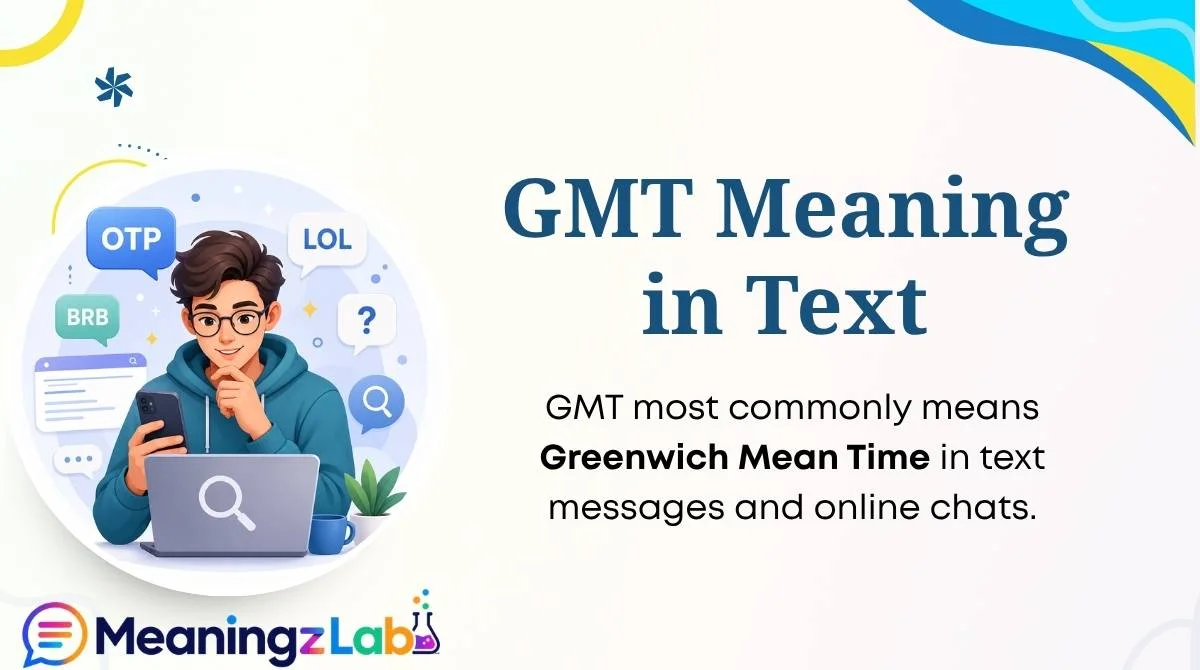
GMT most commonly means Greenwich Mean Time in text messages and online chats. It is used as a standard time reference so people in different countries can coordinate events, meetings, games, livestreams, or deadlines.
What Does GMT Mean in Text & Chat?
The meaning of GMT in text and chat is usually very straightforward. It refers to Greenwich Mean Time, which serves as a common reference point for time around the world.
Instead of telling someone a meeting starts at “3 PM” without clarification, people often write:
- 3:00 PM GMT
- Starts at 18:00 GMT
- We’ll meet at 9 AM GMT
Using GMT removes confusion when people live in different countries or regions.
Why People Use GMT
Many online conversations involve people from multiple time zones. Using GMT gives everyone one standard reference instead of expecting each person to guess another person’s local time.
You’ll commonly see GMT used for:
- Remote work meetings
- Online classes
- International business
- Gaming tournaments
- Livestream announcements
- Virtual events
- Customer support hours
The Tone of GMT
Unlike internet slang, GMT does not carry an emotional meaning.
Its tone is almost always:
- Neutral
- Professional
- Informative
- Practical
It is simply there to communicate time clearly.
Example in a Text Conversation
Person A: “The livestream begins at 7 PM GMT. Can you make it?”
Person B: “Yes! I’ll convert it to my local time first. 😊”
Meaning: GMT tells everyone exactly which time standard to use before converting it into their own local time.
Another example:
Person A: “Deadline is 11:59 PM GMT.”
Person B: “Thanks! Now I know when I need to submit.”
Here, GMT prevents misunderstandings about when the deadline actually ends.
Full Form, Stands For & Short Meaning of GMT
The full form of GMT is Greenwich Mean Time.
It is a globally recognized time standard based on the Prime Meridian, an imaginary line that passes through Greenwich in London, England.
Short Meaning
In everyday online communication, GMT simply means:
A standard time reference used to coordinate time across different countries.
People are not usually discussing geography or astronomy when they write GMT. They simply want everyone to know exactly which time they mean.
What Greenwich Mean Time Represents
Greenwich Mean Time historically represented the average solar time at Greenwich.
Today, many organizations use UTC (Coordinated Universal Time) as the primary international time standard for technical purposes. However, GMT remains widely recognized in everyday communication and is still commonly used by the public when discussing international schedules.
For most casual conversations, many people treat GMT and UTC as interchangeable, even though they are not identical in every technical situation.
Quick Comparison
| Term | Meaning | Common Use |
|---|---|---|
| GMT | Greenwich Mean Time | Everyday scheduling and communication |
| UTC | Coordinated Universal Time | Scientific, aviation, computing, and official systems |
For most text messages, this distinction is not important. If someone says “Meeting at 2 PM GMT,” the goal is simply to give everyone a shared time reference.
Origin, History & First Known Use of GMT
The abbreviation GMT comes from Greenwich Mean Time, which takes its name from Greenwich, a district in London, England.
Greenwich became internationally important because the Prime Meridian (0° longitude) passes through the Royal Observatory there. This line became the reference point for measuring longitude and calculating time zones around the world.
How GMT Became Popular
As international travel, shipping, and communication expanded, countries needed a common way to measure time.
A shared reference helped people coordinate:
- Train schedules
- Maritime navigation
- International communication
- Aviation
- Global business
- Broadcasting
Over time, GMT became familiar worldwide as a universal time reference.
GMT in the Internet Era
The rise of the internet gave GMT a new role.
Instead of appearing mainly in scientific or navigation contexts, it became common in:
- Online gaming
- Virtual conferences
- Streaming schedules
- Software releases
- Global product launches
- International communities
- Remote work
Today, millions of people still write GMT when announcing times that need to be understood across different countries.
Is GMT an Internet Slang Term?
No.
Unlike abbreviations such as LOL, BRB, or IMO, GMT is not internet slang.
It is an official abbreviation that has become widely used in digital communication because it provides a simple and recognizable way to refer to a common time standard.
Its popularity online comes from practicality rather than internet culture.
How People Use GMT in Daily Conversations
Most people use GMT when they need to communicate a specific time to someone in another country or region. Rather than assuming everyone shares the same local clock, they give the time in GMT so each person can convert it to their own time zone.
You’ll commonly see GMT in:
- Work emails and team chats
- Online gaming communities
- Livestream announcements
- Webinar invitations
- International customer support
- Virtual classes
- Social media event posts
Common Ways GMT Appears
Here are a few examples of how people naturally use GMT in everyday conversations:
Person A: “Our project meeting starts at 10:00 AM GMT tomorrow.”
Person B: “Perfect. That’s 3 PM where I live.”
Meaning: GMT provides a shared reference so everyone arrives at the correct time.
Person A: “The game servers go offline at 01:00 GMT.”
Person B: “Thanks for the heads-up!”
Meaning: The speaker is announcing a scheduled maintenance time.
Person A: “I’ll be online after 6 PM GMT.”
Person B: “Great, I’ll message you then. 😊”
Meaning: The conversation uses GMT to avoid confusion between different local time zones.
How Context Changes the Conversation
Although the meaning of GMT stays the same, the surrounding conversation can change how it feels.
| Situation | Tone |
|---|---|
| Business meeting | Professional |
| Livestream announcement | Informative |
| Gaming session | Casual |
| Online class | Organized |
| Deadline reminder | Serious |
| Friendly chat | Neutral |
Unlike slang abbreviations, GMT does not become playful or sarcastic on its own. Any emotion comes from the rest of the message, emojis, or punctuation—not from GMT itself.
GMT Meaning Across WhatsApp, Instagram, TikTok & Snapchat
The good news is that GMT usually means the same thing across all major platforms. Unlike many internet abbreviations that develop platform-specific meanings, GMT remains remarkably consistent.
Whether you’re chatting privately or reading a public post, it’s almost always referring to Greenwich Mean Time.
People often use GMT to arrange calls with friends, relatives, or coworkers living abroad.
Example:
Person A: “Can we video call at 8 PM GMT?”
Person B: “Sure! I’ll set a reminder.”
Here, GMT helps both people coordinate despite living in different time zones.
Creators and brands frequently mention GMT in captions or Stories when announcing:
- Live sessions
- Product launches
- Giveaways
- Q&A events
Example:
“Join us LIVE at 7 PM GMT.”
The abbreviation tells followers worldwide when to tune in.
TikTok
TikTok creators often schedule:
- Live broadcasts
- Community events
- Collaborations
- Countdown announcements
A caption might read:
“Going live at 9 PM GMT—see you there!”
The meaning remains unchanged.
Snapchat
GMT appears less frequently in casual Snaps but may be used when coordinating:
- Group calls
- Gaming sessions
- Online hangouts
Quick Platform Summary
| Platform | Typical Meaning | Does the Meaning Change? |
|---|---|---|
| Greenwich Mean Time | No | |
| Event or livestream time | No | |
| TikTok | Broadcast or event schedule | No |
| Snapchat | Meeting or gaming time | No |
| Discord | Server events and gaming | No |
| Meetings and deadlines | No |
Key takeaway: On nearly every platform, GMT is a time reference—not slang, an emoji code, or a hidden internet expression.
Different Meanings of GMT in Other Fields
Although Greenwich Mean Time is by far the most common meaning in text messages and online conversations, the abbreviation GMT can represent different things in specialized industries.
Understanding the context helps prevent confusion.
Timekeeping
This is the most widely recognized meaning.
GMT = Greenwich Mean Time
Used for:
- Global scheduling
- International communication
- Time zone references
This is the meaning most readers are looking for.
Watches and Horology
In the watch industry, GMT refers to a feature that lets a watch display two or more time zones at once.
For example:
- A traveler may use a GMT watch to track both home time and local time.
- Pilots and frequent flyers often appreciate this functionality.
In this context, GMT refers to the watch’s capability rather than the time standard itself.
Technology and Computing
Some software, operating systems, or older documentation may still label timestamps as GMT.
Modern systems often prefer UTC, but you’ll still encounter GMT in:
- Server logs
- Legacy software
- Technical documentation
- Configuration settings
Business and Global Operations
International companies may mention GMT when publishing:
- Support hours
- Webinar schedules
- Maintenance windows
- Product launches
Again, the purpose is to create a single time reference for audiences in multiple countries.
Quick Comparison
| Context | Meaning of GMT |
|---|---|
| Text messages | Greenwich Mean Time |
| Social media | Time reference |
| Gaming | Event schedule |
| Watches | Multiple time-zone function |
| Computing | Time reference (sometimes replaced by UTC) |
| Business | International scheduling |
Unless the conversation is specifically about watches or technology, GMT almost always refers to Greenwich Mean Time.
Common Confusions, Mistakes & Wrong Interpretations
Because GMT is a well-known abbreviation, people sometimes assume it has a hidden meaning in text messages or social media. In reality, that is rarely the case.
The biggest misunderstanding is thinking GMT is internet slang like “LOL” or “SMH.” It isn’t. Most of the time, it’s simply a reference to Greenwich Mean Time.
Common Mistakes
Here are some of the most frequent misunderstandings:
| Misunderstanding | Reality |
|---|---|
| GMT is a secret chat code. | No. It usually refers to a time standard. |
| GMT has different meanings on every app. | No. Its meaning stays consistent across most platforms. |
| GMT always means the same as UTC. | In everyday conversation, people often use them interchangeably. In technical contexts, they are distinct standards. |
| GMT is only used in the UK. | No. People around the world use it when sharing international schedules. |
Read the Context First
Before assuming an unusual meaning, ask yourself:
- Is the conversation about a meeting or event?
- Is someone sharing a livestream or webinar time?
- Are people discussing different countries or time zones?
If the answer is yes, GMT almost certainly means Greenwich Mean Time.
Only consider other meanings if the discussion is about watches, computing, navigation, or another specialized subject.
Similar Terms, Alternatives & Related Slang
GMT is not slang, but it often appears alongside other time-related abbreviations. Knowing the difference can help you avoid confusion.
Common Alternatives
| Term | Meaning | Typical Use |
|---|---|---|
| GMT | Greenwich Mean Time | Everyday international scheduling |
| UTC | Coordinated Universal Time | Official and technical timekeeping |
| BST | British Summer Time | UK daylight saving time |
| EST | Eastern Standard Time | Eastern North America |
| PST | Pacific Standard Time | Western North America |
| CET | Central European Time | Many European countries |
Is There a Slang Alternative?
Not really.
People usually write the actual time standard rather than replacing GMT with slang.
Instead, you may see messages like:
- “My local time is…”
- “Convert it to your timezone.”
- “Check your local clock.”
These phrases serve the same purpose without using the abbreviation.
Remember
If someone writes:
“The stream starts at 5 PM GMT.”
They are giving a time reference—not using a trendy internet expression.
This consistency makes GMT easier to understand than many online abbreviations whose meanings change depending on the conversation.
Examples of GMT in Real Chat Situations
Seeing GMT used in realistic conversations makes its meaning much easier to understand.
Example 1: Work Meeting
Person A: “Let’s meet tomorrow at 11 AM GMT.”
Person B: “Sounds good. I’ll convert that to my local time. 😊”
Tone: Professional and organized.
Example 2: Gaming Session
Person A: “The tournament begins at 7 PM GMT.”
Person B: “I’ll log in 15 minutes early.”
Tone: Casual and informative.
Example 3: Livestream Announcement
Person A: “New episode premieres Friday at 8 PM GMT.”
Person B: “Can’t wait! I’ll be there.”
Tone: Excited but informational.
Example 4: Friendly Chat
Person A: “I’m usually online after 6 PM GMT.”
Person B: “Perfect! That’s late afternoon for me.”
Tone: Friendly and relaxed.
Example 5: Deadline Reminder
Person A: “Don’t forget—entries close at 11:59 PM GMT.”
Person B: “Thanks for the reminder!”
Tone: Serious and helpful.
How Emojis Affect the Tone
The abbreviation itself remains neutral, but surrounding elements can change how the message feels.
| Message | Tone |
|---|---|
| “See you at 8 PM GMT.” | Neutral |
| “See you at 8 PM GMT! 🎉” | Excited |
| “Please join by 8 PM GMT.” | Formal |
| “8 PM GMT 😊” | Friendly |
| “8 PM GMT!!!” | Enthusiastic |
The emoji or punctuation adds emotion—not the abbreviation.
How to Reply When Someone Says GMT
If someone mentions GMT, your reply should match the situation. In most cases, you don’t need to explain what GMT means. Instead, confirm the time or let the sender know you’ve converted it.
For a Serious or Professional Conversation
- “Thanks. I’ll be there on time.”
- “I’ve added it to my calendar.”
- “That works for me.”
- “I’ll join at the scheduled time.”
For a Friendly Conversation
- “Perfect! See you then. 😊”
- “Got it!”
- “Looking forward to it!”
- “I’ll set a reminder.”
If You’re Confused
It’s completely fine to ask for clarification.
You could reply:
- “What time is that in my time zone?”
- “Could you tell me the local time for me?”
- “I’ll convert GMT before confirming.”
If the Message Seems Incorrect
Occasionally, someone may accidentally use GMT when they mean another time zone.
A polite response is:
- “Just checking—did you mean GMT or your local time?”
- “Can you confirm the time zone?”
Quick Reply Guide
| Situation | Good Reply |
|---|---|
| Business meeting | “I’ll be there.” |
| Gaming event | “See you online!” |
| Livestream | “I’ll tune in.” |
| Confused | “What’s that in my local time?” |
| Needs confirmation | “Can you confirm the time zone?” |
These responses keep the conversation clear and avoid scheduling mistakes.
Is GMT Still Popular? Trends & Online Usage
Yes, GMT is still widely used, especially when people need a simple way to communicate time across different countries. While many technical systems now prefer UTC (Coordinated Universal Time), GMT remains familiar to everyday users because it is easy to recognize and commonly understood.
In online conversations, GMT continues to appear in situations where people from different regions need one shared reference point.
Where GMT Is Still Common
You may see GMT used in:
- International gaming communities
- Online events and livestreams
- Remote work schedules
- Software release announcements
- Global customer support hours
- Online courses and webinars
- Travel-related discussions
For example:
“Server update begins at 02:00 GMT.”
This tells players worldwide when the update starts without requiring the organizer to list dozens of local times.
Why People Still Use GMT
GMT remains popular because it solves a simple communication problem: different countries have different clocks.
Instead of writing:
- 5 PM in London
- 12 PM in New York
- 9 AM in California
- 10 PM in another region
a person can simply write:
“5 PM GMT”
and allow everyone to convert the time.
GMT vs Modern Digital Communication
Many apps automatically adjust dates and times based on a user’s location. However, GMT is still useful when a message needs to be understood by a global audience.
It provides:
- A clear reference point
- Less confusion between countries
- A standard format for announcements
- Easy conversion for international users
Does GMT Have a New Slang Meaning?
No widely recognized modern slang meaning has replaced GMT.
Unlike many internet abbreviations that evolve into jokes, reactions, or expressions, GMT has remained a practical abbreviation. Its meaning depends mainly on the topic being discussed.
Frequently Asked Questions
What does GMT mean in text messages?
In text messages, GMT usually means Greenwich Mean Time. People use it to show a specific time reference when communicating with someone in another country or time zone.
For example, “The meeting starts at 3 PM GMT” means everyone should convert that time into their own local time.
Is GMT a slang word in online chats?
No. GMT is not internet slang. It is a time abbreviation used in conversations, schedules, announcements, and professional communication.
Unlike slang terms, it does not express emotion, humor, or a hidden message.
Does GMT mean the same thing on WhatsApp, Instagram, and TikTok?
Yes. On most major platforms, GMT keeps the same meaning: Greenwich Mean Time.
Whether it appears in a WhatsApp message, Instagram caption, TikTok announcement, or gaming chat, it usually refers to a time standard.
How should I reply when someone says GMT?
Your reply depends on the situation.
Examples:
- “Got it, I’ll be there.”
- “Thanks, I’ll convert the time.”
- “What time is that in my timezone?”
- “I’ll add it to my calendar.”
If you are unsure, ask the person to confirm the local time.
Is GMT the same as UTC?
GMT and UTC are closely related, and many people use them in the same way during everyday conversations.
However, they are technically different time standards. UTC is the modern standard used in many scientific and technical systems, while GMT remains a commonly recognized term for general communication.
Can GMT have another meaning?
Yes, but the meaning depends on the context.
For example, in the watch industry, GMT can describe a watch feature that tracks multiple time zones. In technology, it may appear as a time reference in older systems or documentation.
In normal texting and social media conversations, it almost always means Greenwich Mean Time.
Why do people write GMT instead of their local time?
People use GMT because online conversations often involve people from different parts of the world.
Using GMT gives everyone one shared reference and helps prevent confusion about schedules, events, deadlines, and meetings.
Conclusion
The most common GMT meaning in text is Greenwich Mean Time, a standard reference used to communicate time across different countries. People use it in chats, work messages, gaming communities, social media posts, livestream announcements, and online events to make schedules easier to understand.
GMT is not slang, and it usually does not carry a hidden emotional meaning. Its purpose is simple: helping people coordinate time clearly.
Although the abbreviation can have specialized meanings in areas like watches or technology, context usually makes the intended meaning obvious. When you see GMT in a message, check the conversation topic first.
Understanding GMT is useful for navigating modern online communication. You can also explore other popular abbreviations and text-message meanings to become more confident in digital conversations.

Evan Rellmont is a content writer and researcher who specializes in internet slang, text abbreviations, and social media language. He creates clear, helpful content to make modern online communication easier to understand.