If you see “ICL” in a text, chat, or social media comment, it most commonly means “I Can’t Lie.” People use it before or after a statement to show that they are being honest, direct, or sincere.
For example, “ICL, that movie was actually good” means “I can’t lie, that movie was actually good.” You may see ICL in texts, DMs, TikTok comments, Instagram conversations, Snapchat, and other informal online chats.
Its meaning usually stays the same across these platforms, although the tone can change with context.
In this guide, you’ll learn the ICL meaning in text, its full form, common uses, possible alternative meanings, differences from terms like NGL and TBH, realistic examples, and natural ways to reply.
Quick Reference
| Term | Most Common Meaning | Full Form | Typical Tone | Common Usage |
|---|---|---|---|---|
| ICL | I Can’t Lie | I Can’t Lie | Honest, casual, direct | Texts, DMs, comments, social media |
What Does ICL Mean in Text & Chat?
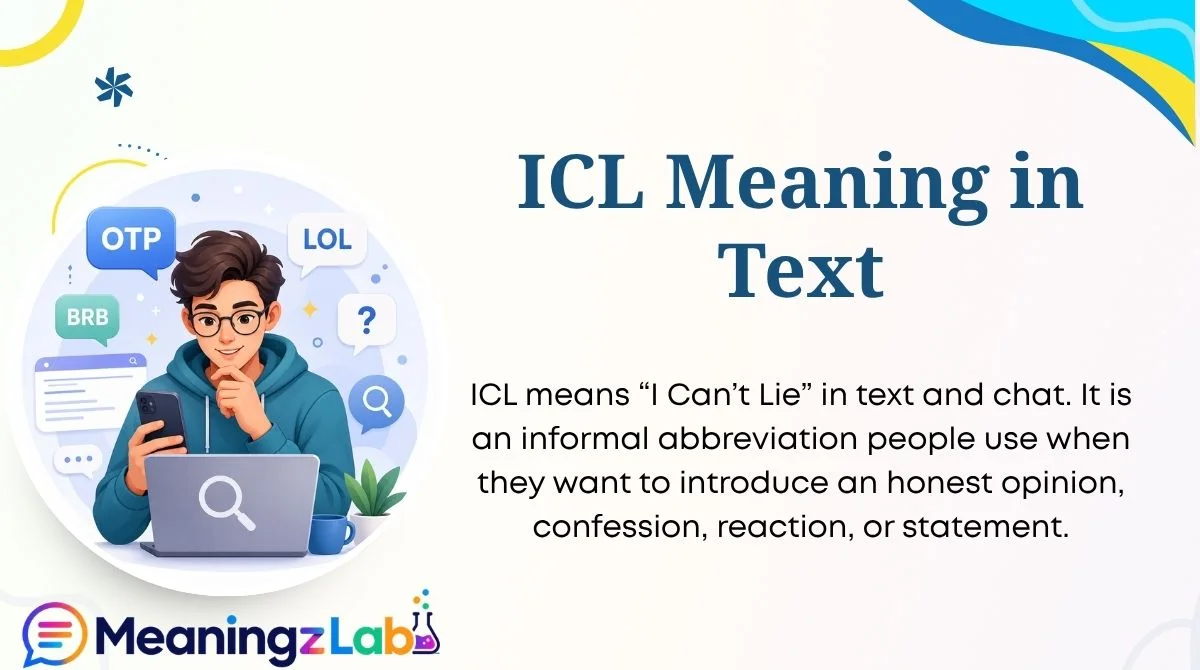
ICL means “I Can’t Lie” in text and chat. It is an informal abbreviation people use when they want to introduce an honest opinion, confession, reaction, or statement.
For example:
“ICL, I really liked that song.”
This means:
“I can’t lie, I really liked that song.”
The phrase often signals that the person is about to be straightforward. It does not always mean they are revealing a serious secret. Sometimes they are simply giving an honest opinion.
ICL can appear at the beginning of a sentence, but people may also place it at the end.
- “ICL, your idea was pretty good.”
- “That game was stressful, ICL.”
- “ICL, I expected more from the movie.”
The tone is usually casual and conversational. It can sound sincere, playful, blunt, or slightly sarcastic depending on what follows.
ICL is closely related to NGL, which means “Not Gonna Lie.” Both can introduce an honest statement. The wording is different, but the purpose is often similar.
A useful rule is simple: when ICL appears in an ordinary social conversation, read it as “I Can’t Lie” unless the surrounding context clearly points to another meaning.
Full Form, Stands For & Short Meaning of ICL
The most common full form of ICL is “I Can’t Lie.”
In simple English, it can mean:
- “Honestly…”
- “To be honest…”
- “I’m being truthful…”
- “I have to admit…”
- “I’ll be honest…”
It is mainly used to emphasize sincerity before sharing an opinion or reaction.
For example:
“ICL, you did a great job.”
Here, the speaker is stressing that the compliment is genuine.
Another example:
“I didn’t like the restaurant, ICL.”
In this case, ICL reinforces the speaker’s honest opinion.
ICL does not automatically mean that the following statement is negative. It can introduce praise, criticism, surprise, agreement, disagreement, or a personal admission.
| Expression | Meaning | Typical Use |
|---|---|---|
| ICL | I Can’t Lie | Honest or direct statement |
| NGL | Not Gonna Lie | Honest admission or opinion |
| TBH | To Be Honest | Direct opinion |
| FR | For Real | Agreement or emphasis |
| Honestly | Being truthful | More standard English |
The exact tone depends on the rest of the message. “ICL, you look amazing 😭” can sound affectionate or excited, while “ICL, that was a terrible idea” sounds blunt or critical.
So, while the full form is stable, the emotional effect comes from the sentence around it.
Origin, History & First Known Use of ICL
There is no reliable, universally accepted record showing exactly when ICL was first created or identifying one person as its inventor.
That matters because internet abbreviations often develop gradually. People shorten familiar phrases in casual conversations, and the shortened version can spread through different online communities.
The phrase “I can’t lie” itself is ordinary informal English. The acronym ICL simply compresses the phrase into three letters. It serves much the same conversational role as “NGL” or “TBH”: it signals that the speaker is about to give an honest thought or reaction.
Modern slang references document ICL primarily as “I Can’t Lie” in social-media and messaging contexts.
There is also evidence that ICL is not understood equally by every English-speaking group. Some online users recognize it immediately, while others are more familiar with NGL. Community discussions have also shown that people can encounter ICL as a newer or unfamiliar alternative to expressions they already know.
Because slang changes naturally, it is safer to describe ICL as an informal internet abbreviation rather than claim a precise invention date.
In short, the phrase has a clear meaning, but its exact origin and earliest use are not firmly established.
How People Use ICL in Daily Conversations
People use ICL when they want to make a statement sound honest or candid.
It can be placed before a comment:
“ICL, I was nervous before the exam.”
It can also appear at the end:
“That was actually fun, ICL.”
The abbreviation works in many everyday situations.
Sharing an honest opinion
“ICL, I think the first movie was better.”
The speaker is giving a genuine opinion.
Admitting something
“ICL, I forgot about the meeting.”
Here, ICL introduces a small confession.
Giving a compliment
“ICL, your new profile picture looks great.”
The abbreviation emphasizes sincerity.
Making a blunt observation
“ICL, that plan needs more work.”
This can sound more direct because the speaker is presenting their honest view.
Context is important. A friendly emoji can soften the message:
“ICL, that outfit is really nice 😊”
Without an emoji, the same words may sound more neutral.
Punctuation matters too. “ICL…” may sound hesitant or thoughtful, while “ICL!” can sound excited or emphatic.
The relationship between the speakers also matters. A close friend may use ICL casually, while the same abbreviation in a professional conversation could seem too informal.
ICL Meaning Across WhatsApp, Instagram, TikTok & Snapchat
The ICL meaning usually does not change between WhatsApp, Instagram, TikTok, and Snapchat. In casual social-media language, it generally means “I Can’t Lie.”
What changes is the way people use it.
| Platform | Common Context | Likely Meaning |
|---|---|---|
| Private chats and group messages | I Can’t Lie | |
| DMs, captions, and comments | I Can’t Lie | |
| TikTok | Comments and casual discussions | I Can’t Lie |
| Snapchat | Friend-to-friend messages | I Can’t Lie |
On TikTok or Instagram, you might see:
“ICL this edit is crazy 🔥”
In a private WhatsApp conversation, someone might write:
“ICL, I was expecting you to cancel.”
The meaning remains the same.
However, abbreviations can have different meanings in specialized communities. That is why the surrounding message should always be considered.
A useful distinction is between platform context and conversation context. The platform usually does not change the slang meaning. The topic of the conversation might.
For example, ICL in a casual conversation about a movie almost certainly refers to “I Can’t Lie.” In a technical document, academic discussion, or professional field, ICL could represent something completely different.
So if you see ICL in a social-media chat, start with “I Can’t Lie.” If that interpretation makes no sense, check the wider context.
Different Meanings of ICL in Other Fields
Although “I Can’t Lie” is the main meaning in casual texting, ICL can represent other phrases in specialized contexts.
This is one reason acronym searches can sometimes produce confusing results.
In technology and artificial intelligence, for example, ICL can mean “in-context learning.” In that setting, it refers to a machine-learning approach where a model uses examples or instructions provided within the current context to perform a task. Academic AI literature uses ICL in this technical sense.
Another technical usage appears in astronomy, where ICL can refer to “intracluster light,” the diffuse light found between galaxies within galaxy clusters.
There are also other specialized expansions of ICL in areas such as law, business, medicine, and organizations.
The important point is that these meanings are not normally intended when someone sends ICL in an ordinary text message.
| Context | Possible Meaning |
|---|---|
| Texting / social media | I Can’t Lie |
| Artificial intelligence | In-Context Learning |
| Astronomy | Intracluster Light |
| Specialized professional contexts | Depends on the field |
Therefore, do not assume that every occurrence of ICL means “I Can’t Lie.” Look at the subject and surrounding words.
Common Confusions, Mistakes & Wrong Interpretations
One common mistake is assuming ICL has only one possible meaning everywhere.
In casual texting, “I Can’t Lie” is the safest interpretation. But professional and technical contexts can use the same three letters differently.
Another confusion is between ICL and NGL.
- ICL = I Can’t Lie
- NGL = Not Gonna Lie
They are similar because both can introduce an honest statement.
People may also misunderstand the tone. ICL itself is not rude. However, the sentence that follows it can be blunt.
Compare:
“ICL, you look amazing! ❤️”
with:
“ICL, that was a bad decision.”
The first sounds positive and warm. The second can sound critical.
Another mistake is assuming ICL always introduces something negative. It does not.
Someone can say:
“ICL, you handled that really well.”
That is clearly positive.
It is also possible for ICL to appear after a statement:
“This is actually pretty good, ICL.”
So its position is flexible.
Finally, avoid treating slang as a fixed grammar rule. Online language is informal. People may write ICL, icl, or Icl depending on their typing style.
The safest approach is to read the whole sentence rather than interpret the three letters alone.
Similar Terms, Alternatives & Related Slang
Several abbreviations can express a similar idea to ICL.
ICL vs. NGL
ICL means “I Can’t Lie,” while NGL means “Not Gonna Lie.”
Both can introduce an honest reaction.
“ICL, that was impressive.”
“NGL, that was impressive.”
The meaning is almost identical.
ICL vs. TBH
TBH means “To Be Honest.”
It also introduces a sincere opinion or admission.
“TBH, I prefer the old version.”
ICL may feel more like current casual slang, while TBH has been widely used as a general internet abbreviation.
ICL vs. FR
FR means “For Real.”
It is often used to emphasize agreement or truth.
“That test was difficult.”
“FR.”
FR does not have exactly the same function as ICL, but both can add emphasis to a statement.
ICL vs. Honestly
“Honestly” is the standard English word rather than an abbreviation.
“Honestly, I expected something different.”
This communicates a similar idea while sounding more natural in formal or professional writing.
Overall, ICL, NGL, TBH, and honestly overlap in meaning, but they are not perfectly interchangeable in every sentence.
Examples of ICL in Real Chat Situations
Seeing ICL in realistic conversations makes its meaning easier to understand.
Honest opinion
Person A: “Did you enjoy the new restaurant?”
Person B: “ICL, the food was better than I expected. 😭”
Meaning: Person B is honestly admitting that the restaurant exceeded their expectations. The emoji makes the message feel playful.
Positive compliment
Person A: “Do you like my new haircut?”
Person B: “ICL, it looks really good on you. 😊”
Meaning: ICL emphasizes that the compliment is sincere and friendly.
Mild criticism
Person A: “Should we use this design for the project?”
Person B: “ICL, I think we can make it cleaner.”
Meaning: The speaker is giving honest feedback. The wording is direct but not necessarily rude.
Playful reaction
Person A: “I stayed up until 3 a.m. watching that show.”
Person B: “ICL, you have absolutely no self-control 😂”
Meaning: This is teasing rather than serious criticism. The laughing emoji makes that clearer.
Honest admission
Person A: “Did you study for the test?”
Person B: “ICL, not nearly enough.”
Meaning: The speaker is openly admitting that they did not prepare well.
These examples show why context matters. The same three letters can introduce praise, criticism, humor, or a personal admission.
How to Reply When Someone Says ICL
How you reply to ICL depends on what the person says after it.
If they share a serious opinion, respond to the actual point rather than focusing on the abbreviation.
If you agree
“Honestly, I agree with you.”
If you disagree
“I get what you mean, but I see it differently.”
If they give a compliment
“Aww, thank you! 😊”
If they are joking
“Lmaoo, you’re not wrong 😂”
If the message is confusing
“What do you mean by that?”
If the comment feels too blunt
“I get that you’re being honest, but that came across a little harsh.”
You do not need a special response to the word ICL itself. Usually, it simply means the person is signaling honesty.
For example:
Person A: “ICL, I think you should go for it.”
Person B: “Thanks. I was actually thinking the same thing.”
The best response addresses the statement, not the abbreviation.
If you are unsure whether the person is being serious or sarcastic, look at their punctuation, emojis, and previous messages. A laughing emoji or exaggerated wording may signal humor.
Is ICL Still Popular? Trends & Online Usage
ICL remains recognizable in online slang in 2026, especially in informal social-media and messaging contexts. Current slang references continue to define it as “I Can’t Lie,” and recent online discussions show that people still encounter and use the abbreviation.
However, popularity can vary by age, location, platform, and online community.
Some users may prefer NGL, TBH, or simply honestly. Others may use ICL regularly. Community discussions suggest that some English-speaking users encounter ICL more often than others, which shows why slang familiarity is not universal.
ICL is also flexible. It can appear at the start or end of a sentence and can express anything from a compliment to a blunt opinion.
For example:
“ICL, this might be my favorite one.”
or:
“That was a little awkward, ICL.”
In both cases, the speaker is emphasizing honesty.
So, while online slang will continue to change, the practical takeaway is straightforward: if you see ICL in a casual 2026 conversation, “I Can’t Lie” is usually the intended meaning.
Frequently Asked Questions
What does ICL mean in text?
ICL most commonly means “I Can’t Lie.” It is used to introduce an honest opinion, admission, reaction, or personal statement.
Is ICL rude?
No. ICL is not inherently rude. However, it can introduce a blunt or critical comment, so the sentence that follows can affect how the message feels.
What does ICL mean on TikTok?
On TikTok, ICL generally means “I Can’t Lie.” Users may place it before an honest reaction, opinion, compliment, or confession.
What does ICL mean on WhatsApp?
In a normal WhatsApp conversation, ICL usually means “I Can’t Lie.” The abbreviation can appear at the beginning or end of a message.
Is ICL the same as NGL?
They are very similar. ICL means “I Can’t Lie,” while NGL means “Not Gonna Lie.” Both are commonly used to introduce an honest statement.
How should I reply to ICL?
You normally do not need to reply to the abbreviation itself. Respond to the statement that follows it. For example, if someone says, “ICL, I agree with you,” you can simply continue the conversation.
Can ICL have other meanings?
Yes. In specialized fields, ICL can mean other things, including “in-context learning” in AI and “intracluster light” in astronomy. Context determines which meaning applies.
Conclusion
The most common ICL meaning in text is “I Can’t Lie.” People use it in casual chats, social media posts, comments, and DMs when they want to emphasize that they are being honest or giving a genuine opinion. It can introduce praise, criticism, an admission, a joke, or a simple reaction.
The abbreviation usually keeps the same meaning across WhatsApp, Instagram, TikTok, and Snapchat, although the tone depends on the surrounding words, emojis, punctuation, and relationship between the speakers.
ICL is closely related to expressions such as NGL and TBH, but it has its own style and usage. If you see ICL in an ordinary online conversation, “I Can’t Lie” is usually the right interpretation. For other meanings, always consider the subject and context.

Evan Rellmont is a content writer and researcher who specializes in internet slang, text abbreviations, and social media language. He creates clear, helpful content to make modern online communication easier to understand.