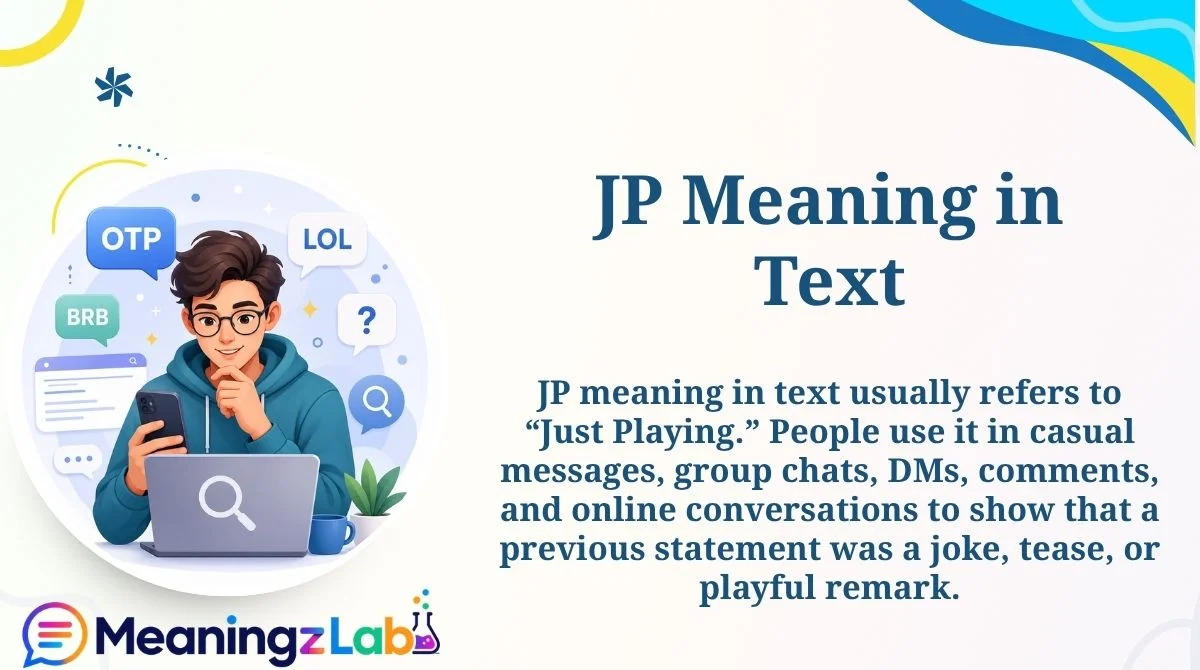
JP meaning in text usually refers to “Just Playing.” People use it in casual messages, group chats, DMs, comments, and online conversations to show that a previous statement was a joke, tease, or playful remark.
In simple terms, “JP” tells you not to take the previous message too seriously.
It can work much like “just kidding” or “I’m joking,” although not every reader will recognize it immediately.
Current abbreviation references list “Just Playing” as a texting and internet-slang use of JP.
Still, JP does not have one fixed meaning everywhere. In formal or non-chat settings, it can mean Justice of the Peace, while dictionaries also use lowercase “jp” for Japan in some contexts.
| Term | Most Common Meaning | Full Form | Typical Tone | Common Usage |
|---|---|---|---|---|
| JP | Just Playing | Just Playing | Playful, casual | Texts, DMs, group chats, social media |
What Does JP Mean in Text & Chat?
In casual texting, JP means “Just Playing.” It is usually added to a message when the sender wants to make it clear that they were joking, teasing, exaggerating, or messing around.
For example:
“You’re paying for my dinner tonight. JP 😂”
The first part sounds like a real demand. The “JP” changes the intended tone and tells the reader that the sender is only joking.
Direct answer
JP = Just Playing.
It is an informal texting abbreviation used to show that the speaker is not being serious about the statement immediately before it.
The expression can appear after a playful insult, a dramatic claim, a fake complaint, or an exaggerated statement. It is especially useful in text because written messages do not carry facial expressions or voice tone.
JP can make a message feel lighter:
“You seriously ruined the whole plan, JP 😂”
Here, the sender is probably teasing rather than making a genuine accusation.
However, context remains important. “JP” by itself does not automatically prove that every earlier statement was harmless. The relationship between the people, the subject being discussed, and the surrounding words all matter.
A close friend may understand:
“I hate you JP 😂”
as obvious playful banter.
Someone unfamiliar with the abbreviation may not understand it at all. For that reason, clearer phrases such as “just kidding” or “I’m joking” may be better when the topic is sensitive or the relationship is formal.
Full Form, Stands For & Short Meaning of JP
The most common texting expansion of JP is “Just Playing.” In this phrase, “playing” means fooling around, teasing, or joking rather than literally playing a game.
| JP | Meaning | Typical Use |
|---|---|---|
| JP | Just Playing | Casual texting and online slang |
| JP | Justice of the Peace | Legal or formal contexts |
| jp | Japan | Country or internet-domain context |
| JP | Initials | Personal names or usernames |
“Just Playing” is specifically documented as a texting, chat, slang, and internet-slang abbreviation.
The phrase is generally short and informal. It can be used after a joke to repair possible confusion without typing a longer explanation.
For example:
“You owe me a new phone. JP 😭”
The sender is not necessarily making a real financial demand. The abbreviation signals that the statement was playful.
JP vs. JK
JP is often compared with JK, which means “Just Kidding.” Both can tell someone that a previous statement was not serious.
The difference is mostly in phrasing and personal usage:
JP: “Just Playing”
JK: “Just Kidding”
There is no universal rule saying one must always be used in a certain type of joke. People may choose whichever abbreviation feels natural to them.
Because texting slang is informal, usage can vary between friend groups. One person may use JP regularly, while another person may prefer “lol,” “jk,” “just kidding,” or an emoji.
Origin, History & First Known Use of JP
There is no well-established, authoritative first-use date for JP meaning “Just Playing” in texting that can be stated confidently. That distinction matters because many online slang pages repeat specific dates or claims without showing reliable historical evidence.
The full phrase “Just Playing” is ordinary English, so its roots are much easier to understand than the history of the abbreviation itself. In casual speech, someone can say they are “just playing” to explain that they were not being serious. Text users can shorten that phrase to JP.
The abbreviation likely fits the broader pattern of digital shorthand, where longer expressions are reduced to a few letters for speed and convenience. Similar texting forms include “JK” for “just kidding” and many other short expressions.
However, it would be misleading to claim that JP was definitely invented on a specific date, by a particular website, or by a specific online community without dependable historical evidence.
Why first-use claims can be difficult
Internet slang often spreads informally. A phrase may appear in private messages, forums, chat rooms, gaming communities, or social networks before it is recorded in a dictionary or abbreviation database.
That means the date a website first documents JP is not necessarily the date the abbreviation was first used.
For readers researching JP meaning in text, the safest conclusion is simple: “Just Playing” is a recognized casual abbreviation, but its precise first texting use is not securely documented.
How People Use JP in Daily Conversations
People usually place JP after a statement that could be misunderstood as serious.
It can follow teasing, sarcasm, exaggeration, fake complaints, playful criticism, or an intentionally dramatic comment.
Playful teasing
“You really thought that outfit was a good idea. JP 😂”
Here, JP softens the criticism and makes it clear that the speaker is teasing.
A fake serious statement
“I’m blocking you forever. JP 😭”
The dramatic wording creates the joke. JP signals that the threat is not meant literally.
Sarcastic humor
“Wow, you answered in only three hours. JP 😂”
In this case, the sender is joking about the delay.
Friendly banter
“You’re officially the worst teammate ever, JP.”
The meaning depends heavily on the relationship. Between close friends, it may sound harmless. Between strangers, the same sentence could feel insulting.
Punctuation can also change the feel:
“JP 😂” usually feels openly playful.
“JP.” can sound flatter or harder to read.
“Jp haha” may feel more relaxed.
“JP!!!” can emphasize excitement.
The abbreviation is therefore only one part of the message. The words around it, punctuation, emojis, and relationship between the speakers help establish the actual tone.
JP Meaning Across WhatsApp, Instagram, TikTok & Snapchat
The “Just Playing” meaning of JP generally does not depend on one specific social platform. A person can use the abbreviation in WhatsApp messages, Instagram DMs, TikTok comments, Snapchat chats, gaming conversations, or other casual online spaces.
What changes is often the style of the conversation, not the underlying meaning.
| Platform | Possible JP Meaning | Typical Context |
|---|---|---|
| Just Playing | Private chats and group banter | |
| Just Playing | DMs, comments, replies | |
| TikTok | Just Playing | Casual comments or conversations |
| Snapchat | Just Playing | Short replies and friend chats |
For example, someone might write:
“You actually believed me? JP 😂”
That sentence can work on almost any casual messaging platform.
Does capitalization matter?
Usually, JP, jp, and Jp can represent the same intended slang phrase when the context is clearly casual. Capitalization is not a reliable way to determine the meaning.
However, lowercase “jp” can matter in another context. Dictionaries use jp as an abbreviation associated with Japan, while JP is also used for “Justice of the Peace.”
So the surrounding conversation is more useful than capitalization alone.
For a sensitive or serious conversation, relying on JP may create confusion. A clearer phrase such as “I’m just kidding” can remove uncertainty.
Different Meanings of JP in Other Fields
Although “Just Playing” is the main casual texting interpretation discussed here, JP has several other established uses.
JP as Justice of the Peace
In legal contexts, JP commonly stands for Justice of the Peace. Cambridge and Oxford both document this abbreviation. A Justice of the Peace is a local judicial official, with specific duties that vary by jurisdiction.
For example:
“The document must be witnessed by a JP.”
In that sentence, “Just Playing” would make no sense. The legal meaning is clearly intended.
JP as Japan
Dictionary references also use jp for Japan, including as the country-code internet domain associated with Japan.
For example:
“This product is available in JP only.”
The context points to Japan rather than texting slang.
JP as initials
JP may also simply be someone’s initials. For example, a person named Jordan Parker might use JP as a nickname, username, or signature.
Other specialized abbreviations
Acronyms can have additional meanings in business, technology, gaming, education, science, or individual organizations. These are context-specific rather than universal texting definitions.
The key rule is simple:
Casual joke + JP = likely “Just Playing.”
Legal context + JP = likely “Justice of the Peace.”
Country or travel context + JP = possibly Japan.
Common Confusions, Mistakes & Wrong Interpretations
The biggest problem with JP is not the phrase itself. It is context.
Because JP has multiple meanings, readers can easily assume the wrong expansion.
Mistake 1: Assuming JP always means “Just Playing”
If someone says:
“The case was heard by a JP.”
This almost certainly is not texting slang. A legal meaning makes much more sense.
Mistake 2: Assuming “playing” means gaming
In the texting phrase “Just Playing,” the word “playing” often means joking around. It does not necessarily mean playing a video game, sport, or physical activity.
For example:
“Relax, JP 😂”
can mean “Relax, I’m just joking.”
Mistake 3: Missing the tone
Consider:
“You’re impossible JP 😂”
The emoji helps show that the comment is playful.
Now compare:
“You’re impossible.”
Without additional context, the same words may sound genuinely annoyed.
Mistake 4: Using JP after a sensitive comment
A serious accusation, personal criticism, or emotionally painful joke may not become harmless simply because “JP” is added afterward.
For instance:
“I was going to tell everyone your private secret. JP.”
The abbreviation may be intended as a joke, but the message could still feel uncomfortable.
In sensitive conversations, clearer language is better.
A simple way to decode JP
Ask yourself:
- Was the message joking or exaggerated?
- Does “Just Playing” fit the sentence?
- Is this a legal, business, travel, or other specialized conversation?
- Does the relationship between the speakers suggest friendly teasing?
These clues usually make the intended meaning much easier to understand.
Similar Terms, Alternatives & Related Slang
Several texting expressions can perform a role similar to JP, especially when someone wants to show that a previous statement was not serious.
| Term | Meaning | Tone |
|---|---|---|
| JP | Just Playing | Playful, casual |
| JK | Just Kidding | Casual, joking |
| Just kidding | The statement was a joke | Clear, informal |
| Just joking | Not meant seriously | Direct and clear |
| LOL | Laughing out loud / humor marker | Casual |
| 😂 | Signals laughter or amusement | Very informal |
| I’m joking | Explicitly says it is a joke | Clear and direct |
JP vs. JK
The closest comparison is usually JK.
“Just Kidding” directly says that the speaker was kidding. “Just Playing” can have a similar function, but wording preferences differ from person to person.
For example:
“You’re paying for dinner, JK 😂”
and:
“You’re paying for dinner, JP 😂”
can communicate almost the same idea.
Which one is clearer?
For people who may not know internet slang, “I’m joking” or “just kidding” is easier to understand.
JP is most natural when the people involved already share the same casual texting style.
The goal is not to use the shortest possible abbreviation. The goal is to make your intended meaning clear.
Examples of JP in Real Chat Situations
Here are several realistic examples showing how JP meaning in text can change with tone and context.
Example 1: Friendly teasing
Person A: “You’re always late to everything.”
Person B: “That happened one time.”
Person A: “Sure, and I’m the president. JP 😂”
Tone: Playful and sarcastic. JP shows that the exaggeration is a joke.
Example 2: Fake complaint
Person A: “You finished the last slice of pizza!”
Person B: “I was hungry 😭”
Person A: “I’m never speaking to you again. JP 😂”
Tone: Lighthearted. The dramatic reaction is not meant literally.
Example 3: Playful compliment
Person A: “You actually did a great job on that presentation.”
Person B: “Thanks! I was nervous.”
Person A: “Don’t get too proud now, JP 😭”
Tone: Friendly teasing. The sender is still being positive.
Example 4: Sarcasm
Person A: “Sorry, I forgot to reply.”
Person B: “Only twelve hours late. Amazing service. JP 😂”
Tone: Sarcastic but probably playful, assuming the relationship supports that kind of humor.
Example 5: Confusing use
Person A: “I need JP for this form.”
Person B: “Sorry, what does JP mean?”
Tone: The meaning is unclear because the context does not point directly to “Just Playing.” Asking for clarification is reasonable.
Example 6: Rude-sounding joke
Person A: “You’re terrible at this game.”
Person B: “Okay…”
Person A: “JP 😅”
Tone: Intended as teasing, but the joke may still feel rude. JP explains the sender’s intention, but it does not automatically control how the receiver feels.
How to Reply When Someone Says JP
Your response should depend on what the sender appears to mean.
When the message is clearly playful
You can reply naturally:
“Haha, I knew you were joking 😂”
Or:
“You almost got me there.”
When you want to play along
“Very funny. You’re paying next time though 😂”
This keeps the same playful energy.
When the meaning is confusing
Ask directly:
“JP means just playing, right?”
That is often better than guessing.
When the message feels rude
You can calmly respond:
“I get that you were joking, but that came across a little harsh.”
This acknowledges the sender’s stated intention without pretending the wording was automatically comfortable.
When the situation is serious
Do not assume JP cancels out a serious statement.
You can say:
“Okay, but I’d rather know what you actually meant.”
The best response depends on both the message and the relationship. A close friend may invite a joking answer, while a stranger or coworker may call for a more direct response.
Is JP Still Popular? Trends & Online Usage
JP remains a recognized abbreviation for “Just Playing” in current texting and slang references in 2026. Contemporary abbreviation and texting-reference pages continue to list the phrase in connection with casual chat and internet slang.
However, there is an important difference between being recognized and being universally common.
There is no single authoritative public database that establishes how often people use JP to mean “Just Playing across all text messages, private chats, and social platforms. Because of that, it would be inaccurate to claim that JP is one of the most popular abbreviations online or that usage is increasing by a specific percentage.
What can be said with confidence?
JP is still understandable in some casual online contexts, especially when it follows a joke or teasing comment. It also exists alongside more familiar expressions such as “JK,” “just kidding,” emojis, and “lol.”
Digital slang also changes quickly. Different age groups, communities, countries, and friend groups may prefer different abbreviations.
For that reason, context matters more than trying to label JP as universally popular or unpopular.
If your goal is clarity, use the expression your audience is most likely to understand. In a close-friend chat, JP may feel natural. In a professional or sensitive conversation, writing “I’m joking” is usually clearer.
Frequently Asked Questions
What does JP mean in text?
In casual texting, JP most commonly means “Just Playing.” It usually tells someone that a previous comment was a joke, tease, or playful statement rather than a serious one.
Is JP a rude word in texting?
No. JP itself is not inherently rude. Its tone depends on the message before it, the relationship between the speakers, and the subject being discussed. A teasing message may feel friendly, while the same style of joke can feel hurtful in another situation.
What should I reply when someone says JP?
You can reply with something playful such as “Haha, you got me,” ask “You mean just playing?”, or respond more seriously if the original comment was uncomfortable. The right response depends on the conversation.
Does JP mean the same thing on WhatsApp, Instagram, TikTok, and Snapchat?
When it is used as texting slang, JP can carry the same “Just Playing” meaning across these platforms. The platform usually does not change the basic slang definition. Context still determines what the sender intended.
Can JP mean something other than Just Playing?
Yes. In formal contexts, JP can mean Justice of the Peace, an established legal abbreviation. Dictionaries also use jp in connection with Japan.
Is JP the same as JK?
They are similar but not identical abbreviations. JP commonly expands to “Just Playing,” while JK means “Just Kidding.” Both can signal that a previous statement was not meant seriously.
Can JP be used in professional messages?
It can be understood differently in professional settings, so it is usually better to avoid it unless you know exactly how your audience uses the abbreviation. Clear wording such as “I’m joking” reduces the chance of confusion.
What does JP mean at the end of a message?
When JP appears after a casual joke, tease, or exaggerated statement, it most likely means “Just Playing.” The sender is signaling that the previous message should not be taken literally or too seriously.
Conclusion
The most common JP meaning in text is “Just Playing.” In casual chats, it is used to show that a previous statement was meant as a joke, tease, exaggeration, or playful comment. It can make a message feel lighter and works in much the same way as “just kidding” in many conversations.
Still, JP is not limited to internet slang. In other contexts, it can mean Justice of the Peace, while dictionary entries also associate “jp” with Japan.
The easiest way to understand JP is to look at the full message, the conversation topic, and the relationship between the people involved. Once you consider that context, the intended meaning is usually much clearer. For more helpful explanations, explore other common text abbreviations, social-media slang, and chat terms.

Evan Rellmont is a content writer and researcher who specializes in internet slang, text abbreviations, and social media language. He creates clear, helpful content to make modern online communication easier to understand.