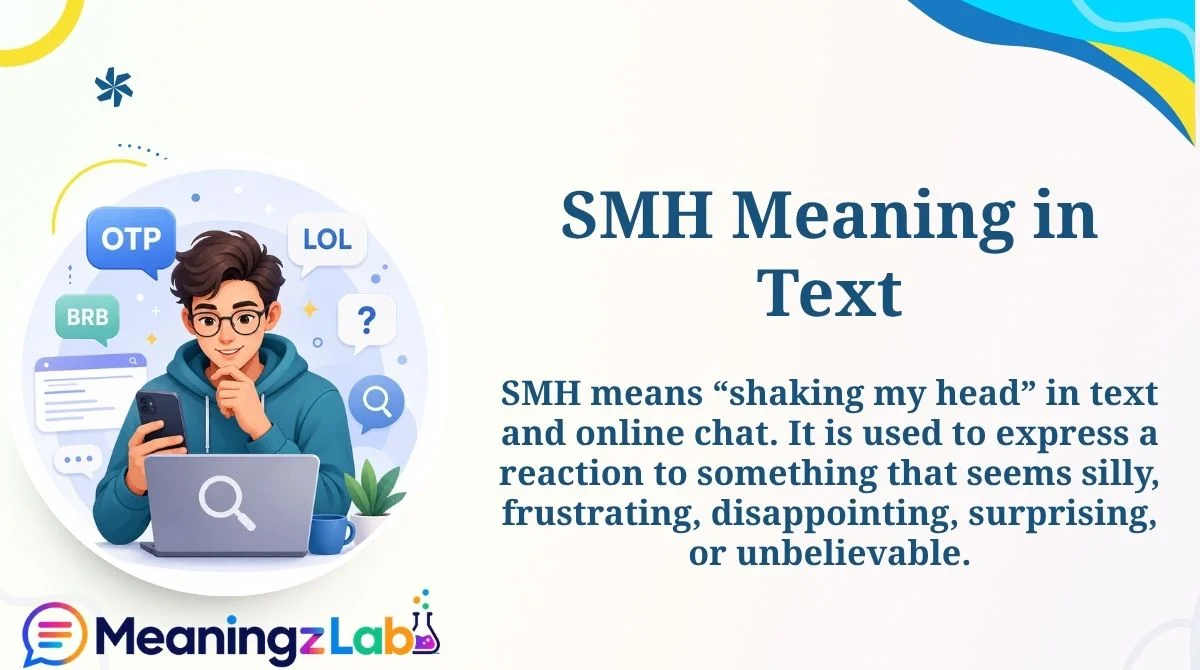
SMH meaning in text is most commonly “shaking my head.” People use this abbreviation when something seems foolish, frustrating, disappointing, unbelievable, or simply hard to understand.
Instead of typing the full phrase, users can write “SMH” to show their reaction quickly.
You may see SMH in text messages, group chats, comments, captions, and social media conversations.
Its tone depends on the situation. It can sound annoyed, amused, sarcastic, disappointed, or playful.
In this guide, you will learn what SMH means, what it stands for, how people use it, and how its tone changes with context.
You will also see real chat examples, platform-specific usage, common misunderstandings, related slang, and natural ways to reply.
| Term | Most Common Meaning | Full Form | Typical Tone | Common Usage |
|---|---|---|---|---|
| SMH | Shaking my head | Shaking my head | Disappointed, amused, annoyed, or sarcastic | Texts, chats, comments, social media |
What Does SMH Mean in Text & Chat?
SMH means “shaking my head” in text and online chat. It is used to express a reaction to something that seems silly, frustrating, disappointing, surprising, or unbelievable.
The literal phrase describes the action of shaking your head from side to side. Online, however, SMH usually represents an emotional reaction rather than an actual physical action.
For example:
“You forgot your keys again? SMH.”
The sender is probably not literally shaking their head. They are showing mild frustration or disbelief.
SMH can have several shades of meaning:
- Disappointment: “You had one job. SMH.”
- Disbelief: “He really said that? SMH.”
- Annoyance: “They changed the schedule again. SMH.”
- Amusement: “You tried to microwave ice cream? SMH 😂”
- Sarcasm: “Great idea, let’s arrive two hours late. SMH.”
- Playful teasing: “You bought another pair of sneakers? SMH 😭”
The surrounding message matters. “SMH” by itself can feel stronger because the reader has less context.
An emoji can soften or strengthen it. “SMH 😂” often sounds amused, while “SMH.” may sound more serious or irritated.
The relationship between the people also matters. Close friends may use SMH as harmless teasing. In a professional conversation, however, it can sound dismissive or disrespectful.
Direct answer
SMH = “shaking my head.” It usually communicates disbelief, disappointment, frustration, or amusement about someone’s action or statement.
Full Form, Stands For & Short Meaning of SMH
The full form of SMH is “shaking my head.”
It is an initialism made from the first letters of the words:
- S = Shaking
- M = My
- H = Head
The short meaning is essentially: “I can’t believe this,” “That’s disappointing,” or “What are you doing?”
However, there is no single emotion attached to SMH. The meaning depends on context.
Consider these two messages:
“You lost your phone again. SMH.”
This likely expresses frustration or disappointment.
“You really thought a potato could grow overnight? SMH 😂”
This is more likely playful teasing.
So, translating SMH simply as “shaking my head” gives you the full form, but not always the complete emotional meaning. In conversation, the expression often carries an implied reaction.
| SMH Use | Possible Meaning |
|---|---|
| SMH. | Disappointment or annoyance |
| SMH 😂 | Amusement or playful disbelief |
| SMH 😭 | Overwhelmed amusement or disbelief |
| SMH… | Frustration, disappointment, or disbelief |
| “SMH, seriously?” | Stronger annoyance or disbelief |
| “You’re cconfused 😂 SMH” | Friendly teasing |
Capitalization is not always important. SMH, smh, and Smh generally refer to the same expression.
Still, formatting can affect the feeling. A short “smh” in lowercase may look casual, while “SMH!!!” can appear more dramatic.
Origin, History & First Known Use of SMH
The phrase “shaking my head” existed long before internet slang. People have naturally used head-shaking as a gesture of disagreement, disbelief, disappointment, or frustration for a very long time.
The abbreviation SMH developed as part of the broader growth of internet and mobile communication. As people began using shorter expressions in online communities, forums, instant messages, and text conversations, phrases such as “shaking my head” could be reduced to their initials.
SMH became especially recognizable during the expansion of social media and smartphone messaging. Its exact first use is difficult to establish with certainty, so it would be misleading to assign a precise inventor or single confirmed starting date.
This is an important distinction when discussing slang. Online abbreviations often emerge gradually. Different communities may use an expression at different times, making a single “first use” difficult to prove.
The expression also fits naturally with the culture of fast digital communication. Typing three letters is much quicker than writing “shaking my head.”
Over time, SMH moved beyond private text messages. It became common in online comments, social posts, group conversations, memes, and casual digital writing.
Its meaning has remained fairly stable. The basic idea is still a reaction of disbelief, disappointment, frustration, or amusement.
What has changed is the way people use it. Emojis, GIFs, punctuation, and surrounding text can now make SMH feel serious, funny, sarcastic, or affectionate.
So, the safest explanation is that SMH developed as internet and texting shorthand rather than having one clearly documented creator or universally agreed first appearance.
How People Use SMH in Daily Conversations
People use SMH when they want to react quickly to something another person has said or done.
It often appears after an event that seems unreasonable or silly.
For example:
Person A: “I left my lunch at home again.”
Person B: “SMH 😂”
Here, the response is probably friendly teasing rather than serious criticism.
SMH can also express genuine disappointment:
Person A: “The store canceled my order after I waited all week.”
Person B: “SMH. That’s so frustrating.”
In this case, SMH adds emotional emphasis.
The expression is especially useful when the sender wants to communicate a reaction without explaining everything. It works almost like a small emotional shortcut.
Tone depends on context
| Context | Likely Tone |
|---|---|
| Friend makes a silly mistake | Playful |
| Someone behaves irresponsibly | Critical or disappointed |
| Unexpected bad news | Frustrated |
| Funny mistake | Amused |
| Argument | Potentially dismissive |
| Casual meme | Humorous |
| Professional conversation | Often too informal |
Punctuation also matters.
“SMH 😂” feels lighter.
“SMH.” may feel colder.
“SMH!!!” can sound dramatic or strongly annoyed.
“smh 😭” can communicate exaggerated disbelief or laughter.
The safest approach is to read the entire message rather than interpreting the three letters alone.
SMH Meaning Across WhatsApp, Instagram, TikTok & Snapchat
The basic SMH meaning usually stays the same across WhatsApp, Instagram, TikTok, and Snapchat: “shaking my head.”
The platform does not normally create a completely different definition. Instead, the style of conversation can influence how SMH feels.
On WhatsApp, SMH often appears in private chats and group conversations. Friends may use it after a funny mistake or frustrating event.
On Instagram, you may see SMH in comments, replies, captions, or direct messages. It can react to a surprising post or a friend’s decision.
On TikTok, SMH may appear in comments or captions as a quick reaction to a video. Because TikTok conversations often involve humor, SMH can be playful or exaggerated.
On Snapchat, the abbreviation can appear in quick messages between friends. It often works as a casual reaction rather than a formal statement.
| Platform | Common SMH Context | Typical Feeling |
|---|---|---|
| Chats and group messages | Casual, annoyed, playful | |
| Comments, DMs, captions | Reactive, humorous, sarcastic | |
| TikTok | Video comments and captions | Humorous, surprised, dramatic |
| Snapchat | Short friend-to-friend messages | Casual, teasing |
| Text messages | Personal conversations | Highly context-dependent |
The main difference is not the dictionary meaning. It is the social setting.
A message such as “SMH 😂” under a funny TikTok may be lighthearted. The same “SMH.” during an argument could feel dismissive.
Therefore, when someone asks what SMH means on a particular platform, the core definition remains the same. Context changes the tone more than the platform changes the meaning.
Different Meanings of SMH in Other Fields
In everyday texting and social media, SMH overwhelmingly means “shaking my head.” That is the meaning most people expect when they see it in a casual digital conversation.
However, abbreviations can have different meanings in specialized settings. A sequence of letters may represent a technical term, organization, title, or other phrase depending on the subject.
This does not mean every alternative expansion is relevant to texting. If someone sends:
“SMH, I can’t believe you did that.”
the intended meaning is almost certainly “shaking my head.”
The context should always come first.
For example, a medical, academic, business, gaming, or technical document may use abbreviations that are unrelated to internet slang. In such cases, interpreting every abbreviation as social-media slang could create confusion.
How to identify the intended meaning
Ask yourself:
- Is this a casual conversation?
If yes, “shaking my head” is the obvious interpretation. - Is it part of a social media comment or text?
SMH almost certainly refers to “shaking my head.” - Is it inside a specialized document?
Look at the surrounding terminology before deciding. - Does the sentence describe someone’s behavior or a frustrating event?
That strongly supports the slang meaning.
For readers searching specifically for SMH meaning in text, the key takeaway is simple: “shaking my head” is the standard interpretation.
Rare or field-specific meanings should not replace the common texting definition without clear contextual evidence.
Common Confusions, Mistakes & Wrong Interpretations
One common mistake is assuming that SMH always means anger. It does not.
Someone can use SMH while laughing, joking, teasing, or expressing mild disbelief.
For example:
“You put ketchup on ice cream? SMH 😂”
This is probably humorous.
Another mistake is treating SMH as an insult every time it appears. The abbreviation can be critical, but the relationship between the speakers matters.
A close friend might write:
“You forgot your wallet again? SMH 😭”
The message may be affectionate teasing.
A stranger might write:
“SMH. People like you are unbelievable.”
That sounds much harsher.
SMH vs. literal head shaking
SMH is usually figurative in text. The sender normally does not mean that they are physically shaking their head at that exact moment.
SMH vs. “I disagree”
SMH can suggest disagreement, but it is broader than simply saying “I disagree.” It may express disappointment, disbelief, annoyance, amusement, or frustration.
SMH vs. “LOL”
These abbreviations serve different purposes.
- SMH = shaking my head
- LOL = laughing out loud
However, they can appear together.
“You really did that? SMH LOL.”
Here, the sender may find the situation both ridiculous and funny.
Punctuation can change the impression
Compare:
- “smh 😂” — playful
- “SMH.” — possibly annoyed
- “SMH…” — disappointed or tired
- “SMH!!!” — dramatic or strongly frustrated
So, never judge the meaning from the letters alone.
Similar Terms, Alternatives & Related Slang
Several internet expressions can communicate feelings similar to SMH, but they are not exact replacements.
Facepalm is closely related. It usually suggests that someone has done something foolish or embarrassing.
OMG means “oh my God” and often expresses surprise, shock, excitement, or disbelief.
WTF can express strong surprise, confusion, or frustration, but it is more intense and can be inappropriate in some settings.
LOL focuses on laughter rather than disappointment or disbelief.
IDK means “I don’t know,” so it communicates uncertainty rather than a head-shaking reaction.
FR means “for real” and is often used to show agreement or emphasize that something is true.
| Term | Main Meaning | Typical Feeling |
|---|---|---|
| SMH | Shaking my head | Disbelief, frustration, disappointment |
| Facepalm | That was foolish/embarrassing | Exasperation |
| OMG | Oh my God | Surprise or shock |
| LOL | Laughing out loud | Amusement |
| WTF | Strong surprise/confusion | Intense reaction |
| FR | For real | Agreement/emphasis |
| IDK | I don’t know | Uncertainty |
The closest alternative depends on what the sender wants to express.
If they are disappointed, SMH may fit best. If they are laughing, LOL may be more suitable. If they are shocked, OMG might communicate the reaction more clearly.
Examples of SMH in Real Chat Situations
Real conversations show why context matters. The same abbreviation can sound completely different depending on the words around it.
Example 1: Friendly teasing
Person A: “I spent twenty minutes looking for my glasses while they were on my head.”
Person B: “SMH 😂 You never learn.”
Tone: Playful and humorous. Person B is teasing rather than seriously criticizing.
Example 2: Disappointment
Person A: “He promised he would help, then canceled five minutes before we started.”
Person B: “SMH. That’s disappointing.”
Tone: Genuine frustration or disappointment.
Example 3: Funny mistake
Person A: “I put my cereal in the fridge and the milk in the cupboard.”
Person B: “SMH 😭 How are you even functioning today?”
Tone: Amused and affectionate.
Example 4: Sarcasm
Person A: “Let’s leave late again. I’m sure traffic will magically disappear.”
Person B: “SMH 😂 Brilliant plan.”
Tone: Sarcastic. The sender does not really think it is a brilliant plan.
Example 5: Short reaction
Person A: “I forgot the tickets.”
Person B: “SMH…”
Tone: Likely frustration or disbelief. The three dots make the reaction feel heavier.
Example 6: Potentially rude
Person A: “I made a mistake on the report.”
Person B: “SMH.”
Tone: Depending on the relationship, this may sound dismissive or judgmental. In a workplace setting, a clearer and more helpful response would usually be better.
These examples show an important rule: SMH does not have one fixed emotional intensity.
How to Reply When Someone Says SMH
Your best response depends on why the person used SMH.
If they are joking, you can joke back.
If they are genuinely frustrated, acknowledge the situation.
If you do not understand why they said it, ask.
Serious situation
Person A: “You missed the deadline again. SMH.”
Person B: “I understand why you’re frustrated. I’ll make sure it gets done today.”
This response works because it addresses the concern instead of escalating the conversation.
Playful situation
Person A: “You ordered dessert after saying you weren’t hungry. SMH 😂”
Person B: “The dessert made me change my mind. 😭”
This keeps the conversation light.
Confusing situation
Person A: “SMH.”
Person B: “Wait, what did I do? 😅”
This is useful when you genuinely do not know what caused the reaction.
When it feels rude
Person A: “SMH. Seriously?”
Person B: “If something bothered you, just tell me what happened.”
This response is direct without becoming aggressive.
Simple replies you can use
Depending on the situation, you might respond with:
- “Haha, I know 😂”
- “What? 😭”
- “Fair enough.”
- “I messed up. My bad.”
- “Why are you shaking your head? 😂”
- “I honestly didn’t mean to.”
- “Okay, explain. 😅”
The key is to match the emotional level of the conversation.
Is SMH Still Popular? Trends & Online Usage
SMH remains a recognizable internet and texting abbreviation in 2026. People who are familiar with online slang can generally understand it without needing the phrase spelled out.
That does not mean every age group, community, or platform uses SMH in exactly the same way. Internet language changes constantly, and some abbreviations become less common while others appear or gain new meanings.
SMH has an advantage because it is short and easy to understand. It also describes a reaction that people frequently want to express online: disbelief, frustration, disappointment, or amused exasperation.
Its continued usefulness does not depend on a single social media platform. You can encounter it in text messages, comments, group chats, memes, and other casual online conversations.
However, usage style can vary.
Some people write “smh” in lowercase because it feels relaxed. Others use “SMH” in uppercase for emphasis. Emojis can also make the expression feel more humorous.
For example:
- “smh” — casual
- “SMH 😂” — amused
- “SMH 😭” — dramatic or humorously overwhelmed
- “SMH…” — disappointed or tired
- “SMH!!!” — strongly emphasized
The important point is that SMH remains understandable, but its tone is shaped by modern conversational style.
It is best viewed as an established piece of casual internet shorthand rather than assuming it has one fixed level of popularity across every online community.
Frequently Asked Questions
What does SMH mean in text?
SMH most commonly means “shaking my head.” It expresses disbelief, disappointment, frustration, annoyance, or sometimes amusement about something someone said or did.
What does SMH mean on WhatsApp?
On WhatsApp, SMH usually means “shaking my head.” Friends may use it after a silly mistake, frustrating event, surprising statement, or funny situation.
Is SMH rude?
SMH is not automatically rude. It can be playful among friends, but it may sound dismissive or judgmental when used during a serious argument or toward someone you do not know well.
What does SMH mean from a girl or guy?
The meaning does not change based on whether the sender is a girl or a guy. SMH still normally means “shaking my head.” The surrounding message and relationship matter more than the sender’s gender.
What is a good reply to SMH?
A good reply depends on the tone. You could say “What? 😂,” “I know, I messed up,” “Fair enough,” or “Why are you shaking your head? 😅” if the situation is unclear.
Does SMH mean “so much hate”?
In ordinary texting and social media, SMH most commonly means “shaking my head.” Other expansions may exist in specialized contexts, but they should not be assumed without supporting context.
What is the difference between SMH and LOL?
SMH usually expresses disbelief, frustration, disappointment, or amused exasperation. LOL primarily indicates laughter or amusement. They can also appear together when something is both ridiculous and funny.
Can SMH be used jokingly?
Yes. SMH is often used jokingly between friends. Emojis such as 😂 or 😭 can make the message feel more playful and reduce the chance that it will be read as serious criticism.
Does SMH mean the same thing on TikTok and Instagram?
Generally, yes. On both platforms, SMH usually means “shaking my head.” The content and surrounding comments determine whether it sounds funny, sarcastic, annoyed, or disappointed.
Conclusion
SMH meaning in text is most commonly “shaking my head.” It is a short way to react when something seems frustrating, disappointing, silly, surprising, or unbelievable. Depending on the situation, it can sound serious, sarcastic, playful, amused, or even affectionate.
The letters themselves do not tell the whole story. Words around SMH, punctuation, emojis, and the relationship between the people can greatly change its tone. For example, “SMH 😂” usually feels lighter than “SMH.”
SMH is mainly used in casual digital communication, including text messages, group chats, comments, and social media. Its core meaning remains fairly consistent even when the platform changes.
Now that you know what SMH means, you can better understand it in everyday online conversations. Explore other common texting abbreviations to become even more confident with modern internet slang.
Meta Description:
SMH meaning in text explained for 2026. Learn what SMH stands for, its tone, social media usage, examples, and natural replies.

Evan Rellmont is a content writer and researcher who specializes in internet slang, text abbreviations, and social media language. He creates clear, helpful content to make modern online communication easier to understand.