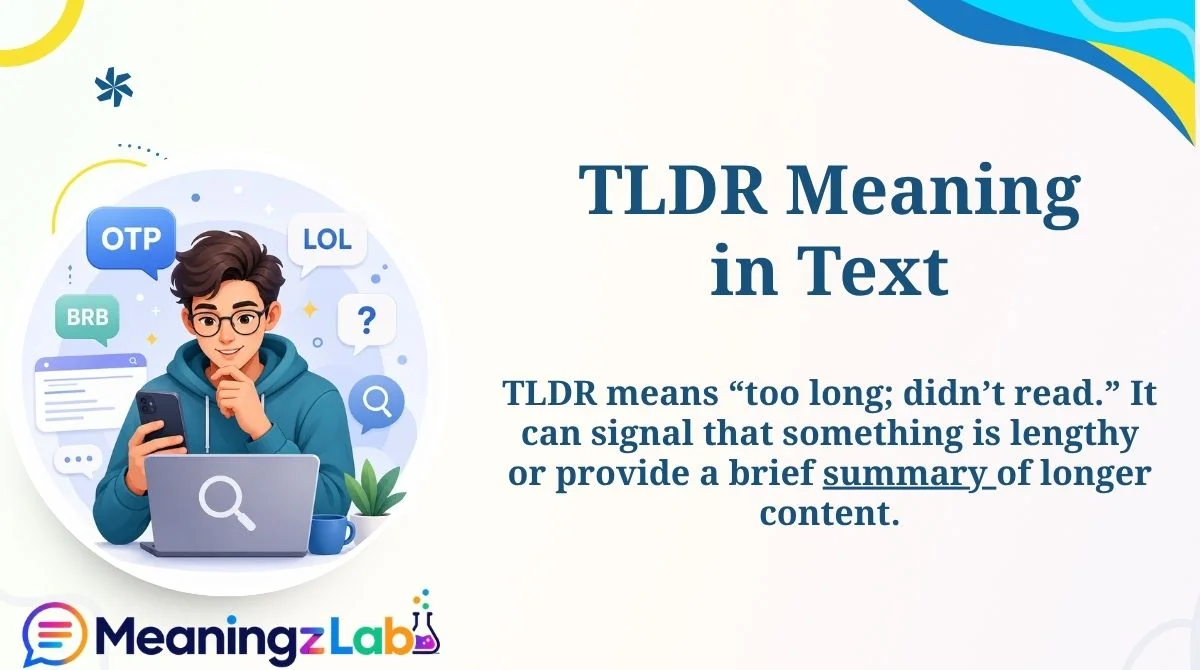
TLDR meaning in text is usually “too long; didn’t read.” People use TLDR when a message, post, article, or explanation feels too long to read in full. It can also introduce a short summary that gives the main point quickly.
You may see TLDR, TL;DR, tldr, or tl;dr in text messages, comments, Reddit posts, emails, online discussions, and social media.
The meaning normally stays the same, but the tone depends on how it is used.
A person saying “TLDR” to someone else can sound blunt, while “TLDR:” followed by a summary is often helpful and practical.
This guide explains the full form, history, everyday meaning, platform usage, common misunderstandings, examples, replies, and current use of TLDR.
| Term | Most Common Meaning | Full Form | Typical Tone | Common Usage |
|---|---|---|---|---|
| TLDR / TL;DR | Too long; didn’t read | Too long; didn’t read | Neutral, helpful, or blunt | Texts, posts, comments, articles, chats |
Quick answer:
TLDR means “too long; didn’t read.” It can signal that something is lengthy or provide a brief summary of longer content.
What Does TLDR Mean in Text & Chat?
In text and chat, TLDR means “too long; didn’t read.” It is used when someone thinks a message, explanation, or post is too lengthy or when they want to give the main point without making others read everything.
There are two main ways TLDR appears in conversations. First, a reader may use it as a reaction:
“TLDR, what happened?”
Here, the person is asking for a shorter explanation.
Second, a writer may use it before a summary:
“TLDR: The meeting was moved to Friday.”
In this case, TLDR is not a complaint. It is a quick-summary label.
That difference matters. The same abbreviation can sound helpful or dismissive depending on who writes it and where it appears. Dictionaries recognize TLDR both as an expression about text being too long and as a noun referring to a short summary of longer material.
In casual texting, people usually understand TLDR without further explanation. It is especially useful when a conversation contains a long story, detailed instructions, or a large block of information.
The abbreviation is usually informal. It fits friends, online communities, social platforms, gaming chats, and relaxed workplace communication. In formal writing, it is better to use a phrase such as “summary” unless the audience already knows the abbreviation.
Full Form, Stands For & Short Meaning of TLDR
The most common full form of TLDR is “too long; didn’t read.” The semicolon is common in the traditional form TL;DR, although many people now write the abbreviation simply as TLDR. Cambridge, Oxford, Merriam-Webster, and other major dictionaries recognize these forms.
Here is the simplest breakdown:
| Part | Meaning |
|---|---|
| TL | Too long |
| DR | Didn’t read |
| TL;DR | Too long; didn’t read |
| TLDR | Same meaning without punctuation |
A useful short meaning is “give me the summary” when TLDR appears before or after a long explanation.
However, context changes the exact message. A standalone “TLDR” may mean, “That was too long, and I did not read it.” A phrase such as “TLDR: We won” usually means, “Here is the important part in a shorter form.”
Oxford describes TL;DR as an informal abbreviation used in response to an online post either to show disapproval or to provide a summary.
You may also see related forms such as TL;DR version, TLDR summary, or the TLDR is… These expressions treat TLDR almost like a regular noun.
For example:
“What’s the TLDR of the meeting?”
The speaker is simply asking for the main takeaway.
Origin, History & First Known Use of TLDR
TLDR grew out of early internet communication, where users often shared long posts and discussions. Its exact creator is not clearly established, so it would be inaccurate to claim that one specific person invented it.
The historical record is also more precise than many internet explanations suggest. Merriam-Webster lists 2002 as the first known use of TL;DR in the sense “too long; didn’t read.” Dictionary.com gives a broader recorded range of 2000–2005, reflecting the development of the expression in digital communication.
The abbreviation fits the culture of early online forums because users could react quickly to lengthy posts without writing a full explanation. Over time, the meaning became more useful and less negative.
Instead of using TLDR only as a complaint, writers began placing it next to their own summaries. This changed the practical role of the expression. Today, a writer may spend several paragraphs explaining an issue and then add:
“TLDR: The cheaper option is better for most users.”
In that form, TLDR helps readers scan information.
This shift explains why the expression can have two very different tones. Historically, it could be dismissive. In modern online writing, it is also a convenient label for a summary. Major dictionaries now record both uses.
So, while TLDR has roots in older internet culture, its basic idea remains useful: make a long message easier to understand quickly.
How People Use TLDR in Daily Conversations
People use TLDR in several simple ways during everyday conversations.
The first is as a request for a shorter explanation. Someone may receive a long story and reply:
“TLDR?”
That usually means, “What is the main point?”
The second use is as a quick summary. Someone might send several messages explaining a problem and finish with:
“TLDR: I’m going to cancel the trip.”
Here, the writer is helping the reader save time.
A third use is playful. Friends may write “TLDR” after a very detailed story, even when they actually read it. The abbreviation can become a light joke about someone’s tendency to over-explain.
A fourth use can sound rude. If someone sends a thoughtful or personal message and the reply is simply “TLDR,” it may feel dismissive. The problem is not the abbreviation itself. The issue is the social context.
As a reader
When you write “TLDR?” you are usually asking for the main point. It is short and informal.
As a writer
When you write “TLDR:” before a sentence or short paragraph, you are normally helping the reader find the key information.
The tone can change with punctuation and wording:
| Message | Likely Tone |
|---|---|
| “TLDR?” | Direct, curious |
| “TLDR 😂” | Playful |
| “TLDR: We’re meeting at 7.” | Helpful |
| “TLDR. Not reading all that.” | Blunt or dismissive |
| “Here’s the TLDR for anyone in a hurry:” | Helpful and considerate |
TLDR Meaning Across WhatsApp, Instagram, TikTok & Snapchat
The meaning of TLDR usually does not change across platforms. Whether you see it on WhatsApp, Instagram, TikTok, Snapchat, Reddit, or another social platform, it generally refers to “too long; didn’t read” or a short summary of longer content.
What can change is the style of the conversation.
On WhatsApp, TLDR may appear after a long personal story or a detailed explanation. A friend may ask for a shorter version.
On Instagram, you might see TLDR in comments, captions, or discussions when someone posts a long explanation. It can also be used jokingly among followers.
On TikTok, the abbreviation may appear in captions or comments as a quick way to ask for the main point of a long explanation.
On Snapchat, where communication is often brief and casual, TLDR can act as a quick request for context.
The platform rarely changes the dictionary meaning. The surrounding words and relationship matter more.
For example:
“TLDR 😂 what happened?”
sounds friendly and playful.
Compare that with:
“TLDR. I’m not reading all that.”
The second message is much more dismissive.
A professional group chat may also use TLDR to make long information easier to scan:
“TLDR: The deadline is Tuesday at 5 PM.”
That use is practical rather than rude.
So, when interpreting TLDR on different apps, focus less on the platform and more on who wrote it, what came before it, and whether a summary follows it.
Different Meanings of TLDR in Other Fields
Outside casual internet language, TLDR has one dominant meaning but can also function grammatically in different ways.
The primary expansion remains “too long; didn’t read.” Major dictionaries also recognize TLDR as a noun meaning a short summary or the essential point of a longer discussion.
For example:
“Can you send me the TLDR?”
Here, TLDR acts like a noun. The person is asking for the summary.
Another example is:
“The TLDR version is much easier to understand.”
Again, TLDR means the shortened version.
In online writing, you may find a heading such as “TLDR” above a short paragraph. This is especially useful when readers want the conclusion before reading the full explanation.
There is also a subtle difference between TLDR as a reaction and TLDR as a summary label:
| Form | Meaning |
|---|---|
| “TLDR.” | I did not read it because it was too long. |
| “TLDR?” | Give me the short version. |
| “TLDR: …” | Here is the short version. |
| “The TLDR is…” | The main takeaway is… |
You may encounter alternative expansions online, but “too long; didn’t read” is the standard and best-known meaning supported by major English dictionaries.
Therefore, readers should not assume a technical meaning simply because TLDR appears in a workplace, academic, or professional setting. In most digital communication, the ordinary internet meaning is intended.
Common Confusions, Mistakes & Wrong Interpretations
One common mistake is assuming that TLDR always means the speaker is being rude. That is not true. It can be dismissive, but it can also be a helpful summary label.
Another mistake is thinking that TLDR always means the writer did not read the content. When someone writes:
“TLDR: The product is not worth the extra cost.”
they are providing a summary, not admitting that they skipped the material.
People also sometimes confuse TLDR with “summary” in every situation. The ideas are closely related, but TLDR carries an informal internet tone. “Summary” is neutral and suitable for almost any setting.
Formatting can create confusion too:
“TLDR?” is often a request.
“TLDR:” usually introduces a summary.
“TLDR 😂” may be playful.
“TLDR. Next.” can sound impatient.
The relationship between people matters as well. A close friend may use TLDR jokingly without causing offense. A stranger or coworker using it after a serious message could sound careless.
Another issue is pronunciation and spelling. Some people write TL;DR, others use TLDR, and lowercase forms such as tldr are also common. These variants generally refer to the same expression.
The safest interpretation is to look at the surrounding sentence before deciding whether TLDR is helpful, neutral, or dismissive.
Similar Terms, Alternatives & Related Slang
TLDR belongs to a wider group of internet abbreviations designed to save time and space.
The closest alternatives depend on what the speaker wants. If someone asks for a shorter version, phrases like “short version,” “main point,” “quick summary,” or “bottom line” can express a similar idea without using slang.
Here is a simple comparison:
| Term | Meaning | Typical Tone |
|---|---|---|
| TLDR | Too long; didn’t read / short summary | Informal |
| Summary | Main points in shorter form | Neutral |
| Short version | Condensed explanation | Neutral |
| Bottom line | Most important conclusion | Casual to professional |
| In short | Brief restatement | Neutral |
| Key takeaway | Most important lesson or point | Professional |
TLDR is more internet-focused than these alternatives. It feels natural in chats, comments, forums, and social media.
For example:
“Can you give me the TLDR?”
is casual.
A professional alternative might be:
“Could you give me the key takeaway?”
The meaning is similar, but the tone is different.
This is why choosing the right phrase matters. TLDR is useful when the audience knows online shorthand and the conversation is informal. In formal documents, reports, or official communication, summary or key takeaway is often clearer.
Understanding these related terms also helps readers interpret TLDR without treating every use as slang or sarcasm.
Examples of TLDR in Real Chat Situations
Here are realistic examples showing how the meaning and tone can change.
Example 1 — Asking for the short version
Person A: “I spent the whole afternoon dealing with the bank because they changed the account rules and asked me to submit three new forms.”
Person B: “TLDR? 😅”
Meaning: Person B wants the main point in a shorter form. The emoji makes the request sound light rather than harsh.
Example 2 — Helpful summary
Person A: “I checked the train schedule, hotel prices, and weather forecast. We can leave Friday morning, stay two nights, and come back Sunday evening.”
Person B: “TLDR: Friday to Sunday trip. Got it!”
Meaning: TLDR is being used to identify the key information.
Example 3 — Playful
Person A: “So first we went to the café, then my cousin called, then we missed the bus, then we walked halfway home…”
Person B: “TLDR 😂 you got home late.”
Meaning: The speaker is joking about the long story.
Example 4 — Potentially rude
Person A: “I wanted to explain why I could not attend yesterday. I had a family issue and needed to—”
Person B: “TLDR. Just tell me what happened.”
Meaning: This sounds impatient and dismissive because the subject is personal and the wording is blunt.
Example 5 — Casual workplace use
Person A: “I reviewed the project notes and updated the pricing spreadsheet. There are still two items that need approval.”
Person B: “Thanks. TLDR: two approvals are still pending?”
Meaning: The speaker is checking the main takeaway. The tone is neutral and practical.
How to Reply When Someone Says TLDR
Your best reply depends on what the person means by TLDR.
When someone asks “TLDR?”, give them the main point first. There is no need to repeat every detail.
For example:
“TLDR: The event starts at 8 PM and tickets are sold out.”
When someone says TLDR jokingly, you can answer in the same playful style:
“😂 Fine. The short version is: I was late.”
When TLDR seems rude, you do not have to match the tone. A calm response usually works better:
“The short version is that something urgent came up, so I couldn’t make it.”
If you are unsure what the person wants, you can ask:
“Do you want the one-sentence version?”
That avoids confusion.
Here are some useful response patterns:
| Situation | Possible Reply |
|---|---|
| Serious | “The main point is that the deadline changed.” |
| Playful | “😂 TLDR: I survived.” |
| Confusing | “Do you want the short version?” |
| Rude | “The key point is that I had a family emergency.” |
| Professional | “TLDR: We need final approval before launch.” |
The biggest tip is simple: answer the point, not the abbreviation. If someone uses TLDR to ask for a summary, give them the information they actually need.
Is TLDR Still Popular? Trends & Online Usage
Yes. TLDR remains a recognized internet and messaging abbreviation in 2026. Major English dictionaries continue to list TLDR or TL;DR as an informal expression connected with online posts, messaging, social media, and summaries.
Its staying power comes from a simple idea: people often want the main point quickly.
The abbreviation is also flexible. It can be used at the beginning of a post, at the end of a long explanation, inside a chat, or as a direct response to someone else’s message. Merriam-Webster records both the “too long; didn’t read” reaction and the use of TL;DR as a brief main point or summary.
Its tone has also become broader than the original dismissive use. A person can use TLDR as a joke, a shortcut, a polite summary tool, or a blunt reaction.
That means the expression is best understood as context-sensitive internet shorthand, not as a phrase with only one emotional meaning.
You may also notice the punctuation becoming less consistent. TL;DR, TLDR, tl;dr, and tldr can all be used. The spelling does not usually change the meaning.
So, while online language changes quickly, TLDR continues to be easy to recognize because it solves a practical communication problem: getting the key message without reading every word.
Frequently Asked Questions
What does TLDR mean in text?
TLDR means “too long; didn’t read.” It can describe a long message or introduce a brief summary of longer content.
Is TLDR rude?
It can be rude when used as a blunt response to another person’s long message. However, “TLDR:” followed by a summary is usually helpful and neutral.
What does TLDR stand for?
TLDR stands for “too long; didn’t read.” The most traditional spelling is TL;DR, but TLDR is also widely used.
What should I reply to TLDR?
If someone writes “TLDR?” give them the main point in one or two sentences. If they use it jokingly, you can respond with a light summary.
Does TLDR mean the same thing on WhatsApp and Instagram?
Yes. The core meaning usually stays the same across messaging and social platforms. The tone changes more often than the definition.
Is TLDR an acronym or abbreviation?
TLDR is commonly described as an abbreviation or initialism formed from the first letters of “too long; didn’t read.” Dictionaries use the term “abbreviation” for it.
Can TLDR mean a summary?
Yes. In modern online usage, a TLDR can mean the short version or main point of a longer explanation. Major dictionaries recognize this noun use.
Conclusion
The most common TLDR meaning in text is “too long; didn’t read.” It is used in chats, comments, social media, forums, emails, and other digital conversations to signal that something is lengthy or to provide a quick summary.
The important part is context. “TLDR?” usually asks for the short version, while “TLDR:” often introduces a helpful summary. A standalone “TLDR” can also sound blunt or dismissive, especially after a serious or personal message.
You may see the term written as TLDR, TL;DR, tldr, or tl;dr, but the basic meaning remains the same. Once you understand the tone and context, this common internet abbreviation is easy to recognize and use.
For more explanations like this, explore other popular text abbreviations, chat slang, and social media meanings.

Evan Rellmont is a content writer and researcher who specializes in internet slang, text abbreviations, and social media language. He creates clear, helpful content to make modern online communication easier to understand.