WTM meaning in text most commonly refers to “What’s the Move?” It is a casual way to ask about plans, activities, or what people should do next.
In a group chat, for example, someone might type “WTM tonight?” when they want to know what everyone is planning.
Current slang references also list “What’s the Matter?” and “Whatever That Means” as established alternative meanings, so context matters.
You may see WTM in text messages, group chats, Snapchat, TikTok, Instagram, WhatsApp, gaming conversations, and other informal online spaces.
This guide explains the main meanings, tone, possible replies, platform use, common mistakes, examples, and what current references can tell us about WTM in 2026.
| Term | Most Common Meaning | Full Form | Typical Tone | Common Usage |
|---|---|---|---|---|
| WTM | What’s the Move? | What’s the Move? | Casual, friendly | Asking about plans or what to do next |
Quick answer:
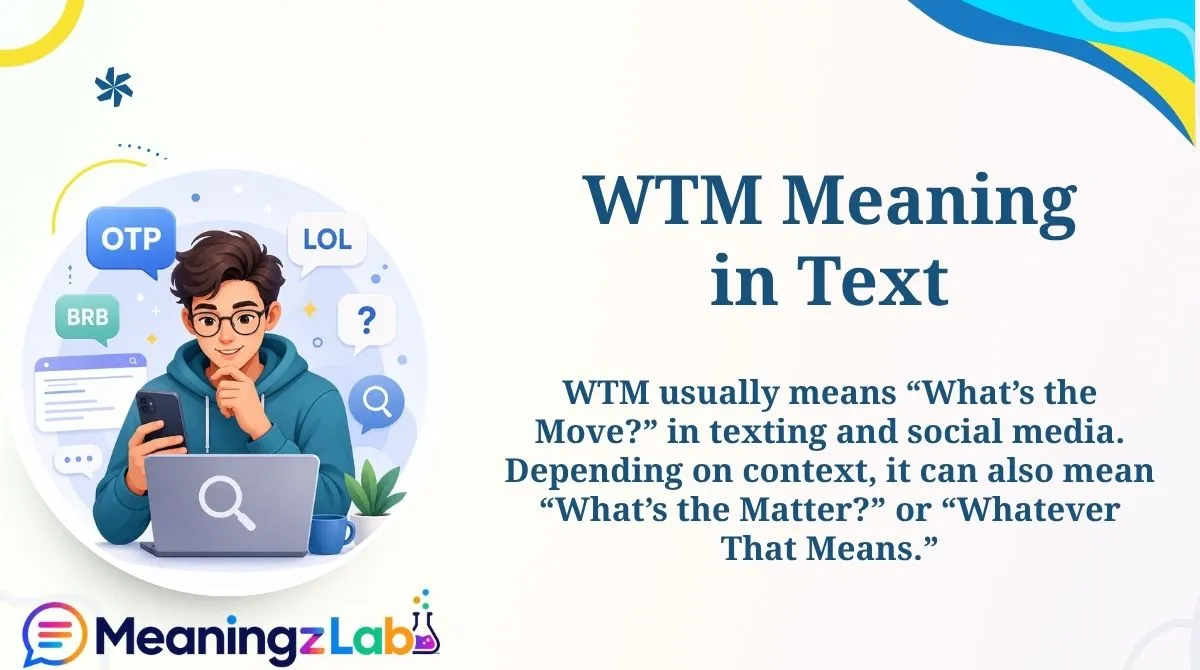
WTM usually means “What’s the Move?” in texting and social media. Depending on context, it can also mean “What’s the Matter?” or “Whatever That Means.”
What Does WTM Mean in Text & Chat?
In text and chat, WTM most commonly means “What’s the Move?” Here, “the move” means the plan, next activity, or thing to do. It is similar to saying, “What’s the plan?” or “What are we doing?”
For example, a friend might send “WTM this weekend?” They are probably asking what plans you have or what everyone should do. The phrase is especially natural when people are deciding where to go, whether to hang out, or what activity to choose.
WTM can also have other meanings. If someone notices that you seem upset, “WTM?” may mean “What’s the Matter?” In another conversation, “WTM.” can mean “Whatever That Means,” often with a skeptical or sarcastic feel.
The surrounding message is the best clue. Compare these:
| Text | Likely meaning |
|---|---|
| “WTM tonight?” | What’s the Move? |
| “You seem quiet. WTM?” | What’s the Matter? |
| “He called himself a genius, WTM.” | Whatever That Means |
Because the same three letters can represent very different ideas, do not interpret WTM from the letters alone. Read the sentence before it, the punctuation, and the relationship between the people.
Full Form, Stands For & Short Meaning of WTM
The most common WTM full form in informal texting is “What’s the Move?”
In simple English, it means:
“What’s the plan?”
“What are we doing?”
“What should we do next?”
It is usually a relaxed question. A friend may use it when they are free, bored, making weekend plans, or waiting for someone to suggest an activity.
Two other meanings appear in established slang references:
What’s the Matter? — used to ask what is wrong or whether someone is okay.
Whatever That Means. — used as a reaction to something unclear, doubtful, exaggerated, or confusing. Depending on context, it may sound sarcastic or dismissive.
| WTM expansion | Simple meaning | Usual tone |
|---|---|---|
| What’s the Move? | What’s the plan? | Casual |
| What’s the Matter? | What’s wrong? | Concerned |
| Whatever That Means. | I am unsure or skeptical about that | Dry or sarcastic |
WTM is usually understood from context rather than from a formal rule. That is why a short message such as “WTM?” can be friendly in one conversation and concerned in another.
Technically, WTM is better described as an initialism when each letter is pronounced separately, although everyday websites often use “acronym” as a broad label for text abbreviations.
Origin, History & First Known Use of WTM
There is no well-established, authoritative record showing the exact first use of WTM as a texting abbreviation. That distinction is important because the phrase “what’s the move?” and the abbreviation “WTM” do not necessarily have the same origin.
Online slang references connect WTM with informal internet and social-media communication, while one current reference describes “what’s the move?” as a casual expression used for discussing plans.
Some websites suggest that the abbreviation developed through gaming and online chat culture. However, those descriptions are not strong enough to establish a definitive first use, inventor, or exact date.
So it is safer to say:
WTM became useful as digital shorthand because short messages are easy to type and quick to understand within familiar groups, but its exact first appearance is not reliably documented.
The same caution applies to claims about a specific year when WTM “started.” There is not enough dependable evidence to name one precise year as its official beginning.
The phrase “what’s the matter?” itself is much older than texting, and the expression has a long history in English. Dictionary sources document it as an established idiom meaning “what is the problem?” or “what is wrong?”
That means the individual words behind WTM have different histories, while the modern abbreviation belongs to informal digital communication.
How People Use WTM in Daily Conversations
People mainly use WTM when they want a quick answer about plans or a next step. It often appears between friends who already understand each other without needing a formal sentence.
For example, “WTM after work?” can mean “What are we doing after work?” A person might send it when deciding whether to get food, watch a movie, meet friends, or simply hang out.
The tone is usually casual and friendly. It can even sound energetic when someone is looking forward to going out:
“WTM?? I’m free tonight 😂”
The extra question marks and laughing emoji make the message feel playful rather than serious.
However, WTM can change tone based on context. Consider:
“WTM?”
This could be a simple question about plans.
But:
“You’ve been acting weird all day. WTM?”
Here, the likely meaning is “What’s the matter?” rather than “What’s the move?”
Punctuation can also matter. “WTM?” clearly looks like a question. “WTM.” may sound more like a reaction when the intended meaning is “Whatever That Means.”
Your relationship with the sender matters too. A close friend can write “WTM?” without sounding abrupt. A stranger using the same message may seem unclear simply because there is less shared context.
The safest approach is to look at the conversation immediately before WTM. In informal texting, context usually does more work than the abbreviation itself.
WTM Meaning Across WhatsApp, Instagram, TikTok & Snapchat
The core meaning of WTM usually does not change simply because the platform changes. In casual social-media use, references commonly identify WTM as “What’s the Move?”, especially when people are talking about plans, activities, or meeting up.
On WhatsApp, WTM may appear in one-to-one messages or group chats:
“WTM tonight?”
On Instagram, someone might use it in a DM or reply to a story when asking about plans:
“Everyone’s out already 😂 WTM?”
On TikTok, WTM can appear in comments or messages between people discussing what to do next.
On Snapchat, its short length fits naturally into quick, casual messages.
The important point is that these platforms do not create completely different official meanings for WTM. The conversation determines the meaning.
| Platform | Typical interpretation | Example |
|---|---|---|
| What’s the Move? | “WTM after dinner?” | |
| What’s the Move? | “WTM this weekend?” | |
| TikTok | What’s the Move? | “WTM now?” |
| Snapchat | What’s the Move? | “WTM tonight 😂” |
Alternative meanings can still appear on any of these platforms. Someone discussing a friend who looks upset may use WTM for “What’s the Matter?” A sarcastic response may use it for “Whatever That Means.”
So platform is a clue, but context is the stronger clue.
Different Meanings of WTM in Other Fields
Outside casual texting and social media, WTM can represent different terms entirely. An abbreviation is not automatically slang, and many professional fields use the same letter combination for unrelated concepts.
For example, World Travel Market is a business and travel-industry name associated with travel trade events. In that setting, WTM is not asking about weekend plans or checking whether someone is upset.
Other fields can also use WTM as an abbreviation for organization names, technical terms, projects, publications, or internal business language. These meanings depend on the field and should not be treated as texting slang.
That is why the surrounding topic is critical.
If a message says:
“WTM tonight?”
the social meaning “What’s the Move?” is a natural interpretation.
But if you see:
“WTM London”
in a travel-industry context, it may refer to World Travel Market instead of internet slang.
A useful rule is:
Texting context → think slang first. Professional context → check the field-specific meaning.
Do not assume every appearance of WTM has the same expansion. Slang dictionaries mainly document the informal meanings discussed above, while broader acronym databases and professional contexts can use WTM differently.
For everyday chat, the three meanings worth remembering are:
| Context | Likely meaning |
|---|---|
| Making plans | What’s the Move? |
| Checking on someone | What’s the Matter? |
| Skeptical reaction | Whatever That Means |
| Business or industry | May be a specialized abbreviation |
This distinction helps prevent a common mistake: treating every three-letter abbreviation as internet slang.
Common Confusions, Mistakes & Wrong Interpretations
The biggest WTM mistake is assuming that it has one universal meaning. In casual texting, “What’s the Move?” is commonly documented as the main interpretation, but “What’s the Matter?” and “Whatever That Means” are also established uses.
Another common mistake is reading “WTM?” as “What’s the Matter?” simply because the sender uses it after a quiet or emotional message. That reading may be correct, but you need the surrounding conversation to confirm it.
Tone can create another problem. Compare:
“WTM tonight? 😊”
This feels friendly and social.
“WTM??”
The double question mark may make it feel more urgent or impatient.
“WTM.”
Without a question mark, it may be a reaction rather than a genuine question. If it follows a confusing statement, “Whatever That Means” becomes more plausible.
People also sometimes confuse WTM with similar abbreviations such as WYD (“What You Doing?”) or HMU (“Hit Me Up”). They can appear in similar conversations, but they are not interchangeable.
For example:
“WYD?” asks what someone is doing.
“WTM?” more often asks what the plan or next move is.
Finally, do not assume capitalization changes the meaning. WTM, wtm, and Wtm can carry the same meaning. Digital writing often uses capitalization mainly for style.
Similar Terms, Alternatives & Related Slang
WTM belongs to a wider group of short expressions used to ask about plans, availability, or activity.
| Term | Meaning | Main difference |
|---|---|---|
| WTM | What’s the Move? | Asks about the plan or next action |
| WYD | What You Doing? | Asks what someone is doing |
| HMU | Hit Me Up | Asks someone to contact you |
| WYA | Where You At? | Asks someone’s location |
| SUP | What’s Up? | General check-in |
| LMK | Let Me Know | Requests information or an update |
These abbreviations can overlap in a real conversation.
For example:
“WYD?” might start the conversation.
Then someone could answer:
“Nothing. WTM?”
In that exchange, the first person asks about the current activity, while the second asks what the plan is.
There are also ordinary English alternatives to WTM. Someone can simply write:
“What’s the plan?”
“What are we doing tonight?”
“Any plans?”
“What should we do?”
That can sometimes be clearer, especially when speaking to someone who may not know texting slang.
WTM is most natural in relaxed digital communication. It is less suitable for formal emails, official requests, workplace documents, or situations where there is a real risk of misunderstanding.
The key difference between WTM and related slang is therefore not just the letters. It is the specific question being asked.
Examples of WTM in Real Chat Situations
The easiest way to understand WTM is to see it in different conversations.
Asking About Plans
Person A: “Are you free after dinner?”
Person B: “Yeah, I am. WTM tonight? 😊”
Meaning: “What’s the Move?” The person wants to know what the plan is.
Making Weekend Plans
Person A: “Saturday is finally here!”
Person B: “I know 😂 WTM this weekend?”
Meaning: Casual and upbeat. The sender is asking what everyone plans to do.
Checking on a Friend
Person A: “I don’t really feel like talking today.”
Person B: “WTM? Everything okay?”
Meaning: Here WTM likely means “What’s the Matter?” because the conversation is about the person’s feelings.
Sarcastic Reaction
Person A: “He says he’s the most organized person in the office.”
Person B: “WTM.”
Meaning: “Whatever That Means.” The tone can be dry or skeptical.
Emojis Change the Feel
Person A: “WTM tonight? 😎”
Person B: “Let’s grab food and watch a movie.”
Meaning: The sunglasses emoji makes the message feel confident, relaxed, and playful.
Compare that with:
Person A: “WTM??”
Person B: “What happened?”
Meaning: The extra question marks may suggest urgency, impatience, or concern. The conversation is needed to know which.
A Potentially Rude Use
Person A: “WTM with you lately?”
Person B: “What do you mean?”
Meaning: Depending on the relationship and prior messages, this can sound confrontational. Here the abbreviation may be intended as “What’s the Matter?” but the wording makes the question feel sharper.
How to Reply When Someone Says WTM
Your best reply depends on which meaning the sender intends.
When WTM means “What’s the Move?”, answer with your plan or suggest one:
“How about pizza around 8?”
“Nothing planned yet. Want to hang out?”
“Let’s see a movie tonight.”
When it means “What’s the Matter?”, explain what is wrong or reassure the person:
“I’m okay, just tired.”
“Nothing serious. I’ve had a long day.”
“I’m a little stressed, but I’ll be fine.”
When WTM appears as “Whatever That Means,” the message may be sarcastic. You can respond by explaining the statement rather than matching the sarcasm:
“I just meant that the schedule is changing.”
When you genuinely cannot tell which meaning was intended, a simple clarification works well:
“Do you mean what’s the move or what’s the matter?”
That may feel slightly direct, but it is better than giving the wrong answer.
If the Message Sounds Friendly
Person A: “WTM tonight? 👀”
Person B: “I’m down for dinner. What are you thinking?”
If the Message Sounds Concerned
Person A: “You’ve been really quiet. WTM?”
Person B: “Nothing major. I’m just tired today.”
If the Message Is Confusing
Person A: “WTM?”
Person B: “Do you mean what’s the plan? 😅”
If the Message Feels Rude
Person A: “WTM with that answer?”
Person B: “I’m not sure what you mean. Can you explain?”
A calm reply is usually better than assuming bad intentions. Short messages can sound harsher than the sender intended.
Is WTM Still Popular? Trends & Online Usage
WTM is still documented as an active piece of informal online slang in 2026. Recent slang and text-meaning pages continue to describe “What’s the Move?” as the main social-media interpretation, while also noting alternative meanings such as “What’s the Matter?” and “Whatever That Means.”
However, there is an important limitation: there is no single authoritative public database that ranks everyday texting abbreviations by actual usage across all users and platforms. Because of that, it would be misleading to give WTM a precise popularity percentage or claim that it is universally common.
Its meaning is more useful than a popularity label. In current casual communication, WTM can still work as a compact way to ask about plans, especially in friend groups and informal social-media conversations.
At the same time, slang is highly personal. One group may use WTM constantly for “What’s the Move?” while another may rarely use it or interpret it differently.
That is why context-aware reading matters more than memorizing a single definition.
When you encounter WTM in 2026, check:
What is the conversation about?
Is the sender asking a question or reacting to something?
Does the message involve plans, emotions, or sarcasm?
Are punctuation and emojis giving you a tone clue?
Those details usually reveal the intended meaning faster than the abbreviation itself.
Frequently Asked Questions
What does WTM mean in text?
WTM most commonly means “What’s the Move?” in casual texting. It usually asks about plans, activities, or what someone should do next. It can also mean “What’s the Matter?” or “Whatever That Means,” depending on context.
What does WTM mean on Snapchat?
On Snapchat, WTM usually means “What’s the Move?” when someone is asking about plans or what is happening next. The same abbreviation can have other meanings, so the surrounding conversation matters.
What does WTM mean on Instagram or TikTok?
On Instagram and TikTok, WTM is commonly used as “What’s the Move?” in casual messages and social interactions. Current slang references describe this meaning across social-media platforms.
Is WTM rude?
WTM is usually not rude when it means “What’s the Move?” between friends. It can sound abrupt, annoyed, or confrontational when punctuation and surrounding words make the message more forceful. As “Whatever That Means,” it may also carry sarcasm.
What does WTM mean from a girl or guy?
The abbreviation itself does not have a special meaning based on whether the sender is a girl or a guy. In most casual contexts, WTM means “What’s the Move?” The conversation and relationship provide the useful clues.
How should I reply to WTM?
First determine what the person is asking. For “What’s the Move?”, suggest a plan. For “What’s the Matter?”, explain what is wrong or reassure them. When the meaning is unclear, ask what they mean.
Can WTM mean “What’s the Matter?”
Yes. “What’s the Matter?” is a documented alternative use of WTM, especially when someone appears upset, quiet, or different from usual.
Can WTM mean “Whatever That Means”?
Yes. In a reaction or statement rather than a direct question, WTM can mean “Whatever That Means.” This use often sounds dry, skeptical, or sarcastic.
Conclusion
The most common WTM meaning in text is “What’s the Move?” It is a casual way to ask about plans, activities, or the next thing to do. You may see it in friend groups, group chats, direct messages, and social-media conversations.
WTM can also mean “What’s the Matter?” when someone is checking whether you are okay, or “Whatever That Means” when a message carries a skeptical or sarcastic reaction.
The main takeaway is simple: read the context before deciding what WTM means. The words around it, punctuation, emojis, and relationship between the speakers can completely change the intended tone.
Once you understand that, WTM becomes much easier to read and use naturally in everyday digital conversations.

Evan Rellmont is a content writer and researcher who specializes in internet slang, text abbreviations, and social media language. He creates clear, helpful content to make modern online communication easier to understand.