If you see “ope” in text, chat, or social media, it usually expresses mild surprise, a small mistake, or a quick apology.
It is often similar to “oops,” “whoops,” “oh,” “excuse me,” or “sorry.” For example, someone might text, “Ope, I didn’t see your message,” after noticing something they missed.
The expression is strongly associated with casual speech in the American Midwest, especially around Minnesota, Wisconsin, Michigan, and nearby areas, although people elsewhere use it too.
This guide explains ope meaning in text, its tone, possible origins, social-media usage, related expressions, common misunderstandings, realistic examples, and natural ways to reply.
| Term | Most common meaning | Full form | Typical tone | Common use |
|---|---|---|---|---|
| Ope | Mild surprise, apology, or acknowledgment | Not an acronym | Casual, polite, playful | Texts, chats, social media |
What Does Ope Mean in Text & Chat?
Ope is an informal interjection used when something unexpected, awkward, or slightly accidental happens. In text messages, it often communicates a reaction that would normally be spoken out loud.
The simplest meaning is:
Ope = “Oops,” “Oh,” “Sorry,” or “Excuse me,” depending on the situation.
For example:
- “Ope, I forgot to send that.”
- “Ope, sorry! I didn’t mean to interrupt.”
- “Ope, there goes my coffee.”
- “Ope, didn’t see you standing there.”
The word does not have one fixed translation. Context matters. If someone drops something, “ope” may mean “oops.” If they bump into someone, it can mean “sorry.” If they suddenly notice something, it may simply express surprise.
The expression is especially associated with Midwestern American English, but its use is not limited strictly to that region. It can also appear online because social media has helped spread regional expressions beyond their original communities.
In texting, lowercase “ope” usually feels relaxed and conversational. Capitalized “OPE!” can make the reaction look more dramatic or humorous.
Full Form, Stands For & Short Meaning of Ope
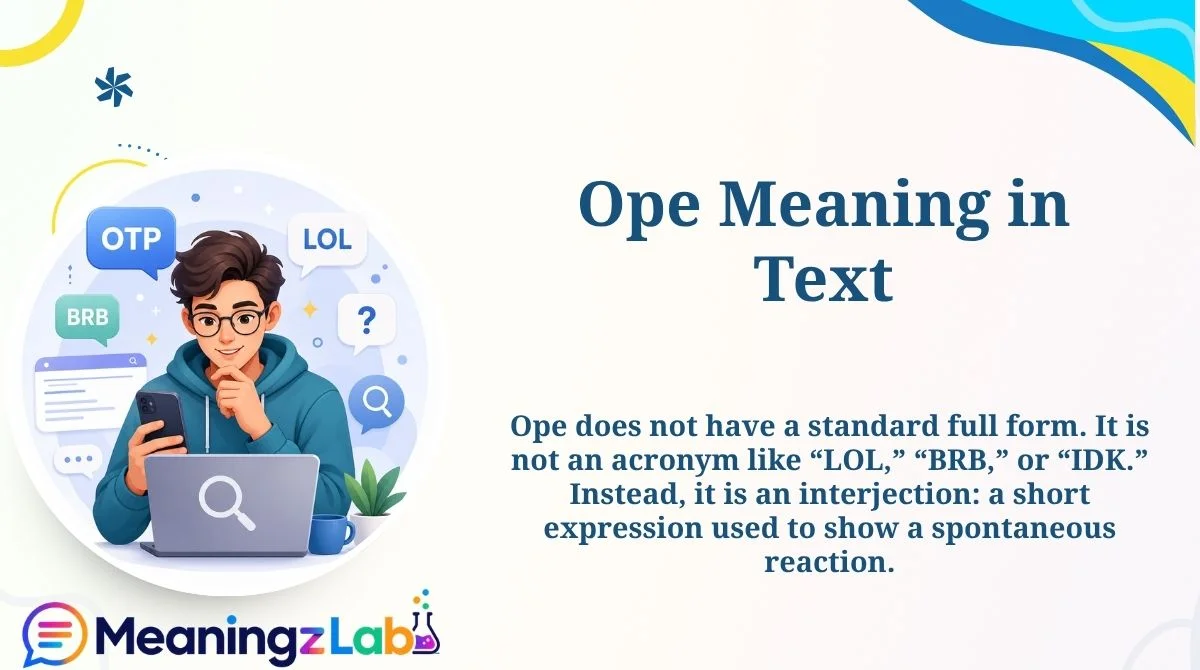
Ope does not have a standard full form. It is not an acronym like “LOL,” “BRB,” or “IDK.” Instead, it is an interjection: a short expression used to show a spontaneous reaction.
A useful way to understand it is:
| Expression | Approximate meaning |
|---|---|
| Ope | Oh / oops / sorry |
| Ope, sorry | Sorry about that |
| Ope! | Oh! / Whoops! |
| Ope, excuse me | Let me get past you |
| Ope, my bad | I made a small mistake |
There is also an older, unrelated use of ope as a literary or archaic form of the verb “open.” Merriam-Webster records that meaning separately and gives its first known use as the 15th century. That historical verb is not the casual slang expression people usually mean in modern texting.
So, when someone sends “ope” in a modern chat, you generally should not treat it as an abbreviation that needs to be expanded. It works more like a quick verbal reaction written down.
Origin, History & First Known Use of Ope
The modern slang expression ope does not have a single, firmly established origin date. Linguistic discussions have connected it strongly with Midwestern American speech, but researchers have cautioned against claiming one simple source or one exact inventor.
One interesting point is that the modern interjection should not automatically be described as simply a shortened spelling of “oops.” Some linguistic explanations treat it as a spontaneous sound related to “oh” and similar English reactions, while other accounts connect it with the sound pattern of “oops.” The exact history remains uncertain.
The Midwest connection is well documented. The expression is particularly associated with states such as Minnesota, Wisconsin, Michigan, and Illinois.
There is also a separate historical English word ope, meaning “open.” That form has a much older documented history and should not be confused with today’s casual interjection.
Therefore, the safest answer to “When was ope first used as slang?” is that there is no reliable single first-use date for the modern interjection. Claims about one exact origin should be treated cautiously.
How People Use Ope in Daily Conversations
People usually use ope for small, everyday moments rather than serious events. It can appear when someone notices a mistake, bumps into another person, nearly drops something, or suddenly realizes something.
Common situations include:
- Accidentally bumping into someone
- Forgetting something
- Dropping an object
- Seeing an unexpected problem
- Getting in someone’s way
- Realizing that something happened
- Politely moving around someone
For example, imagine two people walking through a crowded store.
Person A: “Ope, sorry! I’m just trying to get around you.”
Here, ope softens the interaction. It makes the situation sound casual rather than serious.
The tone can also change based on punctuation. Compare:
- “ope” → relaxed and understated
- “Ope!” → surprised or playful
- “OPE 😭” → humorous or dramatic
- “Ope, sorry.” → polite and apologetic
- “Ope….” → awkward or embarrassed
It can even be used jokingly when nothing serious happened. Someone might text “Ope, forgot what I was saying 😂” simply to make a small conversational mistake sound funny.
The key idea is that ope usually signals a small reaction, not a major emotional event.
Ope Meaning Across WhatsApp, Instagram, TikTok & Snapchat
The meaning of ope generally stays the same across messaging and social-media platforms. WhatsApp, Instagram, TikTok, and Snapchat do not give the word separate official meanings.
What changes is the way people present it.
On WhatsApp, someone may use it in an ordinary conversation:
“Ope, sorry. I sent that to the wrong person.”
On Instagram, it may appear in a comment or caption:
“Ope, that escalated quickly 😂”
On TikTok, users may use ope as part of humorous captions, comments, or reactions to an unexpected moment.
On Snapchat, it can be a quick response to something surprising:
“Ope 😭 I wasn’t ready for that.”
The expression is particularly recognizable as a Midwestern regionalism, but online communication can spread regional vocabulary far beyond its original speech communities.
So if someone from outside the Midwest writes “ope,” it does not necessarily mean they are from the Midwest. They may simply know the expression from friends, entertainment, memes, or social media.
Different Meanings of Ope in Other Fields
The casual interjection is the meaning most relevant to texting and social media. However, ope can have other meanings in different contexts.
Modern informal interjection
This is the meaning discussed throughout this article:
Ope = a small reaction to surprise, an accident, awkwardness, or a need to politely move around someone.
Archaic or literary verb
In older English, ope can mean “open.” Merriam-Webster lists this as an archaic verb and records its first known use in the 15th century.
For example, an old literary text might use a phrase involving something that “opes” or “oped.” That is completely different from someone texting “Ope, sorry!”
Technical abbreviations
In specialized fields, three-letter combinations containing OPE can stand for technical terms. Those meanings depend entirely on the industry or subject being discussed.
Therefore, do not assume that every appearance of OPE online refers to the slang expression. Capitalization and surrounding words can provide useful clues.
For everyday texting, however, “ope” is most likely the informal interjection when it appears by itself or alongside words such as “sorry,” “oops,” or “my bad.”
Common Confusions, Mistakes & Wrong Interpretations
One of the biggest mistakes is assuming ope is always an acronym. It is not. In casual texting, it is normally an interjection.
Another common misunderstanding is treating it as exactly the same as “oops.” The two can overlap, but ope has a wider conversational range. It can express surprise, mild embarrassment, an apology, or a polite attempt to get someone’s attention.
For example:
- “Oops, I deleted the photo.” → clear mistake
- “Ope, let me squeeze past.” → polite movement
- “Ope, there he is.” → sudden recognition
- “Ope, sorry!” → minor accidental contact
The tone can also be misunderstood in written messages because readers cannot hear the speaker’s voice.
“Ope.” might look cold or dismissive if read without context, even though the sender intended it as a lighthearted reaction.
Emojis can make the intended feeling clearer:
- Ope 😅 → embarrassed or awkward
- Ope 😂 → humorous
- Ope, sorry! → apologetic
- OPE! 😳 → strong surprise
Finally, do not confuse the modern interjection with the older literary verb ope, meaning “open.” The surrounding context usually makes the distinction clear.
Similar Terms, Alternatives & Related Slang
Several expressions can communicate a similar idea, but they are not perfect substitutes in every situation.
| Term | Usual meaning | Typical tone |
|---|---|---|
| Ope | Small surprise, apology, or awkward reaction | Casual |
| Oops | Mistake or accident | Casual |
| Whoops | Mistake or unexpected problem | Playful |
| Oh | Surprise, realization, or attention | Neutral |
| Uh-oh | Something may have gone wrong | Concerned/playful |
| My bad | Admitting a mistake | Casual |
| Sorry | Apology | Direct |
| Excuse me | Getting attention or moving past someone | Polite |
Ope is distinctive because it can combine several of these ideas in one tiny expression.
For example, if someone accidentally walks into you, “ope” can function almost like “oops, sorry, excuse me.”
That flexibility is one reason the expression works so well in casual speech and online writing.
Still, replacing every “oops” with “ope” would not always sound natural. The best choice depends on the speaker’s style and the situation.
Examples of Ope in Real Chat Situations
Small mistake
Person A: “Did you send the file to Sarah?”
Person B: “Ope, I sent it to Sam instead. 😅”
Meaning: The person suddenly realizes they made a small mistake.
Accidental interruption
Person A: “I was just explaining the plan.”
Person B: “Ope, sorry! Go ahead.”
Meaning: The speaker realizes they interrupted and quickly apologizes.
Moving past someone
Person A: “I’m standing right in front of the doorway.”
Person B: “Ope, let me squeeze by for a second.”
Meaning: Here, ope works as a casual “excuse me.”
Unexpected news
Person A: “I just found out the meeting starts in ten minutes.”
Person B: “Ope 😳 That’s sooner than I expected.”
Meaning: The expression shows sudden surprise.
Funny situation
Person A: “I accidentally liked a post from 2018.”
Person B: “OPE 😂”
Meaning: The sender is reacting humorously to an awkward social-media mistake.
Mild apology
Person A: “You just bumped my chair.”
Person B: “Ope, sorry about that!”
Meaning: The expression softens a small apology.
These examples show why the surrounding sentence matters. Ope alone is vague, but the words and emojis around it usually make the intended reaction clear.
How to Reply When Someone Says Ope
There is no special response required when someone says ope. Your reply should depend on what happened.
If it is a small mistake
You can simply say:
- “No worries!”
- “You’re good.”
- “It happens.”
- “All good!”
If they are apologizing
A friendly response works best:
“No problem 😊”
or
“You’re totally fine!”
If they are being playful
Match their tone:
“😂 What happened?”
or
“Ope indeed!”
If you do not understand the context
Ask naturally:
“Haha, what happened?”
This is useful because ope does not always identify exactly what the person is reacting to.
If it sounds rude
Usually, ope itself is not rude. But tone comes from the full message. If someone writes something dismissive such as “Ope, whatever,” the surrounding words—not the word itself—may make the message feel rude.
In most casual conversations, however, ope is harmless, light, and often slightly humorous.
Is Ope Still Popular? Trends & Online Usage
Ope is still recognizable in 2026, especially in discussions of Midwestern American speech and informal internet culture. It has also appeared in online conversations outside the Midwest, so its use should not be treated as proof that someone comes from a particular state or region.
The expression has also benefited from social media because short regional expressions are easy to turn into captions, jokes, reaction posts, and memes.
At the same time, there is no good reason to claim that ope is universally popular or that everyone online uses it. Its frequency varies by community, age, location, and personal speaking style.
Modern discussions of the expression continue to focus on its regional identity and uncertain linguistic history. A 2026 Michigan Public discussion, for example, revisited the question of where ope came from and noted that linguists have suggested different explanations rather than one settled origin.
The safest conclusion is that ope remains an active informal expression, especially in American English, while its exact regional strength varies.
Frequently Asked Questions
What does ope mean in text?
Ope usually means a small reaction such as “oops,” “oh,” “sorry,” or “excuse me.” The exact meaning depends on the situation.
Is ope short for oops?
Not necessarily. The two expressions are closely related in meaning, but ope is not simply a confirmed abbreviation of “oops.” Its exact linguistic development is still debated.
Is ope a Midwest slang word?
Ope is strongly associated with the American Midwest, particularly states such as Minnesota, Wisconsin, Michigan, and Illinois. However, people outside the Midwest also use it.
Is ope rude?
Usually, no. Ope is generally casual and harmless. It can even make a small apology sound softer. However, the full sentence and tone can change how a message feels.
How should I reply to “ope”?
You usually do not need a special response. Depending on the situation, you can say “No worries,” “You’re good,” “All good,” or respond playfully with “😂 What happened?”
Does ope mean the same thing on TikTok and Instagram?
Generally, yes. The basic meaning does not change by platform. On TikTok, Instagram, WhatsApp, Snapchat, and other social platforms, ope normally expresses mild surprise, awkwardness, or a small apology.
What does “ope, sorry” mean?
“Ope, sorry” usually means “Oops, sorry” or “Oh, sorry.” It is commonly used after a minor mistake, interruption, or accidental bump.
Is “ope” an acronym?
No. In its modern slang use, ope is an interjection rather than an acronym, so it does not have a standard full form.
Conclusion
The most common ope meaning in text is a quick expression of mild surprise, a small mistake, awkwardness, or a casual apology. Depending on the context, it can be similar to “oops,” “whoops,” “oh,” “sorry,” or “excuse me.”
The expression is strongly linked with Midwestern American English, although people in other regions also use it. Its tone is usually friendly, casual, and harmless. Emojis, punctuation, and surrounding words can make the intended feeling even clearer.
Remember that ope is not normally an acronym or abbreviation with a fixed full form. It works more like a spontaneous reaction written into a conversation. Once you understand the context, messages such as “Ope, sorry!” or “OPE 😂” become easy to interpret.
If you enjoy learning modern texting language, exploring related expressions such as oops, whoops, my bad, LOL, and other chat slang can make online conversations much easier to understand.

Evan Rellmont is a content writer and researcher who specializes in internet slang, text abbreviations, and social media language. He creates clear, helpful content to make modern online communication easier to understand.