A social media acronyms list is a collection of shortened words and phrases people use on platforms such as Instagram, TikTok, WhatsApp, Snapchat, Facebook, X, and online chats.
Common examples include LOL (Laughing Out Loud), BRB (Be Right Back), IMO (In My Opinion), TBH (To Be Honest), and DM (Direct Message).
People use these shortcuts to communicate faster, fit short messages into captions or comments, and make conversations feel more casual.
Some acronyms are friendly and playful, while others can sound sarcastic, serious, or rude depending on the context.
This guide explains the most useful social media acronyms, their meanings, tones, platform usage, common mistakes, and practical examples.
It is designed to help beginners quickly understand unfamiliar abbreviations without guessing what they mean.
| Term | Most Common Meaning | Full Form | Typical Tone | Common Usage |
|---|---|---|---|---|
| Social media acronyms list | Collection of online abbreviations | Varies by acronym | Casual | Chats, comments, captions, DMs |
What Does a Social Media Acronyms List Mean in Text & Chat?
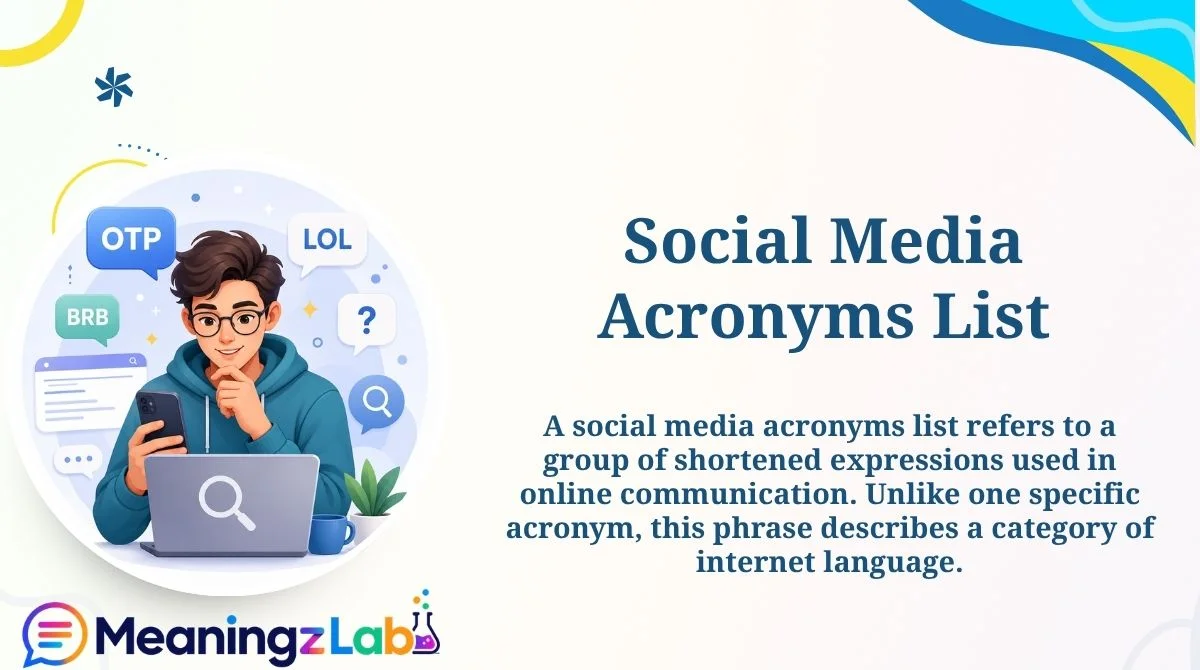
A social media acronyms list refers to a group of shortened expressions used in online communication. Unlike one specific acronym, this phrase describes a category of internet language.
An acronym usually takes the first letters of several words and turns them into a shorter form. For example, LOL comes from “Laughing Out Loud,” while BRB means “Be Right Back.”
Some common social media acronyms include:
| Acronym | Meaning | Typical Use |
|---|---|---|
| LOL | Laughing Out Loud | Showing amusement |
| LMAO | Laughing My Ass Off | Strong amusement |
| BRB | Be Right Back | Temporarily leaving |
| BTW | By The Way | Adding information |
| TBH | To Be Honest | Giving an honest opinion |
| IMO | In My Opinion | Sharing a personal view |
| IDK | I Don’t Know | Showing uncertainty |
| FYI | For Your Information | Giving information |
| DM | Direct Message | Private social-media message |
| IRL | In Real Life | Referring to offline life |
| TMI | Too Much Information | Reacting to oversharing |
The same abbreviation can feel different depending on the conversation. “LOL” can show genuine laughter, soften a statement, or simply acknowledge something funny.
For this reason, understanding the words around an acronym is just as important as knowing its dictionary-style meaning.
Full Form, Stands For & Short Meaning of Social Media Acronyms
There is no single full form for social media acronyms list because it is a category rather than one abbreviation. Each acronym inside the list has its own full form.
Here are some of the most useful categories:
Conversation Acronyms
- LOL — Laughing Out Loud
- LMAO — Laughing My Ass Off
- ROFL — Rolling On the Floor Laughing
- BRB — Be Right Back
- GTG — Got To Go
- TTYL — Talk To You Later
- AFK — Away From Keyboard
- IDK — I Don’t Know
- IDC — I Don’t Care
Opinion and Reaction Acronyms
- TBH — To Be Honest
- IMO — In My Opinion
- IMHO — In My Humble Opinion
- IKR — I Know, Right?
- NGL — Not Gonna Lie
- FR — For Real
- ISTG — I Swear To God
- SMH — Shaking My Head
Social Media Acronyms
- DM — Direct Message
- PM — Private Message
- FYP — For You Page
- POV — Point Of View
- OOTD — Outfit Of The Day
- GRWM — Get Ready With Me
- AMA — Ask Me Anything
- Q&A — Questions and Answers
The safest approach is to check the surrounding sentence before deciding what an acronym means. Some shortcuts have multiple meanings in different communities.
Origin, History & First Known Use of Social Media Acronyms
Social media acronyms do not have one single origin. Shortened expressions existed in communication long before modern social networks became popular.
People have always looked for faster ways to communicate. Abbreviations appeared in letters, notes, messaging systems, online forums, chat rooms, and text messaging. As internet communication developed, users created and popularized shortcuts that made typing quicker.
The rise of mobile phones and SMS messaging helped make short expressions especially useful. Later, instant messaging and social platforms gave these terms an even wider audience.
Some expressions became widely recognized across the internet, while others remained limited to specific communities.
Modern social media also creates new abbreviations and gives older ones new uses. An expression that was once common in text messaging may now appear in TikTok comments, Instagram captions, Discord chats, or gaming communities.
It is important not to assign a precise “first use” date to every acronym without reliable historical evidence. Internet slang often develops gradually, with different users adopting the same expression at different times.
The history of social media acronyms is therefore best understood as an evolving part of digital communication rather than a single event or invention.
How People Use Social Media Acronyms in Daily Conversations
People use acronyms mainly to make online conversations faster, shorter, and more informal.
For example, someone may write “IDK” instead of “I don’t know.” A friend might answer “FR” to strongly agree with a previous message. Someone ending a conversation may type “TTYL.”
Acronyms can also affect tone. Compare:
“That was funny.”
with:
“That was funny lol 😂”
The second version feels more relaxed and conversational.
Capitalization can also vary. LOL, lol, and Lol usually have the same basic meaning, but the style can suggest a different tone. Lowercase “lol” may feel more casual, while uppercase “LOL” can suggest stronger emphasis.
Context matters too. A person who writes “OMG!” may be excited, shocked, or joking. “SMH” can express disappointment, disbelief, or mild annoyance.
In professional communication, common abbreviations such as “FYI” or “ASAP” may be acceptable. More informal expressions such as “LMAO,” “WTF,” or “IDC” may not fit every workplace or relationship.
The best rule is simple: match the acronym to the audience, platform, and situation.
Social Media Acronyms Meaning Across WhatsApp, Instagram, TikTok & Snapchat
Most common social media acronyms keep the same basic meaning across platforms. What changes is often the context in which people use them.
| Platform | Common Acronyms | Typical Context |
|---|---|---|
| LOL, BRB, TTYL, IDK, BTW | Private chats and groups | |
| DM, TBH, POV, OOTD, GRWM | Posts, Stories, Reels, DMs | |
| TikTok | FYP, POV, FR, GRWM, OOMF | Videos, captions, comments |
| Snapchat | HMU, NGL, TBH, WYD, WYA | Casual messaging and Stories |
| LOL, BTW, FYI, IMO, TBT | Posts, comments, groups | |
| X | IMO, TBH, IRL, RT, DM | Posts, replies, discussions |
Some platform-specific terms deserve extra attention.
FYP, for example, is strongly associated with TikTok’s “For You” feed. GRWM is common in social-media content where someone shows their preparation for an event or activity.
However, the platform does not always determine the meaning. “TBH” still generally means “To Be Honest” whether it appears in an Instagram DM or a WhatsApp message.
Different Meanings of Social Media Acronyms in Other Fields
Acronyms can become confusing because the same letters may have different meanings outside social media.
For example, DM commonly means “Direct Message” online. In medicine or other professional settings, those letters can mean something entirely different.
Similarly, IRL has a fairly clear internet meaning: “In Real Life.” But other abbreviations may have technical meanings in business, education, science, medicine, gaming, or computing.
This is why an acronym should never be interpreted from its letters alone.
Consider OP. In an online discussion, it can mean “Original Poster” or sometimes “Original Post.” In gaming, “OP” can mean “Overpowered.”
Another example is AFK. Online, it usually means “Away From Keyboard,” especially in gaming and chat. Its meaning is closely connected to digital communication.
| Acronym | Common Social Meaning | Possible Other Context |
|---|---|---|
| DM | Direct Message | Other professional meanings |
| OP | Original Poster/Post | Overpowered in gaming |
| PM | Private Message | Other technical meanings |
| ETA | Estimated Time of Arrival | Common in travel and business |
| ASAP | As Soon As Possible | General communication |
| AI | Artificial Intelligence | Technology and business |
When an acronym seems strange in a sentence, look at the subject of the conversation before assuming its meaning.
Common Confusions, Mistakes & Wrong Interpretations
The biggest mistake people make with social media acronyms is assuming that every abbreviation has one universal meaning.
Some terms are highly context-dependent. OP, PM, FR, WYA, and RN can be misunderstood if the surrounding message is ignored.
Another common mistake is treating casual acronyms as formal English. Writing “LOL” or “LMAO” may be perfectly normal with friends but may feel inappropriate in a formal email or professional report.
Tone is another major source of confusion.
For example:
“Great job lol.”
could be genuine praise, playful teasing, or sarcasm. The relationship between the people and the surrounding conversation can help reveal the intended meaning.
Punctuation and emojis also matter.
“OMG!!! 😂” usually feels excited or amused.
“OMG.” may sound more serious, shocked, or annoyed.
People also sometimes confuse acronyms with initialisms. In everyday social-media language, both are often called “acronyms,” even though technically they are not always pronounced the same way.
The practical lesson is simple: do not interpret an unfamiliar abbreviation in isolation. Read the complete message, consider the platform, and think about the relationship between the people involved.
Similar Terms, Alternatives & Related Slang
Social media acronyms are part of a larger group of digital-language shortcuts. Related terms include initialisms, abbreviations, internet slang, texting slang, chat shorthand, memes, emojis, and platform-specific expressions.
Some shortcuts are used mainly for speed:
- BRB — Be Right Back
- GTG — Got To Go
- TTYL — Talk To You Later
- WYD — What You Doing?
- WYA — Where You At?
- RN — Right Now
Others mainly communicate emotion or attitude:
- LOL — Laughing Out Loud
- LMAO — Laughing My Ass Off
- SMH — Shaking My Head
- NGL — Not Gonna Lie
- FR — For Real
- IKR — I Know, Right?
Some are connected to social-media features or content styles:
- DM — Direct Message
- FYP — For You Page
- POV — Point Of View
- GRWM — Get Ready With Me
- OOTD — Outfit Of The Day
- AMA — Ask Me Anything
These expressions overlap, but they are not interchangeable. “BRB” tells someone you are temporarily leaving. “TTYL” usually signals that the conversation will continue later.
Learning the meaning is useful, but understanding the purpose of each abbreviation makes online conversations much easier to follow.
Examples of Social Media Acronyms in Real Chat Situations
The following examples show how common acronyms can appear naturally in conversations.
Casual laughter
Person A: “I accidentally sent my grocery list to my teacher.”
Person B: “LOL 😂 How did that even happen?”
Meaning: “LOL” shows genuine amusement.
Honest opinion
Person A: “Do you actually like this new profile picture?”
Person B: “TBH, I think your old one looked better.”
Meaning: “TBH” introduces an honest opinion. It can sound direct but does not automatically mean the speaker is being rude.
Agreeing strongly
Person A: “This week feels like it has lasted forever.”
Person B: “FR 😭 I need the weekend already.”
Meaning: “FR” means “For Real” and shows strong agreement.
Ending a conversation
Person A: “I have to finish my assignment now.”
Person B: “No worries. TTYL! 😊”
Meaning: “TTYL” means “Talk To You Later.” The emoji makes the message feel friendly.
Asking where someone is
Person A: “WYA? We’re about to leave.”
Person B: “Almost there. Give me five minutes.”
Meaning: “WYA” means “Where You At?” It is casual and commonly used between people who already know each other.
Possible sarcasm
Person A: “I waited an hour for the bus.”
Person B: “Wow, amazing service 🙃”
Meaning: The sarcasm comes from the wording and emoji, not from an acronym. This shows why context matters when reading social-media language.
How to Reply When Someone Says Social Media Acronyms
There is no single reply to a social media acronym because an acronym is not one specific message. Your response should depend on the actual abbreviation and the surrounding conversation.
If someone writes LOL, you can simply continue the joke or respond naturally.
If someone says TBH before giving an opinion, listen to the opinion rather than focusing only on the acronym.
If someone writes IDK, you might offer information or ask another question.
If you do not understand an acronym, there is nothing wrong with asking.
When the message is confusing
Person A: “That new update is wild, FR.”
Person B: “What does FR mean here?”
Person A: “For real. I seriously mean it.”
Best approach: Ask instead of guessing.
When the message is playful
Person A: “You really ate the whole pizza? LOL.”
Person B: “I regret nothing 😂”
Best approach: Match the lighthearted tone.
When the message feels rude
Person A: “IDC what you think.”
Person B: “Okay. I wasn’t trying to argue.”
Best approach: Stay calm and avoid escalating the conversation.
When the meaning is unclear
Person A: “OP just posted again.”
Person B: “Do you mean the original poster?”
Best approach: Clarify the abbreviation if it could have multiple meanings.
Is a Social Media Acronyms List Still Popular? Trends & Online Usage
Yes. Acronyms remain a practical part of online communication, but the specific terms people use can change over time.
Digital language is flexible. New expressions appear, older ones become less common, and some terms gain new meanings within particular communities.
The important point is that popularity is not the same as universal understanding. An acronym may be common among one age group, fandom, gaming community, or platform audience but unfamiliar to someone outside that group.
Some long-established shortcuts such as LOL, BRB, BTW, IDK, and OMG remain recognizable across many forms of digital communication. At the same time, newer platform-driven expressions can become popular because of trends, creators, memes, and changing online habits.
People also increasingly mix acronyms with emojis, shortened spellings, hashtags, GIFs, and visual content. As a result, online communication is not based on acronyms alone.
A useful social media acronyms list should therefore be treated as a practical reference, not a permanent dictionary. Meanings can shift, and context should always come first.
Frequently Asked Questions
What is the most common social media acronym?
There is no single universal winner because usage varies by platform and audience. Acronyms such as LOL, OMG, IDK, BTW, TBH, DM, and BRB are widely recognized in online communication.
What does LOL mean on social media?
LOL usually means “Laughing Out Loud.” It can show genuine amusement, but people also use it to make a message feel lighter or less serious.
What does TBH mean in texting?
TBH means “To Be Honest.” It is commonly used before an honest opinion, confession, or personal reaction.
Do social media acronyms have the same meaning on every platform?
Usually, common acronyms keep their basic meaning across platforms. However, some terms are strongly associated with particular communities or features, so context can change how they are understood.
How can I understand an acronym I have never seen before?
Read the entire message first. Look at the platform, topic, surrounding words, emojis, and relationship between the people. If the meaning is still unclear, ask the sender.
Are social media acronyms appropriate in professional messages?
Some are. Common business shortcuts such as “FYI” and “ASAP” may be acceptable in many workplaces. Very casual slang should be used more carefully, especially with clients, managers, or formal contacts.
Can one acronym have multiple meanings?
Yes. Some abbreviations have different meanings in social media, gaming, business, education, technology, and other fields. Context is essential.
Why do people use acronyms on social media?
People use them because they are quick, familiar, and convenient. They can also make messages sound more casual and conversational.
Conclusion
A social media acronyms list is a useful reference for understanding the shortened words and phrases that appear in online conversations. Common examples include LOL, BRB, TBH, IDK, IMO, DM, TTYL, and FR, but there are many more.
The key takeaway is that an acronym’s meaning depends on context. The platform, surrounding words, punctuation, emojis, and relationship between the speakers can all affect its tone.
You do not need to memorize every abbreviation. Start with the common ones, check unfamiliar terms before assuming their meaning, and pay attention to how people use them in real conversations.
As online language continues to evolve, learning common abbreviations makes chats, comments, captions, and direct messages much easier to understand. Explore related text-message abbreviations and internet slang whenever you come across a term you do not recognize.
Social media acronyms list helps you understand common online abbreviations, meanings, tones, and examples used across WhatsApp, Instagram, TikTok, and more.

Evan Rellmont is a content writer and researcher who specializes in internet slang, text abbreviations, and social media language. He creates clear, helpful content to make modern online communication easier to understand.